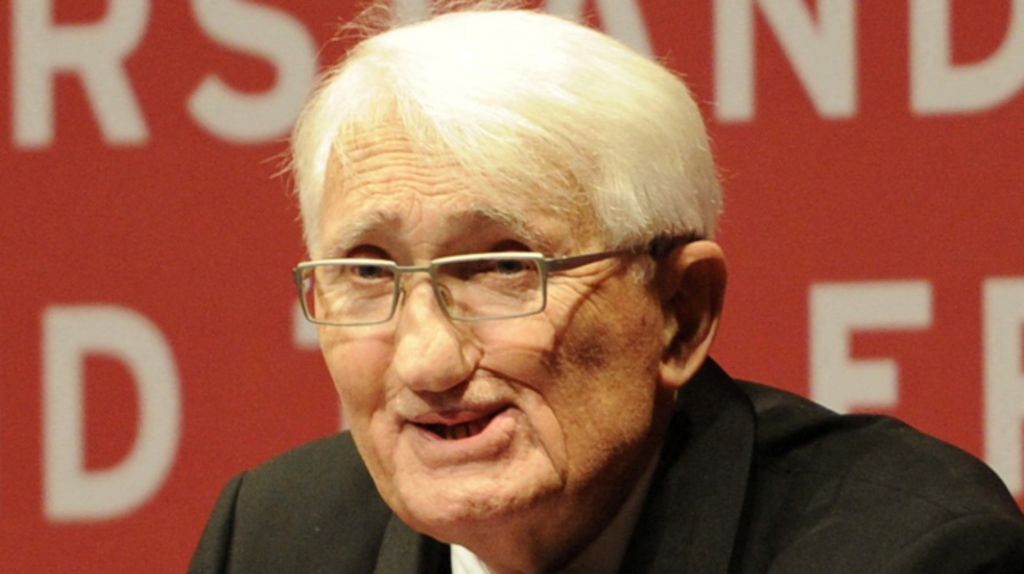
Jürgen Habermas, the preeminent German philosopher and towering intellectual figure whose critical theories shaped post-war European thought, has died at age 96. His publisher Suhrkamp announced his passing on Saturday, marking the end of an era for contemporary philosophy and social criticism.
Born in Düsseldorf in June 1929, Habermas’s early life unfolded under the shadow of Nazi Germany. His father, a local chamber of commerce leader, joined the Nazi Party in 1933, and the young Habermas was enrolled in the Hitler Youth organization, though he remained too young for combat deployment during World War II.
After the war, Habermas embarked on an academic journey that would establish him as a leading voice of the Frankfurt School. He earned his doctorate from Marburg University before joining the University of Frankfurt’s Institute of Social Research, where he worked alongside Max Horkheimer and Theodor Adorno in developing critical theory—a framework challenging capitalist society’s transformation of active citizens into passive consumers.
Throughout the 1960s, Habermas supported student movements at West German universities while developing his distinctive critique of mass media commodification. He argued that industrialized culture systematically undermined meaningful public discourse, a concern that informed his seminal 1981 work, The Theory of Communicative Action, which proposed that human societies are sustained through rational dialogue rather than political or economic power.
Habermas’s intellectual courage extended to historical controversies. During the 1980s Historians’ Debate, he confronted conservative scholars who questioned the Holocaust’s uniqueness as a German phenomenon. Later, during German reunification, he criticized the rapid absorption of East Germany, warning against nationalist resurgence and advocating for European unity as a safeguard against historical rivalries.
His personal experience with a cleft palate, requiring multiple childhood operations, profoundly influenced his theories about language and communication. This physical challenge informed his understanding of dialogic rationality and the fundamental human capacity for communicative action that defined his philosophical legacy.