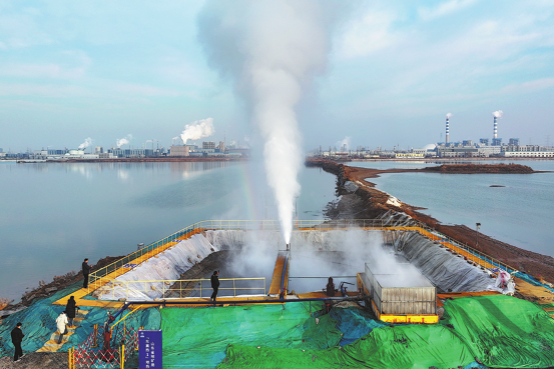
In the frosty climate of the Yellow River estuary, resident Xing Yan experiences unprecedented winter comfort without conventional heating systems. His home maintains ideal temperatures through pioneering geothermal technology tapping into energy sources nearly two kilometers beneath the Earth’s surface.
Niuzhuang township in Dongying, Shandong province, sits above extraordinary geothermal reservoirs where subterranean waters reach 85°C. The town’s heating facility operates through massive plate heat exchangers that transform 82°C geothermal water into 60°C heating fluid distributed through municipal pipelines.
This renewable energy system now serves all 13 urban residential compounds, three rural communities, and over 60 institutions throughout Niuzhuang. Covering 750,000 square meters—98% of the town’s heating needs—the geothermal network benefits approximately 22,000 residents across 7,000 households.
The environmental impact proves substantial: annual savings of 34,000 metric tons of standard coal and reduction of carbon emissions by roughly 80,000 tons. Unlike weather-dependent renewables, geothermal energy provides consistent baseload power unaffected by seasonal or diurnal variations.
Local businesses report significant benefits. Shandong Shuangfu Flowers Company utilizes geothermal heating across 100,000 square meters of greenhouses, maintaining optimal 26°C conditions for year-round orchid cultivation. General Manager Li Binghai confirms heating costs dropped by 15 yuan per square meter, creating 25 yuan per square meter savings compared to coal heating.
“Beyond cost reduction, geothermal provides unprecedented temperature stability,” Li noted. “We now control greenhouse climates via smartphone, extending flowering periods and enabling new variety development.” The company exports orchids to Vietnam, Russia, and Uzbekistan.
Shang Xinjian, director of Niuzhuang’s construction service center, explains the multi-tier utilization system: 80°C water extracted from 1,950-meter depths first heats residential areas, then circulates 50°C tailwater to agricultural greenhouses before being reinjected underground, creating a closed-loop conservation system.
China possesses enormous geothermal potential, with hydrothermal resources equivalent to 1.25 trillion tons of standard coal and annual exploitable capacity matching 1.86 billion tons. The nation leads global geothermal utilization efforts.
Future plans include expanding geothermal applications to agricultural product drying and aquaculture, establishing integrated industrial chains combining advanced farming, processing, and leisure industries. As Deputy Party Chief Song Ke stated: “This subterranean treasure will bring continued warmth and development opportunities to our community.”