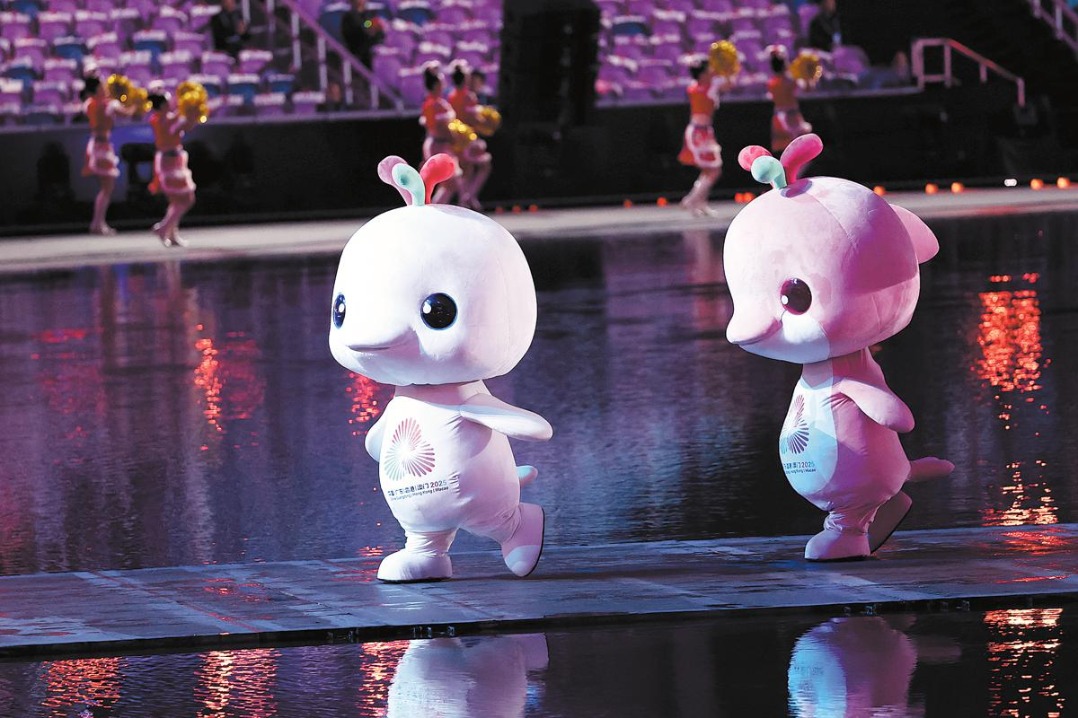
The 15th National Games has witnessed an unexpected phenomenon as the mascots, Xi Yangyang and Le Rongrong, inspired by the Chinese white dolphin, have captured the hearts of audiences across the three host regions. Designed by Liu Pingyun, the creative mind behind the Beijing Winter Olympics’ Bing Dwen Dwen, these mascots showcase a significant evolution in athletic expressiveness. Unlike Bing Dwen Dwen’s limited mobility, Xi Yangyang and Le Rongrong feature a two-heads-tall proportion, enabling smoother and more dynamic movements. This design enhancement not only allows for versatile graphic depictions of various sports but also provides live performers inside the costumes with greater flexibility. Their energetic performances, including break dancing, rapid tail spins, and headstands, have electrified venues like the Dongguan Basketball Center, driving the crowd into a frenzy of cheers. Social media has been ablaze with viral videos and memes of their antics, with many hailing them as the most energetic mascots ever seen. The performers, a group of 23 martial artists from the Foshan Huangfeihong International Martial Arts School, were selected for their physical prowess, discipline, and teamwork. Their rigorous training since late July has paid off, bringing the mascots to life with natural and lively portrayals. The Chinese white dolphin, the mascots’ biological inspiration, carries profound symbolic meaning. Known as the ‘giant panda of the sea,’ it represents the maritime culture of the Guangdong-Hong Kong-Macao Greater Bay Area and embodies unity, perseverance, and endeavor. The dolphins’ annual return to the Pearl River Estuary symbolizes a deep connection to their homeland, reflecting the strong bonds among the people of Guangdong, Hong Kong, and Macao. This symbolism is particularly relevant given the Games’ historic joint hosting, marking a new era of regional cooperation. Liu Pingyun emphasized the challenge of transforming the unfamiliar marine creature into approachable, engaging characters. The final design features rounded bodies, human-like limbs, and distinctive blue, green, and yellow adornments atop their heads, representing water spraying from their blowholes. Despite their design, the mascots have sparked a wave of online humor, with many affectionately dubbing them the ‘great bay chickens,’ a nod to Cantonese cuisine and culture. This grassroots rebranding has made the mascots more approachable, drawing people in and helping them connect more deeply with the cultural and athletic spirit they represent.