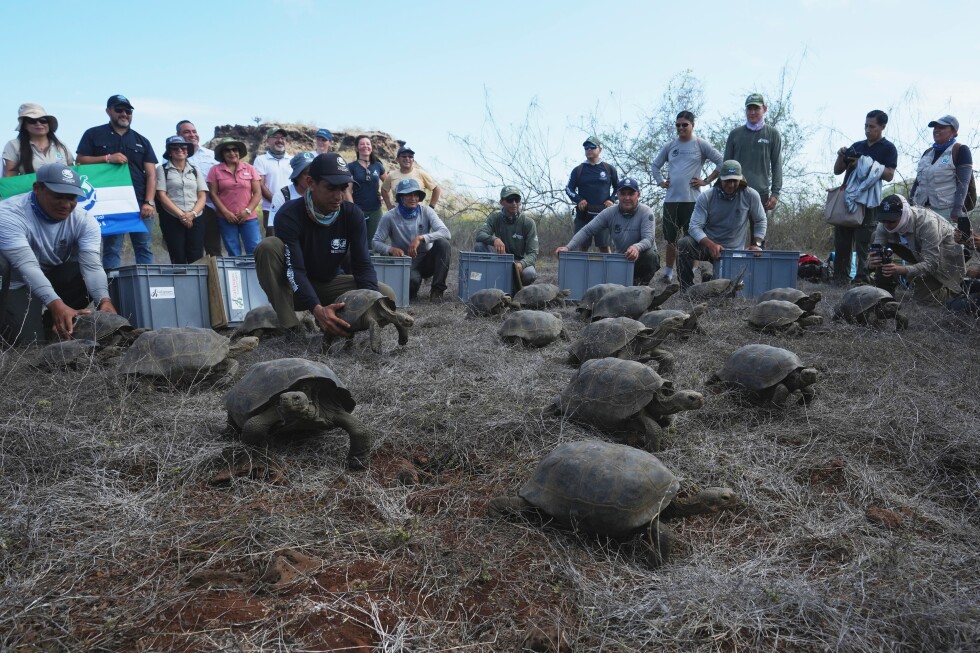
In a landmark conservation achievement, 158 juvenile hybrid giant tortoises have been reintroduced to Ecuador’s Floreana Island, marking the species’ return after a 150-year absence. The carefully selected specimens, aged 8-13 years, were released during the season’s first winter rains, creating optimal conditions for their adaptation to the volcanic island environment.
These tortoises represent a genetic bridge to the extinct Chelonoidis niger species, carrying between 40-80% of its original genetic makeup. Sourced from Wolf Volcano on Isabela Island—a discovery that continues to intrigue scientists—the hybrids underwent rigorous selection for the strongest genetic lineage before their translocation.
The release initiates a comprehensive restoration program targeting Floreana’s degraded ecosystem. According to Fredy Villalba, director of the Galápagos National Park breeding center, the juveniles have reached sufficient size to defend against invasive predators including rats and cats.
Christian Sevilla, ecosystems director for Galápagos National Park, confirmed this release as the first phase of a larger initiative planning to introduce 700 tortoises gradually. The breeding program ultimately aims to restore the Floreana tortoise population to genetic purity through selective reproduction.
The ecological significance extends beyond species revival. Washington Tapia, director of Biodiversa-Consultores, emphasized that reintroducing tortoises with substantial original genetics is crucial for reconstructing the island’s lost biological heritage.
Floreana’s 173-square-kilometer volcanic landscape, situated 1,000 kilometers from mainland Ecuador, once hosted approximately 20,000 giant tortoises before whaling activities, human exploitation, and a devastating fire caused their extinction. The reintroduced population will coexist with nearly 200 human residents and native species including flamingos, iguanas, and penguins, while confronting challenges from invasive plants and animals introduced through human activity.
Local resident Verónica Mora described the release as the realization of a long-standing community dream, reflecting widespread pride in the tortoises’ homecoming. The Galápagos Islands, designated a UNESCO Natural World Heritage Site in 1978, continue to demonstrate global leadership in conservation through this innovative genetic restoration project.