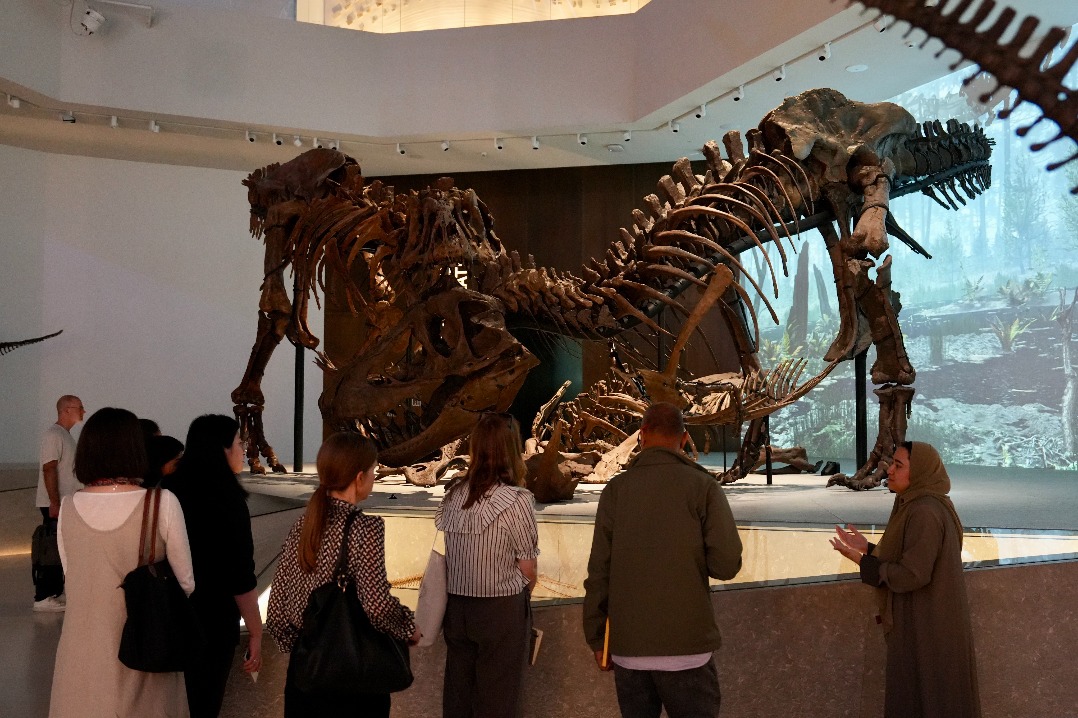
The Natural History Museum Abu Dhabi is transporting visitors through 13.8 billion years of Earth’s history, with its most compelling exhibits revealing a startling transformation in the United Arab Emirates’ landscape. Fossil evidence demonstrates that the region now characterized by golden sand dunes and rocky mountains once hosted vast savannahs, grasslands, and massive river systems teeming with diverse wildlife.
According to Dr. Mark Jonathan Beech, acting geoscience section head at the museum, discoveries in Al Dhafra present incontrovertible evidence that Arabia was not always desert terrain. “Few would imagine Abu Dhabi’s western region once featured giant rivers, savannahs, grasslands, and trees,” Beech stated, noting that these fossils completely reshape our understanding of the region’s ecological history.
The geological timeline reveals even more dramatic changes. Approximately 100 million years ago, the UAE was submerged underwater, with marine remains still being discovered in mountain regions including Sharjah. The Hajar mountains formed mainly between 95-70 million years ago, with subsequent uplift events shaping Jebel Hafit as recently as 25-15 million years ago.
By 7 million years ago, Al Dhafra supported extensive river ecosystems that sustained elephants, giraffes, antelopes, crocodiles, turtles, and catfish. “It was like being on safari in East Africa,” Beech remarked, emphasizing the remarkable biodiversity that once flourished in what is now desert.
These fossil records provide more than historical curiosity—they serve as direct evidence of climate change and its devastating impact on species survival. “It shows that when the climate changes, animals become extinct,” Beech explained, highlighting the instructional value of paleontological findings for understanding contemporary environmental challenges.
The museum utilizes various visual tools, including climate spirals and an Arabia Climate journey, to illustrate climatic oscillations across millennia while documenting the accelerating global warming trend of the past 150-200 years.
Reflecting on the institution’s broader mission, Beech emphasized: “Our goal is to educate people to become better ambassadors of the future. We need to care for our planet and nature.” The museum’s fossil collections thus serve dual purposes—illuminating a forgotten green past while providing crucial insights for addressing current environmental crises.