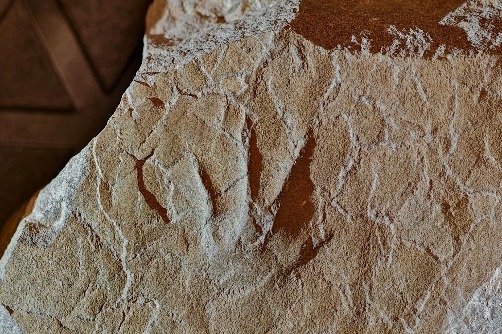
In a landmark paleontological breakthrough, researchers have confirmed the discovery of the first-ever Jurassic-period amphibian footprints found in Asia, located within Beijing’s Mentougou District. The extraordinary find, recently published in the esteemed journal Ichnos, was spearheaded by a team of Chinese scientists and originated from a chance discovery by a local elementary school student.
The fossil evidence consists of a meticulously preserved pair of impressions—a forefoot and a hindfoot—etched onto a single stone slab estimated to be approximately 160 million years old. The tracks were identified on a roadside slope in Longquan town. According to Professor Xing Lida, a renowned dinosaur specialist from the China University of Geosciences in Beijing, the alignment, size, and spacing of the 1.5-centimeter-long prints indicate they were made by a single, small animal in motion.
One impression is exceptionally well-defined, presenting a distinct fan-shaped morphology with four slender, pointed toes. To extract maximal detail from these diminutive traces, the scientific team employed advanced photogrammetric 3D modeling. This digital technique generated a high-fidelity three-dimensional model that unveiled subtle surface features imperceptible to the naked eye, providing a robust foundation for conclusive analysis.
Through rigorous morphological comparison and quantitative skeletal-track correlation, the research team attributed the footprints to a salamander-like amphibian from the Middle Jurassic era. This discovery shatters previous records for the region, which were dominated by dinosaur and turtle tracks, effectively filling a critical void in the Asian vertebrate ichnological record.
The implications extend far beyond a new species identification. These ancient tracks serve as a direct portal into the paleoecology of northern China, painting a picture of a lush, complex ecosystem where small, land-adapted amphibians thrived alongside ferns, ginkgos, and cycads in a lake-swamp environment.
A particularly inspiring aspect of this scientific achievement is its origin. The crucial fossil was first spotted in early 2025 by Ni Jingchen, a young fossil enthusiast and elementary school student, during a exploratory outing. Professor Xing hailed this as a quintessential example of public participation in science, demonstrating that profound historical discoveries can sometimes lie in the most unassuming places, awaiting a curious and observant mind.