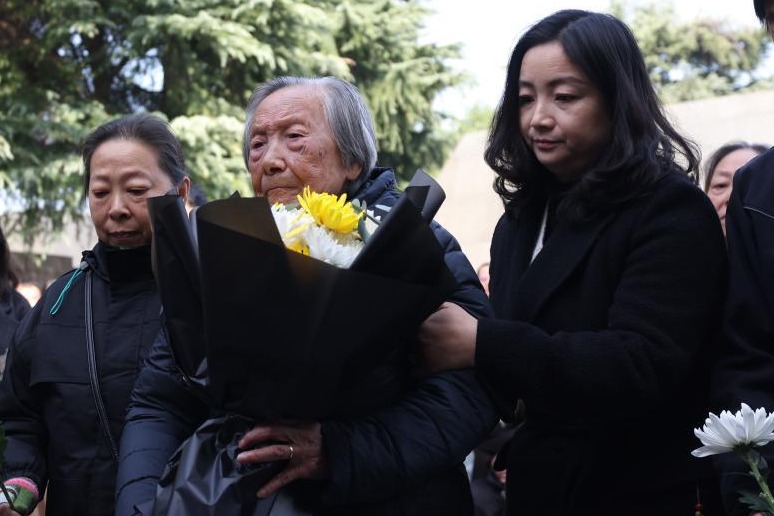
NANJING — As China prepares to observe its 12th national memorial day for the Nanjing Massacre victims on December 13, families of survivors gathered Sunday at the Memorial Hall of the Victims to honor their ancestors and preserve historical memory. The ceremony comes exactly 88 years after Japanese troops captured the then-capital city and initiated six weeks of systematic slaughter that claimed over 300,000 Chinese lives.
Among the attendees was 96-year-old Xia Shuqin, who led her family in solemn tribute before the memorial’s ‘wailing wall’ inscribed with more than 10,000 victims’ names. The elderly survivor, who lost seven family members during the massacre and herself sustained three stab wounds at age eight, located her relatives’ names with trembling fingers as her descendants traced the characters with ceremonial pens.
‘Eighty-eight years, 88 years…’ Xia murmured repeatedly at the memorial, her granddaughter explaining she was communicating with lost family members. ‘I want to witness the day when the Japanese government admits its crimes,’ the nonagenarian declared. ‘Then I can face these names with peace.’
Another survivor, 91-year-old Liu Minsheng, recalled the winter of 1937 when Japanese soldiers took his father from a refugee zone. ‘He never returned,’ Liu stated, indicating a bayonet scar on his right leg. ‘Future generations must remember this history to prevent repetition of such tragedy.’
With only 24 registered survivors remaining—eight having passed this year alone—the transmission of memory has become increasingly urgent. Since 2014, when China’s legislature established December 13 as the national memorial day, the government has preserved survivor testimonies through written transcripts and video documentation. These historical records gained UNESCO’s Memory of the World recognition in 2015.
The memorialization effort now extends to 38 officially recognized inheritors, including descendants like Chang Xiaomei, who documented her late father’s experiences in a trilingual publication. ‘May all victims rest in peace,’ Chang expressed before the memorial wall, ‘may such despair never be repeated, and may the flowers of peace forever bloom on this land.’