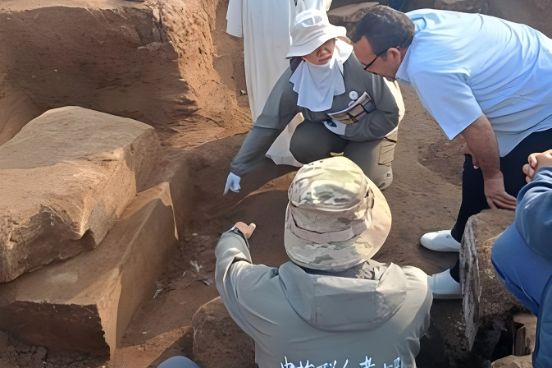
A groundbreaking archaeological discovery has emerged from the sands of Giza, where a joint Egyptian-Chinese mission has unearthed significant structural remains of a temple dedicated to King Apries, who ruled during Egypt’s 26th Dynasty (664-525 BC). The remarkable find was announced by the Shandong Institute of Cultural Relics and Archaeology on Tuesday, marking a new milestone in international archaeological cooperation.
The excavation at the Tell Aziz site in the Mit Rahina area revealed substantial limestone architectural elements that formed part of the previously unknown temple complex. The collaborative project brings together expertise from Egypt’s Supreme Council of Antiquities, Peking University, and the Shandong Institute of Cultural Relics and Archaeology, demonstrating the growing importance of international partnerships in archaeological research.
Beyond the temple structure itself, the mission has recovered an impressive array of artifacts that provide valuable insights into the period. Among the most significant finds are five meticulously carved sphinx statues, numerous stone blocks inscribed with intricate hieroglyphic texts, various pottery fragments, and ancient copper coins. These discoveries offer archaeologists new material evidence to study the architectural styles, religious practices, and daily life during the reign of King Apries.
The temple discovery provides crucial historical context for understanding the 26th Dynasty, also known as the Saite Period, when Egypt experienced a renaissance of art and culture hearkening back to earlier dynastic periods. King Apries, who ruled from 589 to 570 BC, presided over a turbulent period that eventually saw his overthrow and replacement by Amasis II, making archaeological evidence from his reign particularly valuable to historians.
This discovery represents another success in the growing scientific collaboration between Egyptian and Chinese archaeological institutions, which have been working together at multiple sites across Egypt in recent years. The findings will undergo detailed analysis and conservation to better understand their historical significance and ensure their preservation for future study.