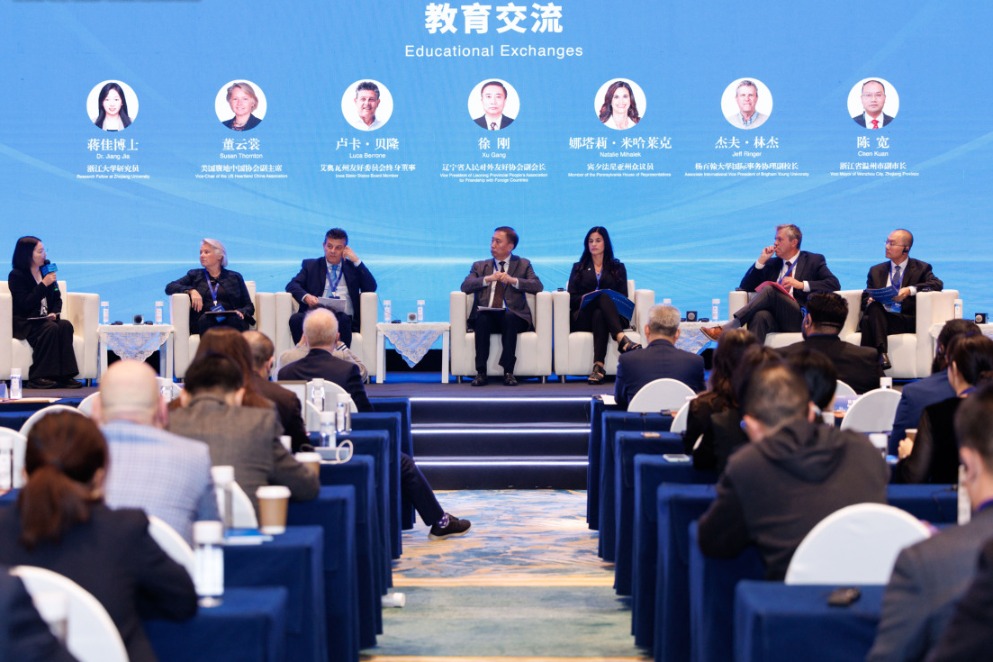
Educational exchanges between China and the United States are set to play a crucial role in fostering stronger bilateral ties, according to officials and experts. This sentiment was highlighted during a sub-forum at the 7th China-US Sister Cities Conference held in Hangzhou, Zhejiang province, on October 27, 2025. Natalie Mihalek, a member of the Pennsylvania House of Representatives, emphasized the importance of such exchanges in bridging cultural and ideological divides. ‘In a world that feels increasingly divided, a conference like this reminds us that knowledge knows no borders,’ she stated. Mihalek further noted that when students and teachers from different countries share classrooms, ideas, and experiences, they cultivate empathy, communication, and understanding. For decades, educational collaborations have enabled students from both nations to gain new skills and perspectives on each other’s history and culture, enriching local communities. Brigham Young University (BYU) serves as a prime example, having collaborated with China for over 40 years. In 1979, a group of BYU student performers visited China, marking one of the first Western performing arts groups to do so in years and establishing a foundation for regular exchanges. Since then, thousands of BYU students and faculty have studied, lived, and performed in China, according to Jeff Ringer, the university’s associate international vice-president. In 1989, BYU initiated the China Teachers Program, which has seen over 2,000 BYU teachers educate hundreds of thousands of Chinese students, fostering lifelong friendships and deepening cultural understanding. Another notable example is Wenzhou-Kean University, a joint project between Zhejiang province and the state of New Jersey, which offers an immersive Chinese cultural experience for international, particularly American, students. Despite these successes, challenges remain. Susan Thornton, vice-chair of the US Heartland China Association, pointed out that fewer American students are studying in China today, and communities across the US Midwest have limited opportunities to engage with Chinese culture. ‘If we are to sustain the foundation of trust and cooperation between our people, that has to change,’ she asserted. Additionally, Chinese students face obstacles such as visa processing when traveling to study in the US. Mihalek stressed the importance of keeping education at the center of the China-US partnership, stating, ‘The more we learn together, the more we grow together, and the more peaceful and prosperous the shared world will be.’