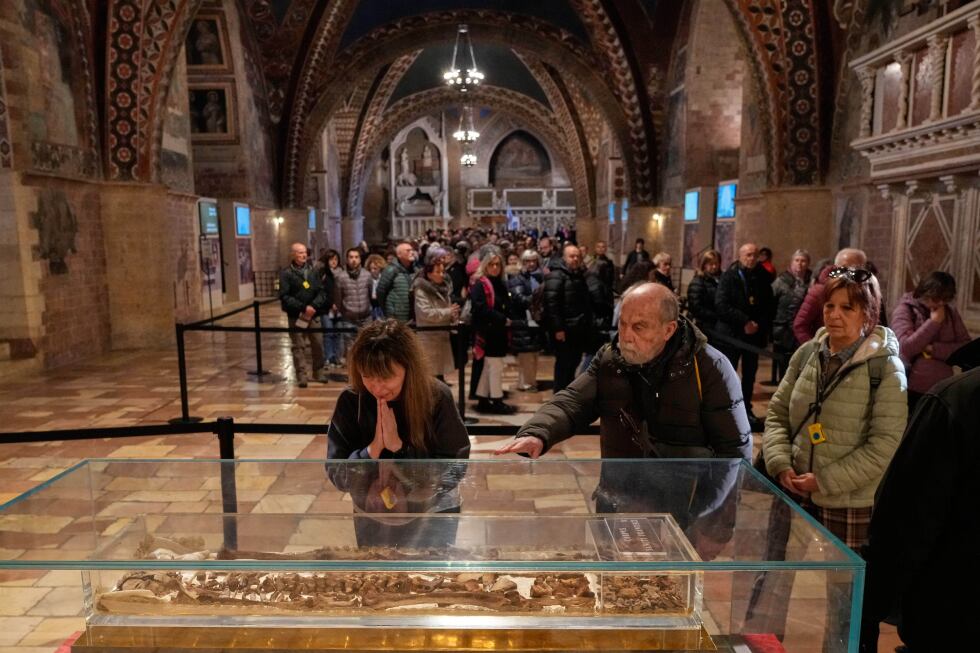
ASSISI, Italy — In an unprecedented spiritual event marking the 800th anniversary of St. Francis of Assisi’s death, the revered saint’s skeletal remains were unveiled for public veneration Sunday, attracting nearly 400,000 registered pilgrims. The bones, meticulously preserved within a sleek bulletproof Plexiglas case, are displayed in the Lower Basilica of St. Francis—the very hilltop Umbrian town the medieval friar transformed into a global spiritual destination.
The month-long exposition, running through March 22, represents both a commemorative act and a spiritual revival initiative. Franciscan organizers aim to reinvigorate St. Francis’s enduring messages of peace, fraternity, and radical humility—values that subsequently inspired Pope Francis to adopt his name upon election to the papacy.
This extraordinary display concludes an eight-century saga surrounding the saint’s physical remains. Born in 1182 to wealth before embracing mendicant poverty, St. Francis reportedly manifested the stigmata—Christ’s crucifixion wounds—toward his life’s end. His posthumous journey proved equally remarkable: fearing relic theft common during medieval Christianity, followers secretly interred his body within the basilica’s unmarked column, where it remained hidden for nearly six centuries until its 1818 rediscovery and subsequent authentication by Pope Pius VII.
Brother Giulio Cesareo, spokesman for Assisi’s Franciscans, emphasized the exhibition’s theological significance: ‘This is not macabre veneration but rather encountering Francis through venerating the Holy Spirit that animated his humanity. For believers, this becomes a pathway to spiritual renewal.’
Contemporary visitors witness the striking physical fragility of the saint—his delicate bone structure reflecting documented struggles with health and nutrition. Yet the spiritual magnitude remains undeniable. Devotee Fiorella Farina, who named her children Francesco and Francesca, expressed profound emotion: ‘Just discussing this gives me goosebumps. In our current historical moment, we need his message more than ever.’
Security measures surrounding the relics are both extensive and discreet, incorporating metal detectors, enhanced police presence, canine units, and surveillance systems—appropriate precautions given historical accounts of attempts to fragment the saint’s garments during his lifetime. Pilgrims experience the relics in carefully managed 10-minute intervals, with registrations opening months in advance.
As explained by Brother William Short of the University of San Diego: ‘Relic veneration stems from natural human desire for connection. The Church channels this toward Christ through the physical remains of saints—our heavenly siblings.’ Despite historical instances of forgery and commercialization, the spiritual potency of relics remains undiminished for the faithful, making this exhibition a once-in-a-lifetime convergence of history, faith, and tradition.