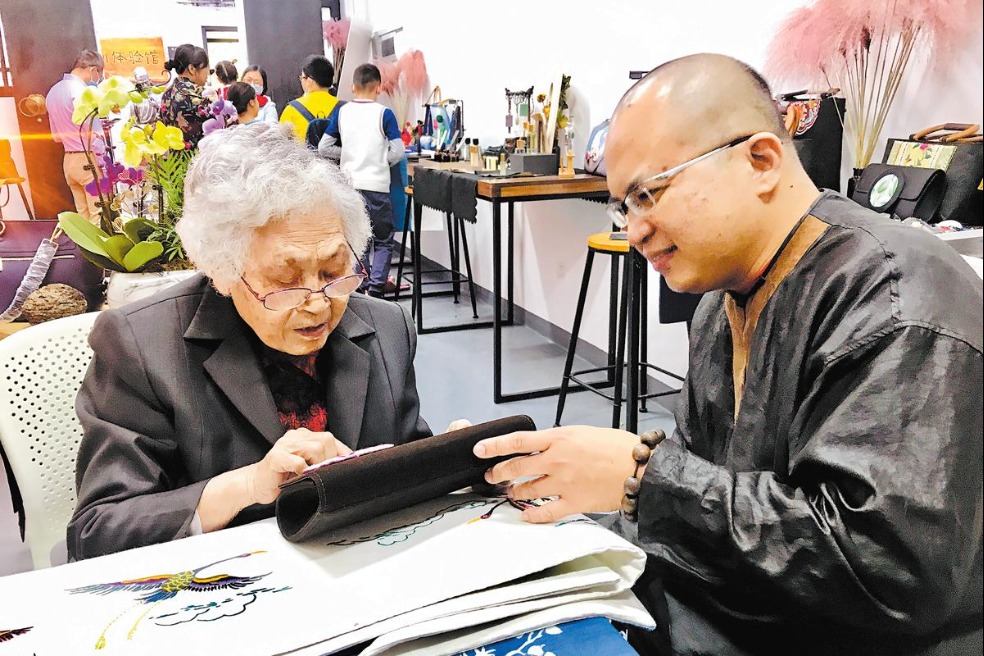
Lin Chun-i, a Taiwanese leather artisan with over two decades of mainland experience, has pioneered a unique fusion of traditional intangible cultural heritage techniques with contemporary leather craftsmanship. Establishing his workshop in Guangzhou’s Liwanhu Park in 1993, Lin recognized the city’s exceptional advantages for creative enterprises, citing its comprehensive supply networks and diverse market opportunities.
Driven by his textile trade family background and artistic training in Taiwan, Lin embarked on extensive journeys across Guizhou, Hunan, and Guangxi to study endangered craft techniques. His collection now incorporates Dong and Tujia brocades alongside Taroko weaving and Bunun embroidery from Taiwan, transforming these cultural expressions into premium leather bags, apparel, and accessories.
Lin’s approach transcends technical mastery, focusing on cultural integration and preservation. “Ethnic embroidery patterns function as cultural repositories,” he explained, “particularly for communities without written traditions.” His dedication was demonstrated when he mastered the complex Tujia brocade weaving technique in merely four days, astonishing local craftsmen who anticipated a month-long learning process.
Beyond preservation, Lin has created sustainable economic opportunities, providing employment for hundreds of female embroiderers in Gansu province. His manufacturing philosophy prioritizes handmade craftsmanship over machine efficiency, with over 50% of production completed manually. “True cultural inheritance means enabling artisans to transform skills into livelihoods, not replacing them with machines,” Lin emphasized.
His contributions were formally recognized in September 2025 when Huaihua city government honored him as an “intangible cultural heritage promotion ambassador.” Additionally, Lin serves as visiting professor at seven universities and operates the symbolically named 1576 Traditional Arts Center, representing the combined coastline measurements of Taiwan and associated islands. The center hosted nearly 40 student groups from Taiwan last year, offering hands-on dyeing and embroidery experiences to foster cultural connection among youth.
Lin remains committed to his dual role as entrepreneur and cultural custodian, asserting: “It is my responsibility to ensure these heritage techniques reach future generations.”