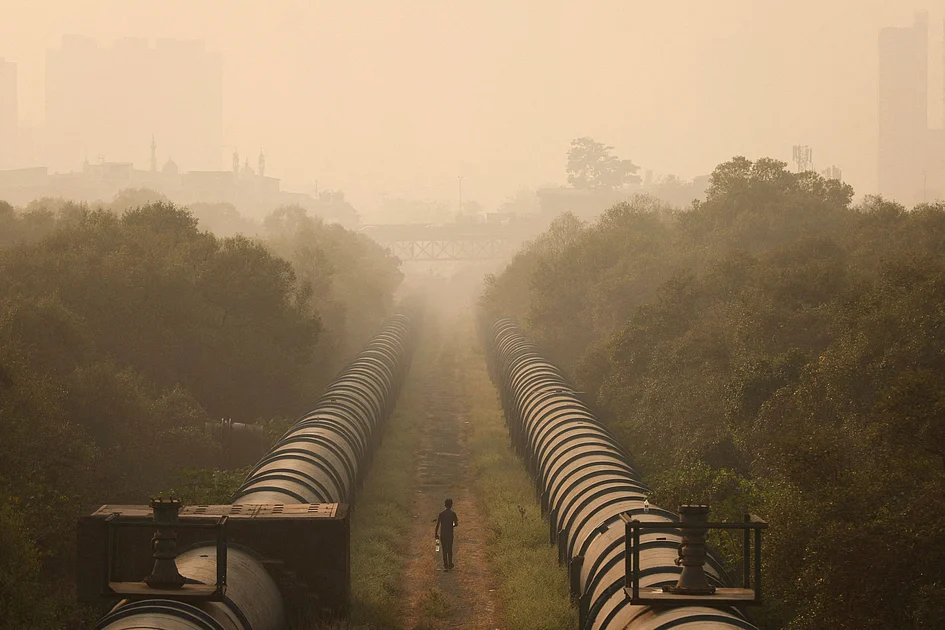
India’s capital has activated its highest-level pollution emergency protocol as Delhi’s air quality deteriorated to its worst levels this season, prompting severe public health measures. On Sunday, official monitoring stations recorded Air Quality Index (AQI) readings exceeding 450—categorized as ‘severe’—marking a significant escalation from Saturday’s 430 reading and representing the most hazardous atmospheric conditions witnessed this winter.
The Commission for Air Quality Management implemented Stage Four of the Graded Response Action Plan on Saturday evening, triggering comprehensive restrictions across the National Capital Region. The emergency measures include prohibiting entry of older diesel trucks into the city, suspending all construction activities including public infrastructure projects, and transitioning educational institutions to hybrid learning models.
Meteorological conditions have significantly contributed to the crisis, with elevated moisture levels and shifting wind patterns creating atmospheric conditions that trap pollutants and prevent their dispersion. This meteorological phenomenon, combined with emissions from vehicles, construction sites, and agricultural burning in neighboring states, has enveloped the 30-million-person metropolitan area in a thick layer of smog.
Health authorities have issued urgent advisories recommending all residents, particularly children and individuals with pre-existing respiratory or cardiac conditions, to remain indoors. Those venturing outside have been advised to utilize protective masks as the particulate matter concentration reaches levels deemed most hazardous to human health. The region consistently ranks among the world’s most polluted urban centers during winter months, presenting chronic public health challenges that intensify with seasonal meteorological changes.