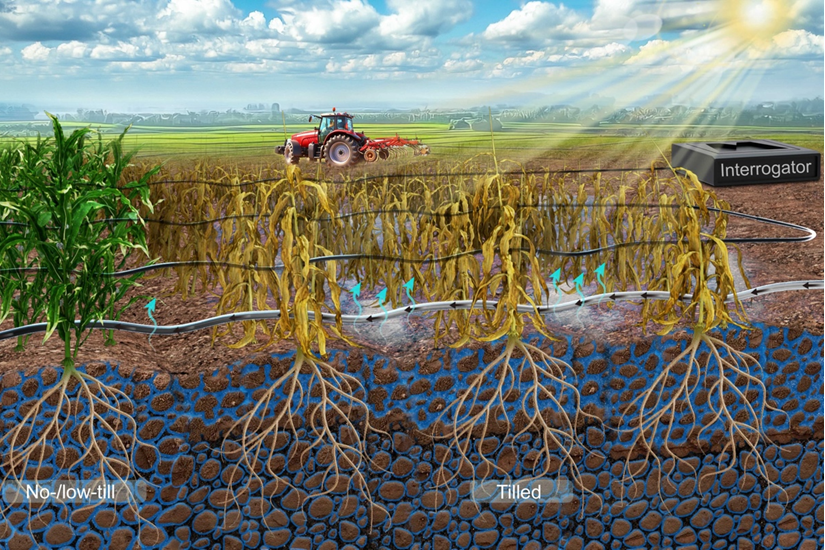
An international scientific collaboration has fundamentally challenged conventional agricultural wisdom through innovative seismic technology, revealing how common farming practices damage soil’s natural hydraulic infrastructure. The breakthrough research, spearheaded by Dr. Shi Qibin from the Institute of Geology and Geophysics at the Chinese Academy of Sciences and published in the prestigious journal Science, demonstrates that intensive deep plowing and heavy machinery compaction severely compromise soil’s sponge-like architecture.
Unlike traditional laboratory methods, the research team from China, the United States, and the United Kingdom deployed fiber-optic cables—identical to those forming the backbone of global internet connectivity—across a 160-meter experimental farm in the UK. This distributed acoustic sensing technology enabled scientists to ‘listen’ to subsurface hydrological activity by transmitting modulated laser pulses through the cables and analyzing returning vibrational signals.
The investigation uncovered that healthy soil maintains an intricate network of microscopic pores and channels that function as a natural plumbing system. This complex architecture facilitates deep water penetration and storage, creating underground reservoirs that sustain crops during drought conditions. Conversely, conventionally farmed soils exhibit compromised porosity where rainfall accumulates superficially rather than permeating deeply, resulting in rapid evaporation and diminished drought resilience.
The research team developed a novel ‘dynamic capillary stress’ theoretical model that contradicts established beliefs about soil mechanics. Their model demonstrates how microscopic water films within soil pores generate surface tension forces that structurally reinforce soil when partially hydrated. Agricultural compaction destroys these capillary networks, altering hydrological dynamics and accelerating moisture loss.
Dr. Shi emphasized the ecological implications: ‘Soil constitutes a sophisticated porous medium rather than merely particulate matter. Its capillary vessel-like structures maintain critical hydrological cycles that support ecosystem stability.’ The findings suggest that while deep tillage may provide short-term yield improvements, it ultimately jeopardizes long-term agricultural sustainability by disrupting these fundamental mechanical and hydrological relationships.
The study highlights the potential for integrating fiber-optic monitoring with artificial intelligence to enable real-time soil diagnostics across agricultural landscapes. This technological synergy could revolutionize farming practices by promoting water-conserving strategies, enhancing climate change adaptation, and contributing to global food security through scientifically-informed land management approaches.