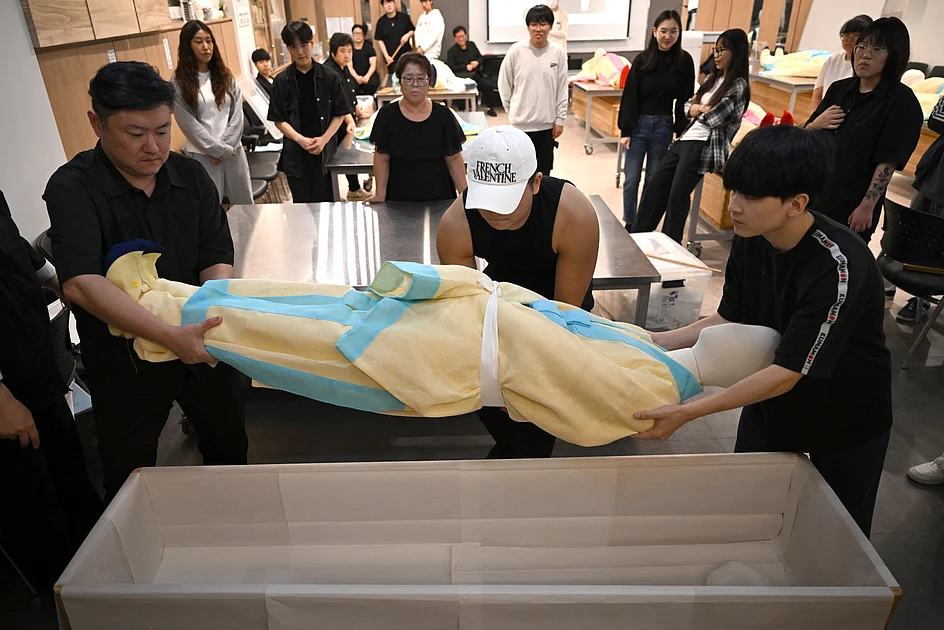
South Korea is witnessing a profound societal shift as its population ages rapidly, with nearly half of its citizens aged 50 or older and birth rates plummeting to among the lowest globally. This demographic transformation has spurred a burgeoning industry centered around death and its associated services. In Busan, a port city, rows of coffins fill university classrooms, where students at the Busan Institute of Science and Technology train to become funeral directors. These students meticulously prepare mannequins for burial, simulating the care required for real-life funerals. Jang Jin-yeong, a 27-year-old student, chose this career path anticipating the growing demand for funeral services in an ageing society. Similarly, Im Sae-jin, 23, was inspired to enter the field after witnessing the dignified preparation of his grandmother’s funeral. The rise of single-person households, now accounting for 42% of all homes in South Korea, has also given birth to a new profession: posthumous home cleaners. These specialists are called to tidy up residences after the solitary deaths of occupants. Cho Eun-seok, a former classical musician, has become one such cleaner, often encountering heartbreaking remnants of lives lived alone. He described homes filled with unopened gifts and neatly stored soju bottles, painting a poignant picture of isolation. South Korea’s high suicide rate, the highest among developed nations, further compounds the issue of lonely deaths. Cho has even begun cleaning vehicles where individuals have taken their own lives and is developing a device to detect unattended deaths, which can lead to environmental hazards. The emotional toll of this work is evident in stories like that of a high school girl who, after escaping domestic violence, lived alone in a tiny room and took her own life. Cho discovered her cherished hamster and guitar, remnants of her unfulfilled dream of becoming a musician. Kim Doo-nyeon, a veteran funeral director, notes an increasing number of young recruits entering the industry, reflecting the growing need for such services. Despite the challenges, these professionals play a vital role in addressing the societal consequences of South Korea’s demographic crisis.