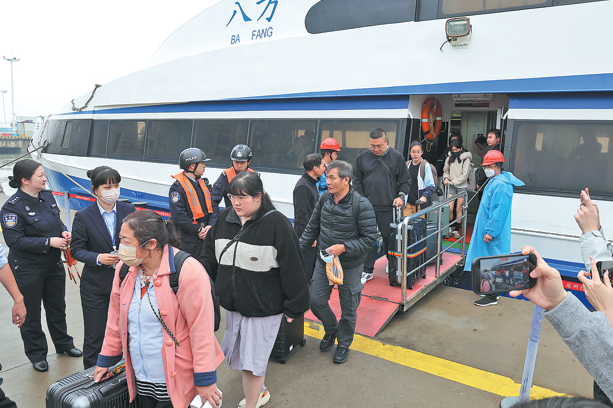
As the annual Qingming Festival, a traditional Chinese occasion for honoring ancestors and reconnecting with family roots, unfolded in 2026, cross-Strait maritime passenger routes witnessed a sharp uptick in travel volumes, driven by thousands of Taiwan compatriots returning to the Chinese mainland to pay respects at ancestral graves and reunite with relatives.
Data released by the Fujian Maritime Safety Administration shows that the four core “Mini Three Links” routes — which operate direct ferry services connecting Fujian’s coastal mainland with Taiwan’s Jinmen and Matsu islands — handled 6,655 passenger trips on the Saturday of the holiday weekend alone, marking a 22.5 percent increase compared to the same period last year.
Among these routes, the Jinmen-Xiamen ferry crossing, which completes the journey in roughly 20 minutes, welcomed nearly 6,000 cross-Strait travelers that Saturday, with Taiwan residents making up more than 70 percent of total arrivals. Border inspection authorities project that total passenger volume on this route across the three-day holiday will reach 20,000, underscoring the sustained demand for cross-Strait family connection during the ancestral commemoration period.
For many Taiwan travelers, the trip back to ancestral homes on the mainland takes top priority, even over personal plans. Li Yung-hung, a Taiwan compatriot who arrived in Xiamen via ferry, shared that she postponed a scheduled leg surgery to make the journey for this year’s Qingming Festival. “It is an unbroken Chinese tradition to return home for tomb-sweeping, and I want the next generation to understand that our roots are here on the mainland,” Li explained. “When the Jinmen-Xiamen Bridge opens in the future, I hope to drive myself straight back to my ancestral hometown.”
To accommodate the wave of travelers and create a smooth, comfortable journey, local authorities have rolled out targeted support measures. At Xiamen’s Gaoqi border inspection station, for example, officers fluent in Hokkien — the shared dialect of most Fujian and Taiwan residents — were deployed to assist travelers, a move informed by the fact that 80 percent of Taiwan residents trace their ancestral roots to Fujian, according to Chen Jinlai, deputy chief of the station.
“Qingming Festival offers the most vivid, tangible proof that people on both sides of the Strait are one family,” Chen noted. “Every trip back is a reaffirmation of our shared ancestral roots and a continuation of collective family memory.”
Beyond efficient border services, specialized support for root-tracing efforts is also widely available. On Friday, ahead of the holiday peak, the China Museum for Fujian-Taiwan Kinship launched on-site genealogy-matching services at a port in Nan’an, Quanzhou. Since 2006, the museum has helped more than 300 Taiwan compatriots locate their ancestral families and confirm their lineages.
These root-seeking journeys often lead travelers to iconic ancestral landmarks across the mainland. One notable site is the Jiangxia Ancestral Hall in Xiamen, built in 1910. The hall once served as a departure point for members of the Huang clan who migrated to Taiwan and Southeast Asia, and today it remains a key gathering place for Huang descendants from both sides of the Strait, who gathered there on March 29 to honor their shared ancestors.
For some younger Taiwan compatriots, the search for origins extends beyond Fujian to deeper ancestral homelands further inland. Huang Chao-jung, a young Taiwan resident, traveled to Jiangxia district in Wuhan, Hubei province — widely recognized as the earliest historical origin of the Huang surname — last month to trace her family’s roots.
“Growing up in Taiwan, we were often told all Huangs originated from Jiangxia, but most of us only knew our immediate ancestral roots were in Fujian,” Huang explained. “Making this trip all the way to Wuhan gave me an incredible sense of connection, like I’ve finally followed my family’s line all the way back to its source. Setting foot on this land feels so moving and meaningful.”