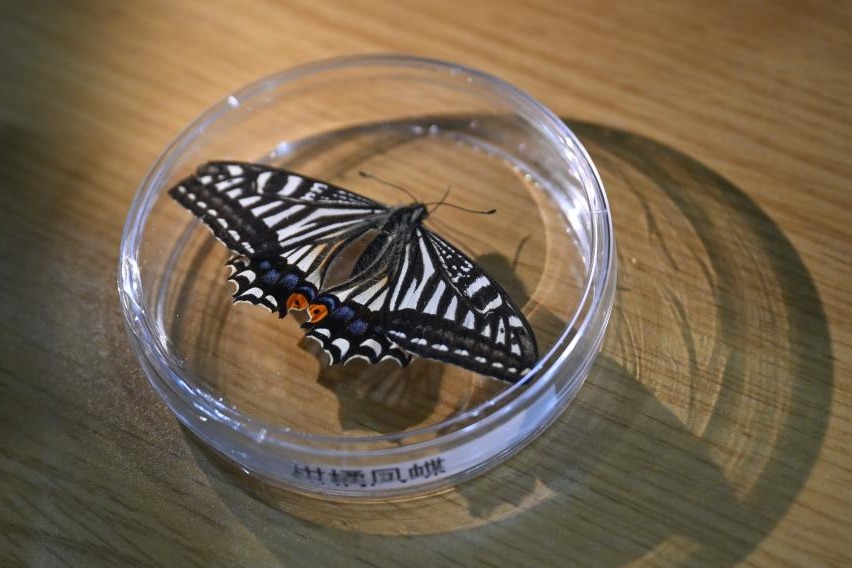
In a pioneering achievement for space biology, Chinese researchers have documented the first successful emergence of a butterfly from its chrysalis in Earth’s orbit. The breakthrough experiment, conducted aboard a miniature sealed ecosystem, provides unprecedented insights into biological adaptation to microgravity conditions.
Chongqing University’s research team developed the specialized 8.3-kilogram payload that housed the butterfly chrysalis alongside pepper plants and microorganisms. Launched December 13, 2025, aboard the Kuaizhou-11 Y8 carrier rocket, the self-contained ecosystem maintained Earth-like conditions through carefully calibrated environmental controls.
Chief designer Xie Gengxin explained the engineering innovations that made the experiment possible. ‘We overcame significant technical challenges, particularly magnesium alloy oxidation in high-humidity environments, to create a robust protective structure for this biological habitat,’ he stated.
The spacecraft’s monitoring systems captured photographic evidence showing the butterfly adapting remarkably to weightlessness—moving within the capsule, resting on leaves, and fluttering its wings despite the absence of normal gravity. Telemetry data confirmed stable pressure, temperature, and humidity levels throughout the emergence process.
This achievement represents more than insect development in space; it validates the viability of complex closed-loop life support systems for long-duration missions. The experiment successfully simulated Earth’s ecological cycles, with plants generating oxygen and potential food sources while microorganisms processed waste to maintain atmospheric stability.
Researchers now turn their attention to evaluating the structure’s orbital endurance, component adaptability, and long-term sealing capabilities—critical factors for future deep-space exploration and potential extraterrestrial colonization efforts.