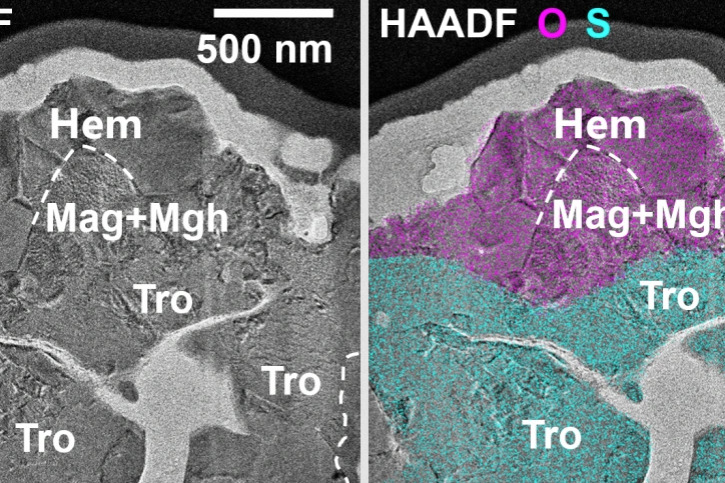
In a groundbreaking discovery, Chinese scientists have identified micrometer-sized crystals of hematite and maghemite in lunar soil samples retrieved by the Chang’e 6 mission from the moon’s far side. Published in the journal Science Advances, this finding unveils a previously unknown oxidation process on the moon, challenging the long-held belief that the lunar surface is entirely in a reduced state with minimal oxidation. The research, conducted by Shandong University, the Institute of Geochemistry of the Chinese Academy of Sciences, and Yunnan University, analyzed samples from the South Pole-Aitken Basin, the largest and oldest known impact basin in the solar system. Using advanced techniques such as micro-area electron microscopy, electron energy loss spectroscopy, and Raman spectroscopy, the team confirmed the native origin of these iron oxides, ruling out contamination from Earth. Unlike Earth, where rust forms through water and oxygen interactions, the moon’s ‘rust’ originates from violent asteroid impacts. These impacts created transient high-oxygen-fugacity gas environments, oxidizing iron in troilite minerals and forming hematite through vapor-phase deposition at 700 to 1,000 degrees Celsius. This process also produced magnetic minerals like magnetite and maghemite, which may explain the magnetic anomalies observed around the SPA Basin. The findings not only enrich our understanding of the moon’s evolutionary history but also provide a scientific basis for future lunar studies. The Chang’e 6 mission, launched in May 2024, successfully retrieved 1,935.3 grams of samples from the moon’s far side, marking a significant milestone in lunar exploration.
Chinese scientists discover lunar rust, revealing new oxidation process on the moon