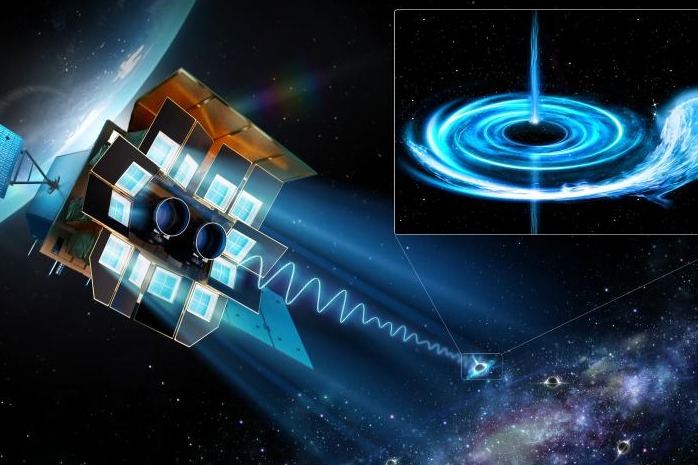
China’s groundbreaking Einstein Probe (EP) astronomical satellite is fundamentally reshaping humanity’s understanding of the dynamic X-ray universe, capturing previously undetectable cosmic phenomena with unprecedented precision. Since its January 2024 launch under the Chinese Academy of Sciences’ leadership, this international collaboration mission has been delivering a steady stream of extraordinary discoveries that are expanding the frontiers of high-energy astrophysics.
The satellite’s advanced instrumentation includes two complementary X-ray telescopes: the Wide-field X-ray Telescope (WXT) utilizing innovative lobster-eye optics to monitor one-tenth of the entire sky simultaneously, and the Follow-up X-ray Telescope (FXT) providing detailed observation capabilities with superior angular resolution. This technological synergy enables the detection of transient cosmic events ranging from seconds to years in duration, capturing faint signals that previously remained hidden in the darkness of space.
Among its landmark discoveries, EP detected EP241021a—a remarkably prolonged X-ray transient persisting for at least 40 days, resembling a slowed-down cosmic firework accompanied by a relativistic jet. Published in The Astrophysical Journal Letters, this finding suggests either a star being torn apart by an intermediate-mass black hole or an unusual core-collapse explosion of a massive star, offering new insights into catastrophic cosmic events and jet formation mechanisms.
In September 2024, the probe captured EP240904a, an exceptionally faint X-ray burst within the Milky Way approximately 100 times dimmer than typical black hole eruptions. This discovery, also published in The Astrophysical Journal Letters, represents a breakthrough in identifying previously hidden black hole populations in our galaxy through its distinctive X-ray ‘heartbeat’ and spectral evolution patterns.
The mission’s autonomous capabilities were demonstrated with EP240801a, an extremely ‘soft’ X-ray flash where low-energy X-rays dominated radiation. The probe independently detected this transient event and immediately triggered follow-up observations, showcasing its sophisticated automated monitoring system that completed the entire process from discovery to tracking without human intervention.
This collaborative effort involving the European Space Agency, Germany’s Max Planck Institute for Extraterrestrial Physics, and France’s CNES space agency has established China as a leading force in time-domain astrophysical research, providing astronomers worldwide with unprecedented tools to explore the most extreme physical phenomena in the cosmos.