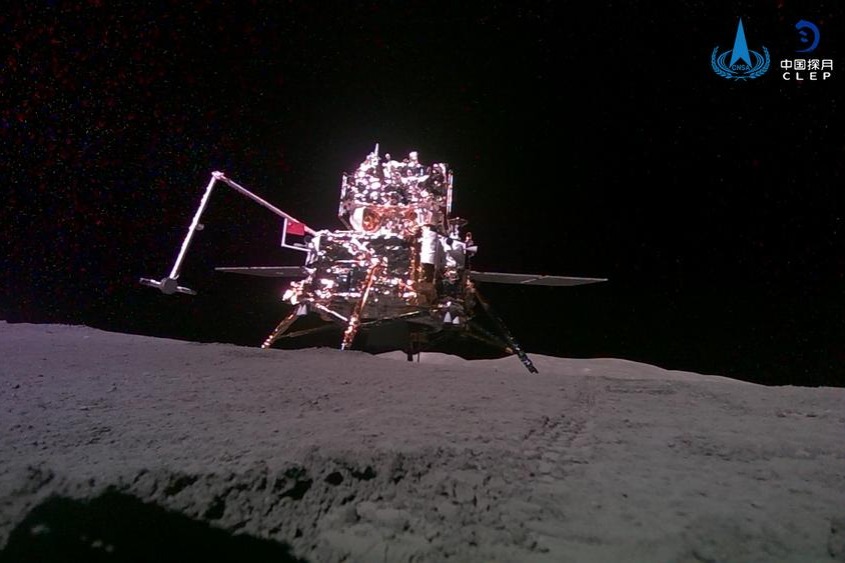
For decades, scientists have chased clues about how the raw materials for life first arrived on the early Earth, and a groundbreaking new discovery from a Chinese-led international research team has brought that story into sharper focus than ever before. In a first for planetary science, the team has successfully identified multiple nitrogen-bearing organic compounds on the surfaces of lunar soil grains brought back to Earth by China’s Chang’e 5 and Chang’e 6 missions, opening new windows into how organic matter moved through the early solar system. The team’s findings, which include contributions from the Institute of Geology and Geophysics of the Chinese Academy of Sciences, the University of New Mexico, and Changsha University of Science and Technology, were officially published in the peer-reviewed journal *Science Advances* on April 10, 2026.
The longstanding core hypothesis among planetary scientists holds that asteroids and comets acted as cosmic delivery couriers in the chaotic early days of the solar system, shuttling critical organic compounds and life-essential elements—including carbon, nitrogen, oxygen, phosphorus, and sulfur—to the rocky terrestrial planets of the inner solar system. These deposited materials, researchers argue, likely supplied many of the fundamental chemical building blocks that allowed life to emerge and evolve on early Earth. But tracing this history has proven extraordinarily difficult on our home planet: billions of years of constant geological activity, tectonic shifts, and biological processes have erased nearly all traces of these earliest organic inputs. The Moon, by contrast, has almost no geological activity, making it a perfectly preserved time capsule that retains 4.5 billion years of solar system history, including records of these ancient organic delivery events.
Prior studies of lunar samples collected by NASA’s Apollo missions successfully detected simple carbon- and hydrogen-containing organic compounds in lunar regolith, but concrete evidence of nitrogen-bearing organics had never been found—creating a critical gap in the hypothesis that organic materials were delivered to the inner solar system via asteroid and comet impacts. To fill this gap, the research team deployed cutting-edge analytical techniques: high-resolution microscopy, energy-dispersive spectroscopy, and high-precision spectroscopic methods, which allowed them to map and characterize tiny organic deposits on individual lunar soil grains at a micro scale.
Their analysis confirmed that the organic matter found on the lunar grain surfaces is primarily composed of carbon, nitrogen, and oxygen, with no uniform fixed chemical structure. “In some of the samples we tested, we detected amide functional groups, a key structural component of biological molecules like proteins,” explained Dong Mingtan, first author of the study and a PhD candidate at the Institute of Geology and Geophysics, Chinese Academy of Sciences. “This confirms these materials are not just inert graphitized carbon—they have undergone complex chemical reprocessing that brings their structure much closer to the type of organic molecules that could be used by developing life.”
Further isotopic analysis revealed that the hydrogen, carbon, and nitrogen isotopic compositions of these lunar organics are generally lighter than the same organic materials found in carbonaceous chondrites (primitive asteroid fragments that fall to Earth) and directly collected asteroid samples. Dong noted that this specific isotopic signature matches the expected outcome of impact processing: when asteroids or comets collide with the Moon, extreme impact heat triggers the decomposition and volatilization of organic molecules from the impacting extraterrestrial body, leading lighter isotopes to preferentially condense and deposit onto lunar mineral grains.
In another landmark finding, the team also identified clear signatures of solar wind implantation in the lunar organic matter for the first time. “We observed distinct shifts in hydrogen isotopic composition and hydrogen-to-carbon ratios close to the surfaces of the soil grains, which matches the pattern one would expect from prolonged exposure on the lunar surface and continuous irradiation by solar wind particles,” said Hao Jialong, the study’s corresponding author and a senior engineer at the Institute of Geology and Geophysics. “Crucially, these patterns rule out the possibility that the organic compounds came from terrestrial contamination after the samples were returned to Earth.”
The research team’s work outlines a clear, continuous evolutionary pathway for lunar organic matter: initial delivery by extraterrestrial impacting bodies, followed by chemical restructuring driven by impact heat, and final modification by long-term lunar space weathering. This sequence provides transformative new insights into the evolution of small solar system bodies and the full history of organic delivery to the inner solar system. Beyond advancing our understanding of early solar system evolution, the new analytical techniques developed for this research have broad applications for future deep space exploration. Dong emphasized that these methods can be adapted to identify microscale organic matter and trace its evolutionary history in samples collected by future sample return missions—including China’s Tianwen 2 mission, which is scheduled to return the country’s first asteroid samples to Earth by the end of 2027.