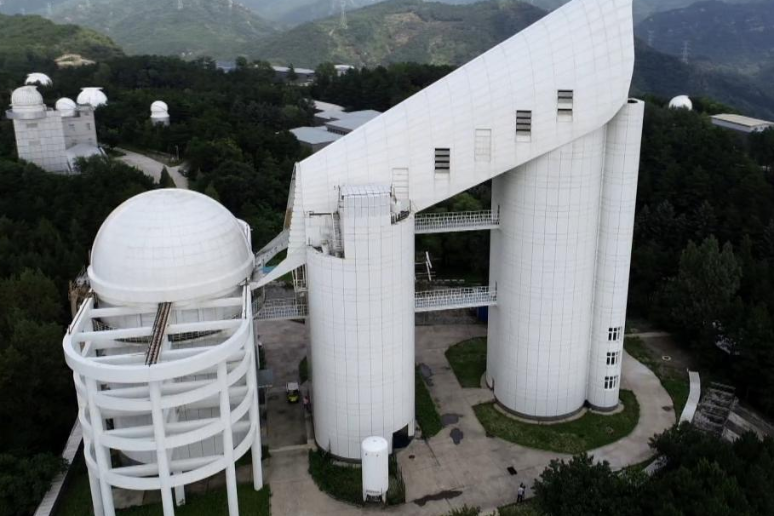
China’s National Astronomical Observatories has unveiled a monumental astronomical dataset from its Large Sky Area Multi-Object Fiber Spectroscopic Telescope (LAMOST), distributing over 30 million celestial spectra to researchers worldwide. The newly released DR13 dataset, covering observations from 2011 through June 2025, represents the most extensive spectral survey ever conducted, solidifying China’s position at the forefront of astronomical research.
The comprehensive data release includes approximately 13.47 million low-resolution spectra and 17.35 million medium-resolution spectra, accompanied by a stellar parameter catalog containing nearly 12.94 million entries. This unprecedented collection continues LAMOST’s reign as the world’s leading spectral survey project in both data volume and stellar parameter scale.
Since becoming operational as China’s first major national scientific infrastructure in astronomy, LAMOST has revolutionized large-scale spectroscopic sky surveys. The telescope’s pioneering design has enabled 14 years of efficient and stable operation, during which it has transformed our understanding of the Milky Way’s structure and evolution.
The scientific impact of LAMOST’s data is demonstrated by its widespread adoption across the global astronomy community. Researchers from 278 institutions worldwide, including significant participation from the United States, Germany, Belgium, and Denmark, have utilized the telescope’s data to produce more than 2,200 high-quality research publications. Recent years have seen particularly robust output, with over 300 annual publications—more than 40 percent authored by international astronomers—placing LAMOST’s scientific productivity among the world’s elite 6-to-10-meter class telescopes.
Beyond galactic studies, LAMOST’s spectra have facilitated groundbreaking discoveries across multiple astronomical domains, including the identification of compact objects, advances in stellar physics, exoplanet detection, and quasar research. This latest data release promises to further accelerate astronomical discovery and international collaboration in the coming years.