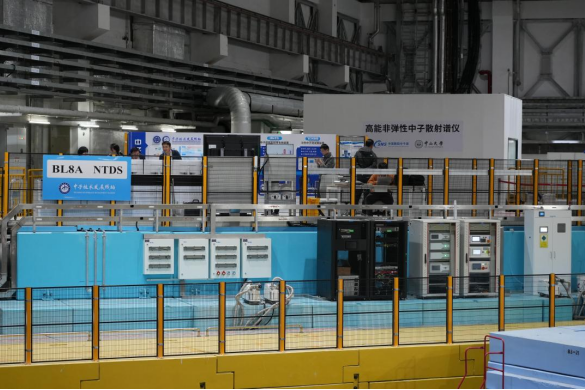
China’s ambitious Phase II expansion of its premier scientific facility, the China Spallation Neutron Source (CSNS), has achieved a groundbreaking milestone with the successful generation of its first neutron beam. This achievement marks a pivotal moment in the project’s development timeline, demonstrating significant progress in China’s advanced scientific infrastructure capabilities.
Situated in Dongguan, Guangdong province, the CSNS represents China’s inaugural pulsed spallation neutron source and ranks as the world’s fourth such facility. Operated under the auspices of the Institute of High Energy Physics within the Chinese Academy of Sciences, this sophisticated installation functions as an ultra-precise microscopic observatory. By employing neutron scattering techniques, scientists can examine materials at unprecedented resolutions, revealing critical structural information about metal fatigue, battery performance characteristics, and numerous other material properties that remain invisible to conventional imaging methods.
The newly operational neutron technology development station serves as a specialized testing platform for advancing detection methodologies. Featuring an ultra-clean environment with minimal interference, this station enables researchers to capture extremely faint neutron signals with remarkable efficiency. The successful beam output follows five years of intensive interdisciplinary collaboration addressing complex engineering challenges including precise neutron beam control, dynamic equipment switching mechanisms, and the relocation of heavy components.
Concurrently, CSNS has demonstrated remarkable operational stability, achieving a record-breaking 185 kilowatts beam power on target during a 72-hour continuous operation period. This performance builds upon previous milestones of 160 and 170 kilowatts reached in 2024. The enhanced power output significantly reduces experiment durations while optimizing facility utilization, providing stronger technical support for cutting-edge scientific investigations.
The Phase II project, initiated in 2024 with anticipated completion by 2029, will elevate the facility’s proton accelerator target power to 500 kilowatts. This substantial enhancement will increase the neutron beam’s intensity, enabling scientists to detect fainter structural signals and achieve nanoscale precision in material analysis. The advancements will significantly bolster China’s research capabilities across multiple disciplines including renewable energy development, aerospace engineering, and bioscience innovation.