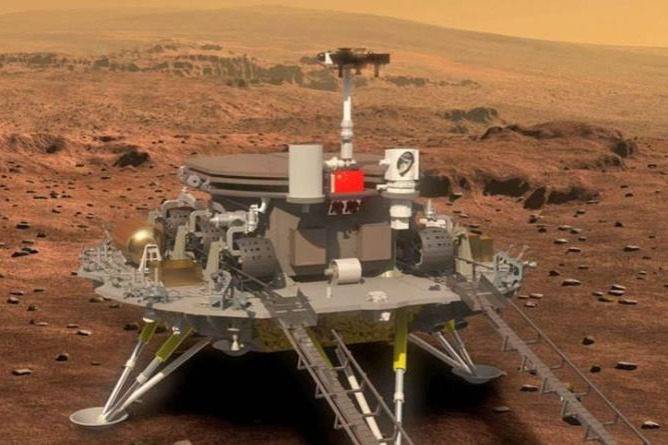
In a groundbreaking revelation that reshapes our understanding of Martian evolution, China’s Zhurong rover has uncovered compelling evidence indicating water persisted on the Red Planet hundreds of millions of years longer than previously established. The findings, published in the National Science Review by researchers from the Chinese Academy of Sciences’ Institute of Geology and Geophysics, fundamentally alter existing Martian hydrological timelines.
Utilizing advanced quad-polarized ground-penetrating radar technology—functioning as a sophisticated planetary CT scanner—Zhurong examined subsurface structures at its Utopia Planitia landing site. The data revealed a uniformly thick sedimentary layer approximately 4 meters beneath the surface, covering buried impact craters with remarkable consistency.
According to lead researcher Liu Yike, the geological evidence decisively eliminates volcanic or aeolian origins. “The sedimentary layer’s uniform thickness and continuity point conclusively toward aqueous deposition,” Liu explained. “The formation environment likely resembled a shallow marine or lacustrine system rather than dry volcanic or wind-driven processes.”
The radar imaging further captured centimeter-scale stratifications characteristic of aquatic sedimentation, providing additional validation of sustained water activity during the middle-late Amazonian Period approximately 750 million years ago. This timeline pushes Mars’ hydrological activity significantly closer to the present era than the previously accepted cutoff of 3 billion years ago.
Since its May 2021 landing, Zhurong has traversed 1,921 meters across the Martian terrain, gathering extensive datasets that continue to revolutionize planetary science. These findings not only recalibrate Martian climatic models but also enhance our understanding of planetary habitability thresholds and geological evolution.
The discovery underscores the growing sophistication of China’s deep space exploration capabilities while providing crucial insights for future interplanetary research missions seeking evidence of extraterrestrial life and habitable environments.