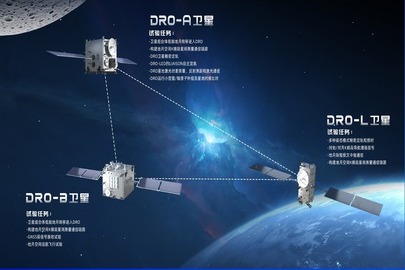
China has achieved a significant breakthrough in space exploration infrastructure with its experimental satellite constellation successfully operating for two consecutive years in a specialized lunar orbit. The Technology and Engineering Center for Space Utilization (CSU) under the Chinese Academy of Sciences announced this milestone during the 2026 Zhongguancun Forum’s sub-forum on Earth-Moon space development.
The three-satellite constellation, positioned in the Distant Retrograde Orbit (DRO) within Earth-moon space, represents a pioneering achievement in orbital mechanics and space infrastructure. This orbital region, extending approximately 2 million kilometers from Earth, provides a highly stable environment for spacecraft operations. The constellation consists of DRO-A and DRO-B satellites developed by CAS, which have established successful inter-satellite measurement and communication links with the previously launched DRO-L satellite in near-Earth orbit.
This project marks the world’s first successful low-energy insertion into the DRO and has demonstrated stable spacecraft residency and efficient maneuvering capabilities within this unique orbital environment. Notably, the mission accomplished the unprecedented feat of touring all Lagrange points in the Earth-moon system during a single flight, showcasing advanced navigation and propulsion technologies.
The technological verification provided by this constellation establishes critical infrastructure for future lunar exploration missions. According to space experts participating in the forum, these advancements will play a vital role in supporting China’s ambitious space program and its goal of becoming a leading space power.
The forum brought together more than 200 representatives from over 20 institutions, focusing on key developmental aspects including Earth-moon space infrastructure, cost-effective access to lunar space, and sustainable resource utilization strategies. Ding Chibiao, Vice-President of CAS, emphasized that the Earth-moon space serves as a strategic hub connecting Earth to deep space and represents a new frontier for scientific and industrial transformation.
Concurrent with these developments, Beijing is positioning itself as a commercial aerospace innovation hub, hosting more than half of China’s core space research institutions. The successful operation of this satellite constellation demonstrates China’s growing capabilities in space technology and its commitment to advancing lunar exploration through international cooperation and technological innovation.