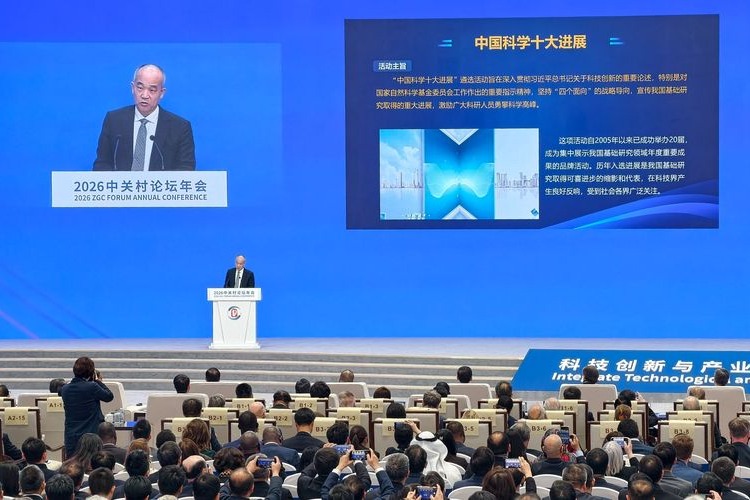
China has officially recognized its most significant scientific achievements of 2025 during the opening ceremony of the 2026 Zhongguancun Forum in Beijing. The National Natural Science Foundation of China (NSFC) unveiled the annual selection of top 10 scientific advancements, showcasing remarkable progress across multiple disciplines of basic research.
Leading the prestigious list was a groundbreaking lunar discovery stemming from the Chang’e 6 mission. Chinese scientists analyzing the first-ever lunar farside samples identified that the farside basalts originated from an extremely depleted mantle source. This critical finding suggests that giant impact events may have triggered melt extraction from the lunar mantle, providing essential evidence for understanding the moon’s hemispheric dichotomy.
In medical science, a Chinese research team achieved a world-first by successfully transplanting a gene-edited pig liver into a human patient. This pioneering xenotransplantation procedure overcame fundamental barriers of immune rejection and functional compatibility, establishing crucial data and technological foundations for clinical translation.
The recognized advancements spanned numerous critical domains including advanced material sciences, controllable nuclear fusion technology, deep-sea exploration capabilities, cutting-edge chipmaking processes, and next-generation solar cell development. These achievements demonstrate China’s comprehensive approach to scientific innovation.
NSFC Director Dou Xiankang emphasized that the annual selection process, maintained since 2005, serves to motivate researchers to address fundamental research bottlenecks and produce more original scientific accomplishments. The initiative simultaneously aims to enhance public understanding and support for basic research fields.
The 2025 selections emerged from a rigorous evaluation process involving more than 600 basic research projects. The transparent procedure incorporated expert screening, real-time online voting, and committee deliberation, ensuring broad participation and scientific credibility.