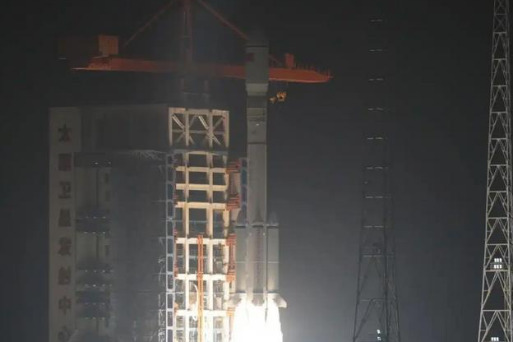
In another landmark step for China’s expanding space program, the country successfully placed a new batch of internet satellites into planned orbit early Thursday, marking its 23rd space launch mission of 2026. The launch was carried out by a Long March 6A carrier rocket, lifting off at 3:38 a.m. local time from the Taiyuan Satellite Launch Center located in northern China’s Shanxi Province, according to mission contractor China Aerospace Science and Technology Corp.
This latest group of spacecraft represents the 21st batch of low-orbit satellites built for China’s state-operated global space-based internet network. Developed by the Innovation Academy for Microsatellites, a Shanghai-based subsidiary of the Chinese Academy of Sciences, all satellites were successfully delivered to their preassigned orbital positions shortly after liftoff.
With this latest deployment, the Chinese mega-constellation — frequently compared to SpaceX’s Starlink network in global aerospace circles — now operates nearly 170 low-Earth orbit satellites. When fully completed, the large-scale network is planned to include approximately 13,000 low-orbit satellites that will deliver continuous global internet coverage across the world.
The Long March 6A rocket, which carried out this mission, was developed by the Shanghai Academy of Spaceflight Technology as a medium-lift launch vehicle tailored for modern satellite deployment missions. Standing 50 meters tall, the rocket features a liquid-fueled core booster paired with four solid-propellant side boosters, with a total liftoff weight of 530 metric tons. It is capable of delivering payloads to a range of orbital regimes, including low-Earth orbit, sun-synchronous orbit and intermediate circular orbit. This mission marked the sixth flight of the Long March 6A that has been dedicated to deploying satellites for the low-orbit internet constellation.
Nationwide, this successful launch also pushed the total number of flights for China’s entire Long March rocket family to 637, underscoring the reliability and consistent progress of the country’s commercial and governmental launch programs. The steady cadence of missions in 2026 — already 23 completed before the end of the second quarter — reflects China’s ongoing push to advance its space infrastructure and expand its capabilities in satellite-based communications.