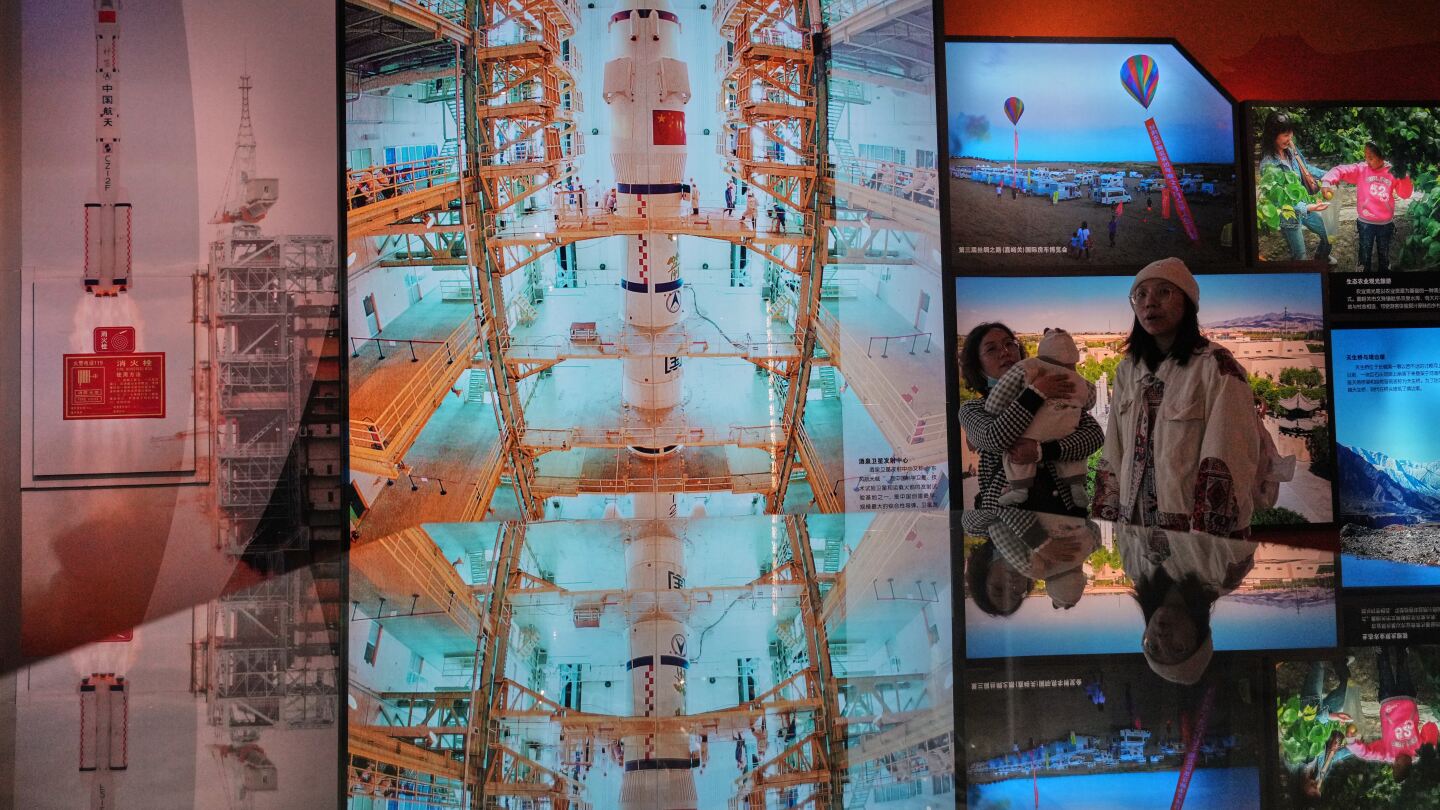
China has reaffirmed its commitment to landing astronauts on the moon by 2030, marking a significant milestone in its ambitious space exploration agenda. Zhang Jingbo, spokesperson for the China Manned Space Program, announced on Thursday that all preparatory efforts, including the development of the Long March 10 rocket, lunar landing suits, and exploration vehicles, are progressing smoothly. ‘Our goal of achieving a manned moon landing by 2030 remains steadfast,’ Zhang emphasized. This announcement underscores China’s determination to establish itself as a global leader in space exploration. In parallel, China is preparing to launch its latest crew to the Tiangong space station, a critical component of its broader space strategy. The new crew, consisting of Zhang Lu, Wu Fei, and Zhang Hongzhang, is scheduled to depart from the Jiuquan launch center on Friday at 11:44 p.m. local time. While Zhang Lu has prior experience from the Shenzhou 15 mission, Wu Fei and Zhang Hongzhang will be venturing into space for the first time. The astronauts will also conduct experiments on four mice—two male and two female—to study the effects of weightlessness and confinement. The Tiangong space station, meaning ‘Heavenly Palace,’ was developed after China was excluded from the International Space Station due to U.S. national security concerns, highlighting the country’s independent advancements in space technology.
China says it’s on track to land astronauts on the moon by 2030 ahead of space station mission