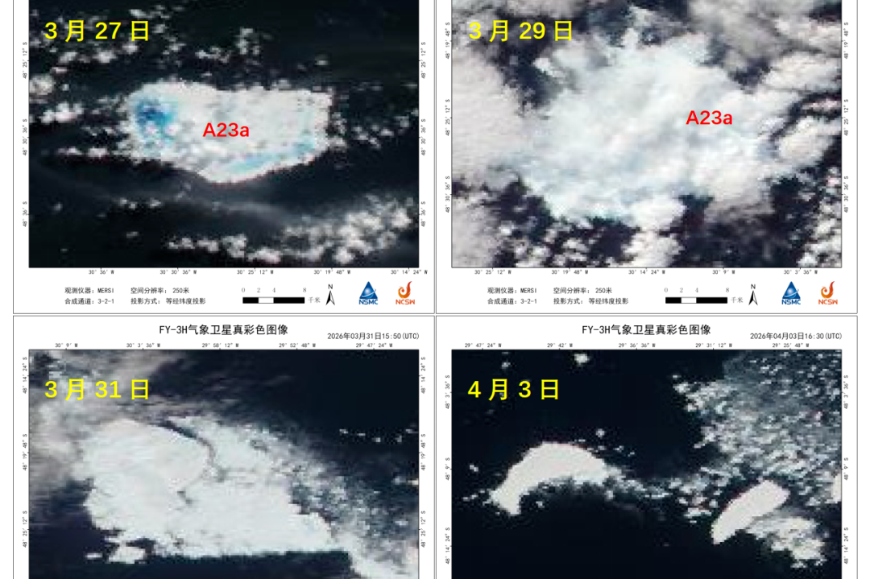
After four decades of drifting and gradual transformation through the Southern Ocean, what was once recognized as the world’s largest iceberg, A23a, has reached the end of its lifecycle, with its final collapse fully captured by China’s network of Fengyun meteorological satellites, according to the China Meteorological Administration.
When A23a first calved off Antarctica’s Filchner Ice Shelf in 1986, it was a massive frozen structure spanning 4,170 square kilometers, measuring nearly 400 meters thick, and weighing an estimated one trillion tons. For decades, the giant iceberg remained grounded in the Weddell Sea, locked in place and largely unchanged until around 2020, when warming ocean temperatures melted enough surrounding ice to free it from the seafloor. It remained stationary for another two years, however, before significant movement began in late 2022.
By early 2023, A23a still covered 4,035 square kilometers, earning it an official Guinness World Record as the largest iceberg on the planet at that time. From that point, the iceberg entered a period of steady northward acceleration: it exited the Weddell Sea in 2024 and entered the powerful Antarctic Circumpolar Current, which carried it steadily toward warmer waters. Between June and September 2025, the iceberg suffered multiple large-scale fracture events, shrinking its total area from 3,536 square kilometers at the start of the year to roughly 1,400 square kilometers. By January 2026, further breakup reduced the iceberg’s main remaining body to just 503 square kilometers.
Propelled by the swift currents of the Antarctic Circumpolar Current, A23a continued its rapid drift, experiencing three more major collapse events in its final weeks. Data from the Fengyun-3 meteorological satellite confirms the iceberg completed its final breakup between late March and early April 2026. By April 3, a final collapse event reduced the largest remaining fragment to just 11 kilometers long and 35.2 square kilometers in area — a size that no longer meets the official classification threshold for an iceberg, closing the book on A23a’s 40-year existence.
A research team led by Zheng Zhaojun, chief expert at the National Satellite Meteorological Center’s International User Service Center, has leveraged high-resolution remote sensing data from Fengyun satellites to track A23a’s trajectory, morphological shifts, and gradual disintegration over its entire lifecycle. The Fengyun-3 satellite series, in particular, has proven uniquely suited for monitoring massive ice formations in polar and subpolar waters, thanks to its on-board Medium Resolution Spectral Imager (MERSI). With a spatial resolution of 250 meters, the instrument can capture both the full outline of giant icebergs and fine-grained details of their surface structure, allowing researchers to track growing structural instability long before major collapse events occur.
These continuous observations have already revealed new insights into the physical processes that drove A23a’s rapid final breakup, the center noted. Beyond glaciological research, the satellite data has also uncovered notable ecological shifts in the waters surrounding A23a during its final disintegration. Starting in late 2025, satellite imagery captured a gradual “greening” of the ocean in the iceberg’s fragmented ice zone, with expanding green plumes shifting across the sea surface as meltwater flowed into the surrounding waters.
This visible discoloration is tied directly to phytoplankton blooms, which are triggered when nutrient-rich meltwater from melting icebergs enters the open ocean. Zheng explained that the research team is continuing to analyze the data to build a clearer understanding of the broader ecological impacts of iceberg melt in polar regions. The continuous, high-quality observations of A23a’s entire lifecycle collected by Fengyun satellites will provide a valuable open-access dataset for future research into polar glacial change and polar ecosystem dynamics, Zheng added.