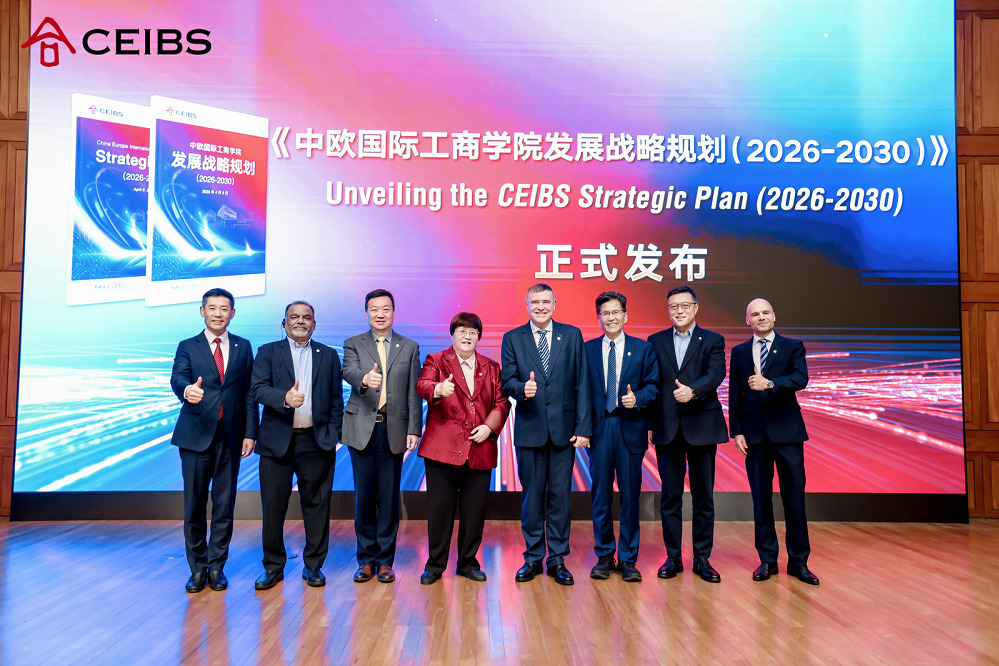
On April 9, 2026, the China Europe International Business School (CEIBS) launched an ambitious five-year strategic blueprint on its Shanghai campus, designed to deepen cross-continental connections between China, Europe, and the broader global community through innovative, globally focused management education.
Founded as a collaborative venture between the Chinese government and the European Union in 1994, CEIBS has built its global reputation on its distinctive core positioning: “China Depth, Global Breadth”. Unlike many standalone business schools, it operates a multi-campus global footprint that extends beyond major Chinese hubs including Beijing, Shanghai and Shenzhen to international locations in Zurich, Switzerland, and Accra, Ghana, giving it an unmatched on-the-ground presence across two continents and emerging markets.
Over the past five years, CEIBS has cemented its status as a world-leading business education institution, with a track record of consistent top-tier rankings. The Financial Times has ranked its Global Executive Master of Business Administration (Global EMBA) program among the top two programs globally for six consecutive years, while its full-time MBA program has held the number one ranking in Asia for a full decade. Beyond rankings, CEIBS’ business case studies have been accessed more than two million times by over 1,100 academic institutions across more than 80 countries. Its global alumni network now counts more than 34,000 members across over 90 countries and regions, with 85 percent of graduates holding senior leadership positions. Notably, 480 alumni serve as chairmen, presidents or chief executive officers at 437 listed companies in China, CEIBS President Wang Hong confirmed.
Looking ahead to the 2026–2030 strategic period, Wang outlined eight core pillars that will guide the school’s growth: reinforcing its position as a global top-tier business school, embedding meaningful social responsibility into all its programs, expanding its tenured world-class faculty body, developing targeted signature research themes aligned with global business needs, optimizing its academic program portfolio, deepening institutional and people-to-people engagement between China and Europe, accelerating full-scale artificial intelligence (AI) integration across all operations, and expanding support for its global alumni network.
As China enters its own 15th Five-Year Plan period (2026–2030), the country’s economic and industrial landscape demands a new generation of business leadership, Wang explained. “What the country needs most is no longer simply experts in a single field, but rather versatile management professionals capable of bridging science and technology, industry, capital, organizations, and global norms. Our mission is exactly to cultivate such talents who understand both China and the world, technology and business, as well as who drive growth while taking on responsibility,” Wang said.
Frank Bournois, CEIBS’ European Co-President, emphasized that amid growing global geopolitical complexity and widespread economic uncertainty, CEIBS’ decades-long role as a pioneering bridge between China and Europe remains one of its most enduring and valuable competitive advantages. To adapt to shifting global business needs, the school will update its program portfolio to integrate emerging critical topics such as AI, deepen industry collaboration through dedicated engagement platforms, and increase the share of international students in both its MBA and Global EMBA programs to more than 30 percent per cohort.
Bournois noted that CEIBS’ cross-continental bridging role is both long-term and continuously evolving to match a changing world. “While external conditions may fluctuate, the demand for globally minded leaders with cross-cultural capabilities will only grow, reinforcing the school’s mission to connect Europe, China, and the wider world through management education,” he added.
A key innovation of the new strategic plan is the rollout of a groundbreaking “AI + HI (human intelligence)” dual-driven educational model, which is set to reshape the future of global business education. The model will drive a full-scale upgrade of the school’s teaching methods, research output, and campus operations, with the end goal of building a new smart, personalized, and high-quality ecosystem for global business education that leverages the strengths of both artificial and human insight.