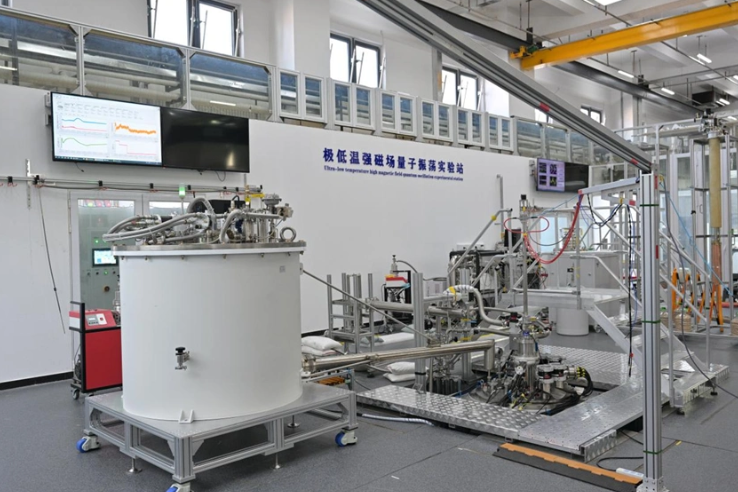
Chinese scientists have established a new global benchmark in superconducting technology by successfully developing a 35.6 tesla all-superconducting magnet, the Chinese Academy of Sciences announced Tuesday. This groundbreaking achievement represents a significant milestone in extreme magnetic field generation capabilities.
The record-setting magnet, featuring a 35-millimeter usable aperture, was engineered and tested at the Synergetic Extreme Condition User Facility. Designed specifically for research applications, this advanced instrument will provide both domestic and international scientific teams with unprecedented experimental conditions for cutting-edge investigations.
This magnetic field intensity dramatically surpasses conventional benchmarks, measuring approximately 12-24 times stronger than medical MRI systems and exceeding Earth’s natural magnetic field by over 700,000 times. Such extreme conditions enable previously impossible scientific exploration at microscopic levels.
The technological breakthrough resulted from collaborative efforts between the Institute of Electrical Engineering and the Institute of Physics under CAS. Researchers overcame substantial engineering challenges including sophisticated health monitoring systems and precision measurement techniques for high-temperature superconducting components.
This advancement establishes critical infrastructure for pioneering research across multiple disciplines including materials science, quantum physics, and life sciences. The magnet’s exceptional properties – characterized by extreme field strength, remarkable uniformity, and exceptional stability with minimal energy consumption – position it as a transformative tool for scientific discovery.
Beyond fundamental research, this superconducting technology holds substantial practical implications for national scientific infrastructure, advanced instrumentation, medical imaging technology, and next-generation applications in energy and transportation systems. The achievement demonstrates China’s growing capabilities in high-tech research infrastructure development with potential global scientific impact.