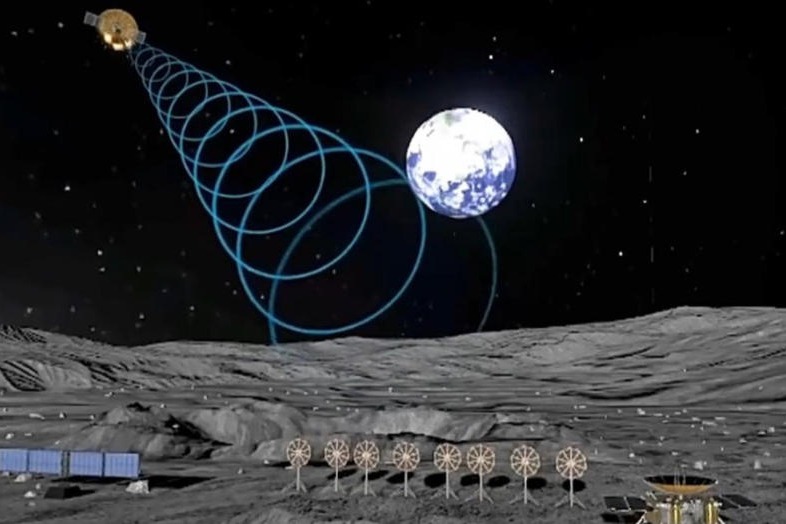
China’s ambitious next step in lunar exploration is on track for liftoff in the second half of 2026, with the Chang’e 7 robotic probe now fully prepared for final pre-launch operations at its coastal launch site, China’s human spaceflight authority has confirmed.
As of April 9, all structural components and scientific instruments of the Chang’e 7 probe have arrived at the Wenchang Space Launch Center in southern China’s Hainan Province, transported via a combination of air and road shipments, according to an official statement from the China Manned Space Agency (CMSA). In the coming months, engineering teams will complete on-site assembly of the spacecraft and conduct a full suite of functionality and integration tests to confirm the probe is flight-ready.
The core objective of the Chang’e 7 mission is to map the unique geological environment and natural resource reserves of the moon’s south polar region, an area that has emerged as a high-priority target for global lunar exploration in recent years. To achieve this goal, the mission will pursue major breakthroughs in several cutting-edge space technologies, including high-accuracy soft landing on the uneven lunar surface, legged rover mobility, and controlled hopping detection for permanently shadowed craters – regions that never receive sunlight and are thought to hold large deposits of water ice.
Unlike previous lunar missions that relied on a single flight architecture, Chang’e 7 will use a combined multi-phase operation approach: an orbiter will survey the region from lunar orbit, while a lander, a mobile rover, and a small hopping flying probe will conduct on-site surface investigations. The mission will also host multiple collaborative scientific projects with international research institutions, underscoring China’s commitment to open space exploration.
In a notable shift from past Chang’e program announcements, CMSA, rather than the China National Space Administration (CNSA), which has overseen robotic lunar exploration updates for decades, released this latest progress update. Agency officials explained the change is part of a broader plan to integrate China’s existing capabilities in both manned lunar exploration development and unmanned robotic lunar research.
“By combining the technological advances and decades of mission experience accumulated through both the national manned space program and the Chang’e robotic exploration initiative, we can greatly improve the overall efficiency of China’s lunar exploration efforts,” the statement noted.
Per pre-launch mission design documents, Chang’e 7 consists of four integrated modules: the orbiter, lander, rover, and the small hopping flying probe. The latter craft is specifically engineered to descend into permanently shadowed craters to search for and analyze water ice, a resource that is critical for future long-term human lunar outposts and deep space exploration missions. In a nod to international collaboration, the probe carries six scientific payloads developed by research teams from around the world. These include laser retroreflector arrays from Italy’s National Institute for Nuclear Physics Frascati National Laboratory, a lunar dust and electric field instrument from the Russian Academy of Sciences’ Space Research Institute, and an international lunar-based telescope from the International Lunar Observatory Association.
China’s Chang’e program has already completed six landmark robotic lunar missions since its inception, cementing the country’s position as a global leader in deep space exploration. Previous missions have achieved a series of historic firsts: Chang’e 3 and Chang’e 4 successfully deployed two rovers on the lunar near side and far side respectively, while Chang’e 5 and Chang’e 6 retrieved lunar surface samples from both the near and far sides of the moon – a feat no other space program has accomplished to date.
With pre-launch preparation moving forward according to schedule, Chang’e 7 is set to open a new chapter of detailed scientific exploration of the lunar south pole, generating data that will inform both future unmanned research and China’s planned manned lunar landing missions targeted for before 2030.