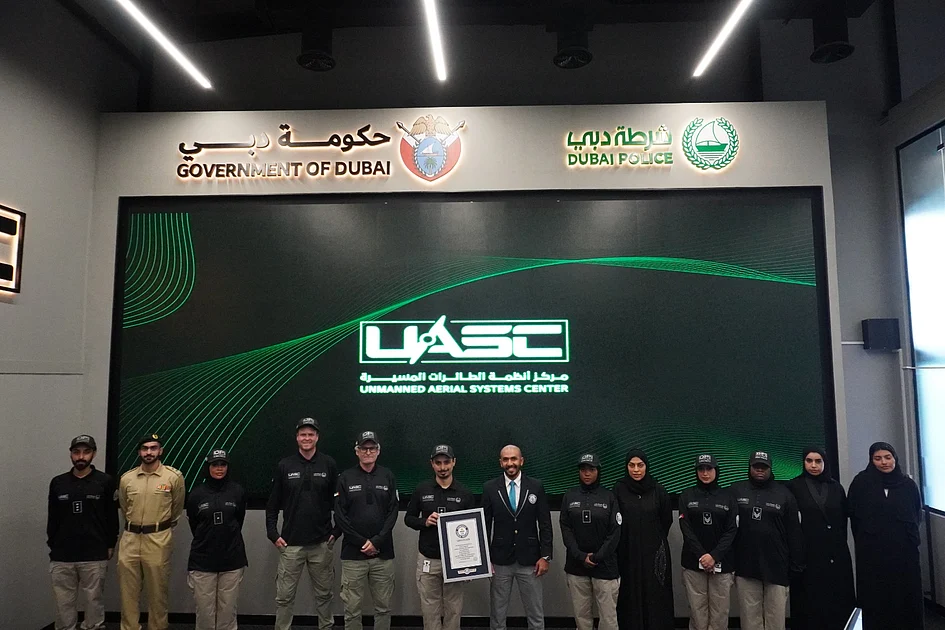
Dubai Police has etched its name in the annals of technological innovation by setting a new Guinness World Record for the fastest drone ever developed. The unmanned aerial vehicle, crafted at the Dubai Police Unmanned Aerial Systems Center, achieved a staggering top speed of 580 kilometers per hour. This remarkable feat was accomplished in collaboration with South African developers Luke Bell and Mike Bell, who previously held the record with their Peregreen 2 drone, which peaked at 510 km/h in June 2024. The newly unveiled Peregreen 3, a battery-powered remote-controlled quadcopter, now officially holds the title for the ‘fastest ground speed by a battery-powered RC quadcopter.’ The record-breaking flights were conducted at Al Qudra in Dubai, where the drone completed two runs in opposite directions to neutralize any wind advantage. Dubai Police emphasized that this achievement underscores their commitment to leveraging cutting-edge technology to bolster security, enhance rapid response capabilities, and ensure operational readiness. The milestone aligns with Dubai’s broader vision of fostering innovation and integrating smart systems into public safety frameworks.
分类: technology
-

Samsung users report ‘unremovable’ Israeli bloatware AppCloud on devices
Samsung, the South Korean tech giant, is embroiled in a global controversy as users and cybersecurity experts raise alarms over pre-installed bloatware on its devices. The software in question, AppCloud, initially reported in Samsung Galaxy A and M series phones in West Asia and North Africa, has now been found in devices across Europe and South Asia. Users claim the app is unremovable without root access, the highest level of system control, raising significant privacy and ethical concerns.
AppCloud, linked to the Israeli firm ironSource, has been accused of secretly harvesting user data and lacking a transparent privacy policy. IronSource, now owned by American company Unity, has a notorious history of creating invasive programs that bypass user permissions and security checks. Despite being disabled, AppCloud persists on devices, reappears after updates, and can covertly install additional software.
Digital rights organization SMEX has highlighted these issues, noting that Samsung’s terms of service fail to address AppCloud or ironSource explicitly. In May, SMEX sent an open letter to Samsung, but the company has yet to respond. The issue has gained traction online, with users sharing screenshots of AppCloud’s extensive permissions, including full network access and the ability to download files without notification.
Cybersecurity experts warn that while AppCloud’s behavior doesn’t confirm it as classic spyware, its aggressive data collection and unremovable nature blur the line between ad-tech and surveillance. As the controversy grows, Samsung faces mounting pressure to address these privacy concerns and provide users with greater control over their devices.
-

Tenable named a leader in the 2025 Gartner Magic Quadrant for Exposure Assessment Platforms
Tenable (NASDAQ: TENB), a leading exposure management company, has been recognized as a Leader in the inaugural 2025 Gartner Magic Quadrant for Exposure Assessment Platforms. The company achieved the highest position for Ability to Execute and was placed furthest to the right for Completeness of Vision. This recognition underscores Tenable’s leadership in the rapidly evolving cybersecurity landscape. Additionally, Tenable was named a Leader in both the IDC MarketScape: Worldwide Exposure Management 2025 Vendor Assessment and The Forrester Wave: Unified Vulnerability Management, Q3 2025. Tenable’s mission is to help organizations understand and mitigate risk by providing a comprehensive view of vulnerabilities across modern attack surfaces, including AI, cloud, IT, identity, third-party systems, web applications, and operational technology (OT). The Tenable One Exposure Management Platform offers organizations actionable insights to identify and address exposures swiftly. Mark Thurmond, co-CEO of Tenable, emphasized the significance of this recognition, stating, ‘Being named a Leader in the first Gartner Magic Quadrant for Exposure Assessment Platforms validates our proactive approach to cybersecurity. We’ve moved beyond reactive measures to help customers stay ahead of threats.’ Tenable’s platform integrates risk-based analytics and over 300 ecosystem integrations, trusted by more than 44,000 organizations globally. The company’s focus on Continuous Threat Exposure Management (CTEM), a framework introduced by Gartner, has positioned it as a pioneer in the shift from vulnerability management to exposure management. Thurmond added, ‘In an era where AI is weaponized, detection and response alone are insufficient. Exposure management provides a preemptive, holistic view of the attack surface, and Tenable One is uniquely equipped to deliver this.’
-

UAE: Deepfakes now so real ‘you can’t tell Zoom from fake videos,’ expert warns
The rapid advancement of deepfake technology has reached a point where distinguishing between real and fabricated videos is nearly impossible, according to experts. At the Dubai Business Forum–USA Edition, Ben Colman, CEO and Co-founder of Reality Defender, highlighted the growing dangers of synthetic media. He emphasized that deepfakes, which can now be created in minutes, pose significant risks to individuals, businesses, and governments. Colman noted that even a single image or a few seconds of audio can be used to create convincing fake videos, making it alarmingly easy for malicious actors to spread misinformation or damage reputations. The UAE, with its push to become a global tech hub, is at the forefront of addressing these challenges. UAE Economy Minister Abdullah Bin Touq Al Marri recently condemned a series of deepfake videos falsely depicting him promoting investment schemes, urging the public to rely on official channels for accurate information. Colman also warned that AI tools are becoming increasingly accessible, enabling even non-experts to launch sophisticated cyberattacks. To combat this, Reality Defender has developed advanced detection tools capable of identifying AI-generated content in real-time. However, Colman cautioned that as deepfake technology continues to evolve, the line between reality and fabrication will only blur further, making vigilance and verification more critical than ever.
-

FVC and X2O Media announce strategic partnership to drive next-gen hybrid communication solutions across MEA
FVC, a prominent provider of unified communications, audio-visual solutions, and cybersecurity across the Middle East and Africa, has entered into a strategic partnership with X2O Media, a global leader in visual communication and immersive hybrid collaboration technologies. This collaboration is set to transform the landscape of hybrid communication and learning across the MEA region by combining FVC’s extensive regional expertise and distribution network with X2O Media’s innovative X2O oneroom platform and unified visual communication solutions. The partnership will enable enterprises, educational institutions, and public-sector organizations to deploy immersive hybrid learning and meeting environments, enhance workforce collaboration through dynamic messaging and digital signage, and leverage FVC’s robust regional presence for seamless deployment and support. Rob Brinklow, Director of Sales for EMEA & APAC at X2O Media, emphasized the significance of this collaboration, stating that FVC’s market reach and commitment to high-quality service make it the ideal partner to bring X2O oneroom to the region. Parag, Managing Director of FVC, expressed enthusiasm about introducing X2O Media’s cutting-edge technologies to regional clients, highlighting the partnership’s potential to deliver tailored, future-ready solutions that address real business challenges. The alliance will accelerate the adoption of X2O Media’s technologies across various sectors, including corporate, education, life sciences, and government, offering clients advanced visual communication platforms that integrate immersive hybrid environments with real-time collaboration and centralized content delivery.
-

Traffic drones, automated public transport: 9 deals to ease Abu Dhabi commutes
Abu Dhabi is taking a giant leap toward revolutionizing urban transportation with the signing of nine strategic agreements aimed at creating a smart, safe, and sustainable mobility ecosystem. These initiatives, unveiled during the DRIFTx 2025 event as part of the Abu Dhabi Autonomous Week, span across air, land, and sea, showcasing the emirate’s commitment to cutting-edge technology and innovation. The Integrated Transport Centre (ITC), in collaboration with global and national partners, is spearheading these efforts to transform the way residents and visitors navigate the city. Key projects include AI-powered traffic-monitoring drones, personal driverless vehicles, mini robo-buses, electric air taxis, and autonomous marine vessels. Additionally, the agreements focus on enhancing connectivity through 5G and 5.5G networks, bolstering cybersecurity, and advancing autonomous logistics with self-driving trucks and cargo drones. These initiatives not only aim to reduce congestion and emissions but also to improve first- and last-mile connectivity, ensuring a seamless and eco-friendly transportation experience. With these partnerships, Abu Dhabi is positioning itself as a global leader in smart mobility, setting a benchmark for other cities to follow.
-

CNS Sichuan achieves desired results on its maiden sea trial
China’s first Type 076 amphibious assault ship, the CNS Sichuan, has successfully concluded its maiden sea trial, marking a significant milestone in the nation’s naval advancements. The vessel, which is the largest and most advanced of its kind in China, returned to the Hudong-Zhonghua Shipbuilding yard in Shanghai on Sunday afternoon after a three-day voyage. During the trial, engineers meticulously tested and verified the ship’s electric, propulsion, and other critical systems, achieving the desired results. Further tests are planned as part of the ship’s construction blueprint. The Sichuan, with a hull code of 51, displaces over 40,000 metric tons and is equipped with an electromagnetic catapult system, making it the first Chinese amphibious assault ship capable of deploying fixed-wing drones. This technology, previously seen only on the CNS Fujian aircraft carrier, underscores China’s growing prowess in naval innovation. Once commissioned, the Sichuan will support a range of operations, including amphibious landings, airstrikes, and airborne missions. The PLA Navy currently operates four Type 075 amphibious assault ships, each with a full displacement of nearly 40,000 tons, built at the same Shanghai shipyard.
-

Museums turn to technology for relics care
At the 27th General Conference of the International Council of Museums in Dubai, officials and scholars emphasized the pivotal role of museums as custodians of civilization. The event, the largest global gathering of museum professionals, highlighted the importance of integrating new technologies and engaging younger generations to protect cultural heritage and foster mutual understanding among civilizations. Hala Badri, Director-General of Dubai Culture and Arts Authority and chairwoman of the conference’s organizing committee, underscored the shared commitment to leveraging digital transformation, artificial intelligence (AI), and virtual interaction to create inclusive and impactful cultural experiences. Harith Al Battashi, an expert from the National Museum of Oman, stressed that attracting and nurturing young talent is central to museums’ missions. He praised the Chinese video game *Black Myth: Wukong* as a groundbreaking example of how cultural heritage can be promoted globally through youth-centric mediums. The game, which integrates Chinese folklore, has sparked international interest and bridged the gap between tradition and modern youth culture. At the conference, Zhejiang University’s Department of Cultural Heritage showcased the International Alliance of Teaching Museology in Universities, an initiative aimed at advancing global museum education and professional training. The alliance, comprising nearly 20 members from East Asia, Europe, and North America, seeks to foster collaboration with Middle Eastern universities to develop a more open museology education system. Chinese companies like Bangda Group also demonstrated their innovative solutions for cultural relic preservation, including earthquake-resistant storage facilities with real-time environmental monitoring. Omar Al Kaabi, an official from Abu Dhabi’s Department of Culture and Tourism, announced the upcoming opening of the Zayed National Museum, which will utilize VR and AI technologies to showcase the UAE’s rich cultural history. He expressed openness to adopting Chinese technologies for heritage protection and promotion.
-

Formula 1 tech used to rev-up train wi-fi speeds in new pilot
In a groundbreaking initiative, Great Western Railway (GWR) is set to revolutionize train Wi-Fi by implementing a hybrid system that combines signals from ground-based mobile phone masts and low earth orbit (LEO) satellites. This UK-first pilot scheme, developed by British tech company Motion Applied in collaboration with Peninsula Transport, aims to deliver faster and more reliable internet connectivity for passengers. The technology, originally designed for Formula 1 cars, will be tested for 60 days on GWR’s Intercity Express Train in the South West region, starting mid-November. The project is part of a broader effort to modernize transport infrastructure across Cornwall, Devon, Plymouth, Somerset, and Torbay. According to a recent study by Ookla, the UK ranks 16th out of 18 major European and Asian countries for train Wi-Fi speed, with average download speeds at just 1.09 megabits per second. Nick Fry, chairman of Motion Applied, highlighted the parallels between high-speed internet connectivity in trains and motorsport, emphasizing the potential of LEO satellites to ensure seamless connections. The Department of Transport has allocated £41 million in the 2025 spending review to introduce LEO satellite connectivity on all mainline trains by 2030. Councillor Dan Rogerson from Peninsula Transport described the pilot as a ‘major milestone’ in enhancing digital infrastructure, while Bruce Williamson of Railfuture welcomed the initiative as a positive step towards meeting the growing demand for reliable Wi-Fi among travelers.
-
Hackers steal maternity ward CCTV videos in India cybercrime racket
Indian authorities have uncovered a sprawling cybercrime operation involving the hacking and sale of sensitive CCTV footage from hospitals and other institutions across the country. The breach, which compromised over 50,000 surveillance systems, has raised significant concerns about privacy and cybersecurity in India, where CCTV cameras are ubiquitous. The investigation began after videos from a maternity hospital in Gujarat were discovered on YouTube and Telegram, showing intimate medical procedures involving pregnant women. These videos were linked to Telegram channels where longer clips were sold for 800–2,000 rupees ($9–22). The hospital director claimed the cameras were installed to protect doctors from false allegations, but they have since been removed from sensitive areas. Police have arrested eight individuals connected to the racket, charging them with violations of privacy, voyeurism, and cyber terrorism. Cybersecurity experts warn that poorly secured systems, often using default passwords, are vulnerable to hacking. They recommend robust passwords, regular audits, and manufacturer warnings to improve security. The case highlights the broader issue of inadequate cybersecurity measures in India, where surveillance systems are widely used but often lack proper safeguards.