The lighting hub in Guzhen township, Zhongshan, Guangdong province, has launched a cutting-edge AI platform aimed at bolstering its competitive edge in the global market. The platform was unveiled during the recent four-day international lighting fair, which concluded on Saturday. Designed to streamline research, design, marketing, and service operations for local manufacturers, the platform is built on a self-developed vertical AI model. It integrates real-time data across the supply chain, offering a comprehensive solution to enhance efficiency and innovation. The initiative is a collaborative effort involving the Guzhen township government, telecom companies, and local lighting enterprises. Officials emphasized that the platform will serve as a catalyst for transforming the lighting industry, enabling businesses to adapt to evolving market demands and technological advancements.
分类: technology
-

Conference exhibits Shanghai’s smart city models
The 2025 SDG Cities Global Conference commenced in Shanghai on Sunday, highlighting the city’s pioneering role in advancing sustainable urban development worldwide. The event unveiled the latest edition of the Shanghai Manual, a comprehensive document featuring 21 case studies from 11 countries. These case studies span diverse areas such as urban planning, economic revitalization, community governance, transportation, cultural tourism, climate and energy, ecological protection, and digital governance. The manual serves as a vital resource for cities globally, offering replicable models and policy insights for creating people-centered smart cities.
Among the showcased examples, eight are from China, with two standout initiatives from Shanghai. The Dongming Road community in Pudong New Area leverages modern technologies to enhance youth participation, addressing the live-work separation challenge faced by younger residents. The community developed a mobile app featuring a 3D replica of the area, augmented reality oral history systems, and gamified elements to foster engagement and rediscovery of the neighborhood.
Another notable example is the Shanghai metro’s smart maintenance project, which represents the nation’s first complete digital transformation in rail transit. Integrating industrial internet, artificial intelligence, big data, and cloud computing, the project shifts from reactive maintenance to proactive real-time monitoring, significantly improving efficiency and reducing response times.
The conference also introduced the Shanghai Award, an international accolade recognizing cities excelling in sustainable development. Jointly presented by the United Nations Human Settlements Programme and the Shanghai government, the award aims to amplify the voices of developing and least developed countries in global governance.
Shanghai’s influence extends beyond its borders, with its ’15-minute community life circles’ concept gaining traction globally. This model, which ensures all essential services are within a 15-minute walk, has inspired cities like Paris and Milan. Additionally, the conference released international standards for green block design, developed by the World Green Design Organization, with plans for global expansion.
Experts and delegates lauded Shanghai’s innovative approaches, emphasizing their potential to shape the future of urban development worldwide.
-

China’s C919 jet faces turbulent skies amid US-China trade tensions
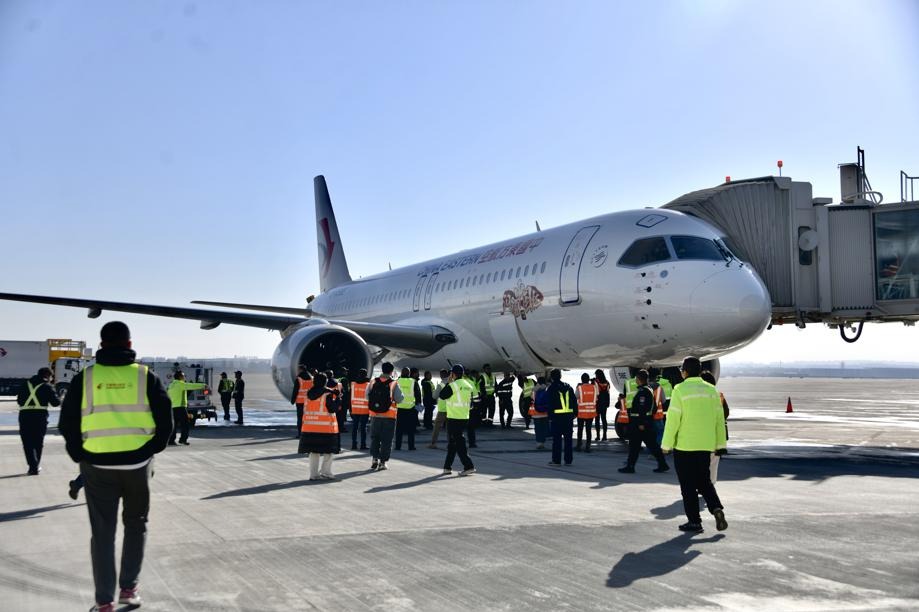
China’s ambitious endeavor to rival global aviation giants Boeing and Airbus with its domestically developed C919 passenger jet is encountering significant hurdles. Despite Beijing’s vision of technological self-reliance, the project is grappling with production delays, geopolitical tensions, and reliance on Western components. The C919, a single-aisle aircraft manufactured by state-owned COMAC, has fallen short of its 2023 delivery targets, with only seven units delivered as of October, compared to the planned 30 by 2025.
-

Japan successfully launches new cargo spacecraft to deliver supplies to International Space Station
Japan’s space agency, JAXA, achieved a significant milestone on Sunday with the successful launch of its new flagship H3 rocket. The mission, which carried the unmanned HTV-X1 cargo spacecraft, marks Japan’s latest effort to deliver supplies to the International Space Station (ISS). The launch took place at the Tanegashima Space Center in southern Japan, where the HTV-X1 was successfully placed into its planned orbit. If all goes according to plan, the spacecraft is expected to dock with the ISS in a few days, with Japanese astronaut Kimiya Yui set to retrieve it using the station’s robotic arm. The HTV-X1 is the successor to JAXA’s H-II Transfer Vehicle, known as Kounotori, which completed nine missions to the ISS between 2009 and 2020. The new spacecraft boasts enhanced capabilities, including a larger payload capacity and the ability to supply power during flight, enabling the transport of sensitive lab samples requiring low-temperature storage. Additionally, the HTV-X1 can remain connected to the ISS for up to six months, delivering supplies and retrieving waste, before embarking on a three-month technical mission in orbit. The H3 rocket, which replaces the H-2A model, is designed to be more cost-competitive in the global space market, reflecting Japan’s commitment to establishing a stable and commercially viable space transport capability. Since its failed debut in 2023, the H3 has completed six consecutive successful flights, underscoring its reliability and potential for future missions.
-

A humming annoyance or jobs boom? Life next to 199 data centres
Loudoun County, Virginia, often referred to as ‘Data Center Alley,’ is home to nearly 200 data centres spanning 45 million square metres. These facilities, which power the internet and artificial intelligence, have become a cornerstone of the global digital economy. However, their rapid expansion has sparked significant concerns among local residents.
-

China reportedly caught reverse-engineering ASML’s DUV lithography
A Chinese firm reportedly sought technical assistance from ASML, the global leader in chipmaking equipment, after failing to reassemble a deep-ultraviolet (DUV) lithography machine following an internal teardown. The incident highlights China’s ongoing challenges in replicating advanced semiconductor technology amid US sanctions. Brandon Weichert, a senior national security editor at The National Interest, revealed in a social media post that the Chinese firm dismantled an older ASML DUV machine in an attempt to reverse engineer it but encountered significant difficulties in reassembling the complex system. Weichert suggested that the firm’s actions were driven by efforts to circumvent US restrictions on advanced chipmaking equipment. However, the attempt appears to have backfired, as the machine was reportedly damaged during the process. The incident underscores the immense technical hurdles China faces in developing its own lithography systems, despite substantial investments in domestic research and development. While Chinese commentators acknowledge the challenges, they remain optimistic about the country’s progress in mastering key components of lithography technology. For instance, Professor Zhao Yongpeng of the Harbin Institute of Technology successfully developed a discharge plasma extreme ultraviolet (EUV) light source in 2024, marking a significant milestone. Nevertheless, reverse engineering ASML’s immersion DUV machines remains a formidable task due to their extreme precision, complex mechanics, and highly integrated technology. Despite these obstacles, China continues to expand its domestic lithography supply chain, with several firms making strides in optical systems, laser technology, and precision components. The Ministry of Industry and Information Technology has also endorsed domestically produced lithography systems capable of producing 130 nm and 65 nm chips, signaling gradual progress in the sector.
-

Association of IT Experts announces AITEX Summit Fall 2025 focused on deployable AI solutions
The Association of Information Technology Experts (AITEX) has unveiled plans for the AITEX Summit Fall 2025, a high-intensity event set to take place on November 1–2, 2025. This summit will bring together AI and IT professionals from across the globe to develop practical, deployable AI solutions under real-world conditions within a 48-hour timeframe. Unlike traditional hackathons, AITEX emphasizes tangible results, requiring participants to create original, functional prototypes that address complex challenges. Reused code and recycled ideas are strictly prohibited, placing a premium on innovation, execution, and real-world applicability.
The summit is designed to push the boundaries of AI development, focusing on measurable outcomes and real business and social impact. A spokesperson for AITEX highlighted the event’s mission: ‘AITEX Summit is built on the principle that innovation should be measurable and applicable. Our goal is to bring together professionals who can turn AI concepts into working solutions.’
AITEX Summit Fall 2025 is more than just an event; it is a global network of seasoned technologists from the U.S., Europe, and the Commonwealth of Independent States. Members of this network have spearheaded over 30 major technology initiatives and published more than 100 peer-reviewed articles in leading journals. The summit’s rigorous evaluation process, overseen by senior engineers, domain specialists, and product leaders from top companies like Oracle, Amazon, and Walmart, ensures that each prototype is assessed for originality, usability, and technical integrity.
Participants, including software engineers, UX designers, and data scientists, are challenged to create solutions with real-world impact. The judging criteria prioritize functionality, value creation, and scalability over mere showmanship. Amidst the rapid evolution of AI and increasing industry interest, the AITEX Summit provides a structured platform for developing enterprise AI solutions that deliver tangible results.
Beyond the competition, participants gain visibility, professional recognition, and access to a global network of peers and potential employers. AITEX Summit Fall 2025 stands as a proving ground for credible, deployable AI solutions, fostering innovation that truly matters.
-

China weighs draft amendment to cybersecurity law to better promote, regulate sound AI development
China is taking significant steps to regulate and promote the responsible development of artificial intelligence (AI) through a draft amendment to its Cybersecurity Law. The amendment, submitted for its second reading at the 18th session of the Standing Committee of the 14th National People’s Congress (NPC), aims to address the rapid growth of AI technologies and their societal implications. Key proposals include bolstering fundamental AI research, advancing critical technologies like algorithms, and establishing robust AI infrastructure. The draft also emphasizes enhancing ethical standards, strengthening security risk monitoring, and implementing stricter AI safety regulations. With China’s generative AI user base doubling to 515 million in just six months, as reported by the China Internet Network Information Center (CNNIC), these measures are deemed essential for ensuring sustainable AI development. Additionally, the amendment seeks to align with existing laws such as the Civil Code and the Personal Information Protection Law to better safeguard personal information online. It also introduces stricter legal responsibilities, including increased fines and penalties for violations, with severe offenses potentially leading to license revocation. The draft has undergone public consultation, receiving 162 opinions since its first reading in September. China’s current Cybersecurity Law, enacted in 2016, remains a cornerstone of the nation’s digital governance framework.
-

Mindfire Technologies CTO Rejeesh Kumar featured as keynote speaker at MSP Global 2025 in Barcelona
Mindfire Technologies LLC, a prominent leader in cybersecurity and managed services, proudly announced that its Chief Technology Officer, Rejeesh Kumar, was a featured keynote speaker at the prestigious MSP Global 2025 conference. The event, held on October 22–23, 2025, at the renowned PortAventura Theme Park in Barcelona, Spain, convened top managed service providers (MSPs), resellers, and industry experts to discuss the future of digital transformation, automation, and cybersecurity. Kumar’s participation highlighted Mindfire’s dedication to advancing strategic innovation in the cybersecurity domain. With over two decades of experience in technology leadership, Kumar has been instrumental in developing secure, scalable solutions for enterprises globally. As a Certified Information Systems Security Professional (CISSP), he has guided Mindfire’s evolution into a trusted partner for integrated cyber protection, offering services such as backup and disaster recovery, vulnerability assessments, and AI-driven threat detection. His expertise has enabled clients to navigate complex cyber challenges and ensure business continuity amid rising digital threats. During his keynote, Kumar emphasized the importance of leveraging emerging technologies to build resilient infrastructures. ‘MSP Global is a crucial platform for the managed services community, and we’re honored to share insights from the forefront of cybersecurity,’ he stated. ‘Barcelona’s vibrant atmosphere fosters meaningful discussions on how MSPs can transform potential threats into competitive advantages.’ The conference featured high-level networking, product launches, and sessions focused on business growth, including sales optimization, M&A strategies, and AI integration. Kumar’s presentation showcased Mindfire’s integrated cyber protection tools, drawing on nearly five years of experience with scalable platforms that enhance operational efficiency and client trust. For more information about the event and Kumar’s contributions, visit the MSP Global Speakers page.
-

iPhone 17: Why Apple’s latest lineup is a global hit
Apple’s iPhone 17 lineup has taken the global market by storm, with unprecedented demand leading to supply shortages in key regions like the UAE. Retailers report a 50% surge in foot traffic at Apple stores, driven by the overwhelming popularity of the iPhone 17 Pro and Pro Max models. Launched on September 19, the new series has already outsold its predecessor, the iPhone 16, by 14% in critical markets such as the US and China. In China alone, iPhone 17 sales during the launch week nearly doubled those of the iPhone 16, signaling a strong preference for the entry-level model, which now accounts for 22% of total sales. The Pro and Pro Max models, bolstered by carrier subsidies and upgrade deals, continue to dominate the lineup. Meanwhile, the iPhone Air, though off to a slower start, offers a niche appeal with its portability and design. Apple’s three-year innovation roadmap, starting with the iPhone 17, promises groundbreaking advancements, including foldable designs and zero-bezel screens by 2028. The iPhone 17 Pro’s camera upgrades, featuring an 8X zoom lens and enhanced video stabilization, have sparked social media trends, with users marveling at its image quality. iOS 26 introduces new customization options, while the Pro models’ orange finish has become a status symbol. Despite Apple’s quiet stance on AI advancements, the iPhone 17 lineup has successfully reignited consumer excitement, marking a significant milestone for the tech giant.