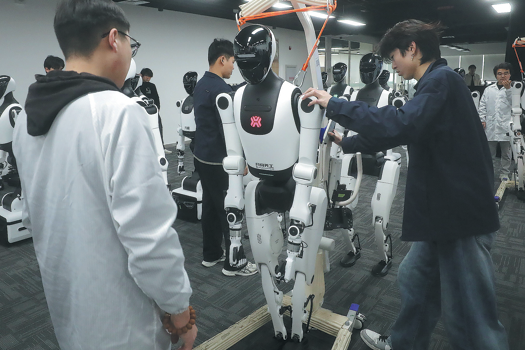
Beijing has inaugurated a groundbreaking pilot manufacturing and validation facility specifically designed for humanoid robots, signaling a strategic shift from experimental prototyping to industrialized mass production. Operated by the Beijing Innovation Center of Humanoid Robotics, this first-of-its-kind facility represents a critical infrastructure development for China’s robotics sector.
The newly commissioned platform spans approximately 9,700 square meters within Beijing’s Economic-Technological Development Area (E-town) and is equipped with 500 sets of specialized production and testing equipment. The facility boasts an annual pilot production capacity of up to 5,000 embodied humanoid robots, offering comprehensive services including prototyping, performance validation, process optimization, module assembly, and full robot integration.
This initiative addresses significant bottlenecks that have hampered the global humanoid robotics industry’s transition from research and development to commercial implementation. According to Liu Yizhang, head of the pilot platform, the industry has struggled with inadequate pilot manufacturing readiness, inconsistent standardization protocols, and discontinuous data flow from development through scale-up phases.
“Research institutions and startup ventures typically rely on costly, inefficient self-developed trial lines,” Liu explained. “The absence of standardized processes compromises quality consistency, while insufficient testing systems allow unresolved risks to persist before real-world deployment.”
The digital infrastructure forms the core of Beijing’s innovative approach. The facility operates on a unified master data platform with an integrated digital operation system that connects information and logistics networks. This enables continuous data tracking from design through production to test feedback, significantly shortening iteration cycles between prototype validation and small-batch production.
The platform’s establishment aligns with China’s broader industrial strategy. In November 2025, the Ministry of Industry and Information Technology identified humanoid robots as a priority sector requiring accelerated validation platform development. The Beijing government subsequently announced a tiered support system in January 2026, offering subsidies of up to 100 million yuan ($14.39 million) for newly established pilot facilities.
The initiative already demonstrates tangible economic impact. According to the Beijing Municipal Bureau of Economy and Information Technology, the city’s robotics industry revenue grew by nearly 40% in the first half of 2025. Beijing additionally leads China in hosting specialized “little giant” enterprises within the robotics sector—small and medium-sized firms recognized for their innovation capabilities and market specialization.
The center plans further expansion through national research and development projects, positioning Beijing at the forefront of global humanoid robotics manufacturing capabilities.