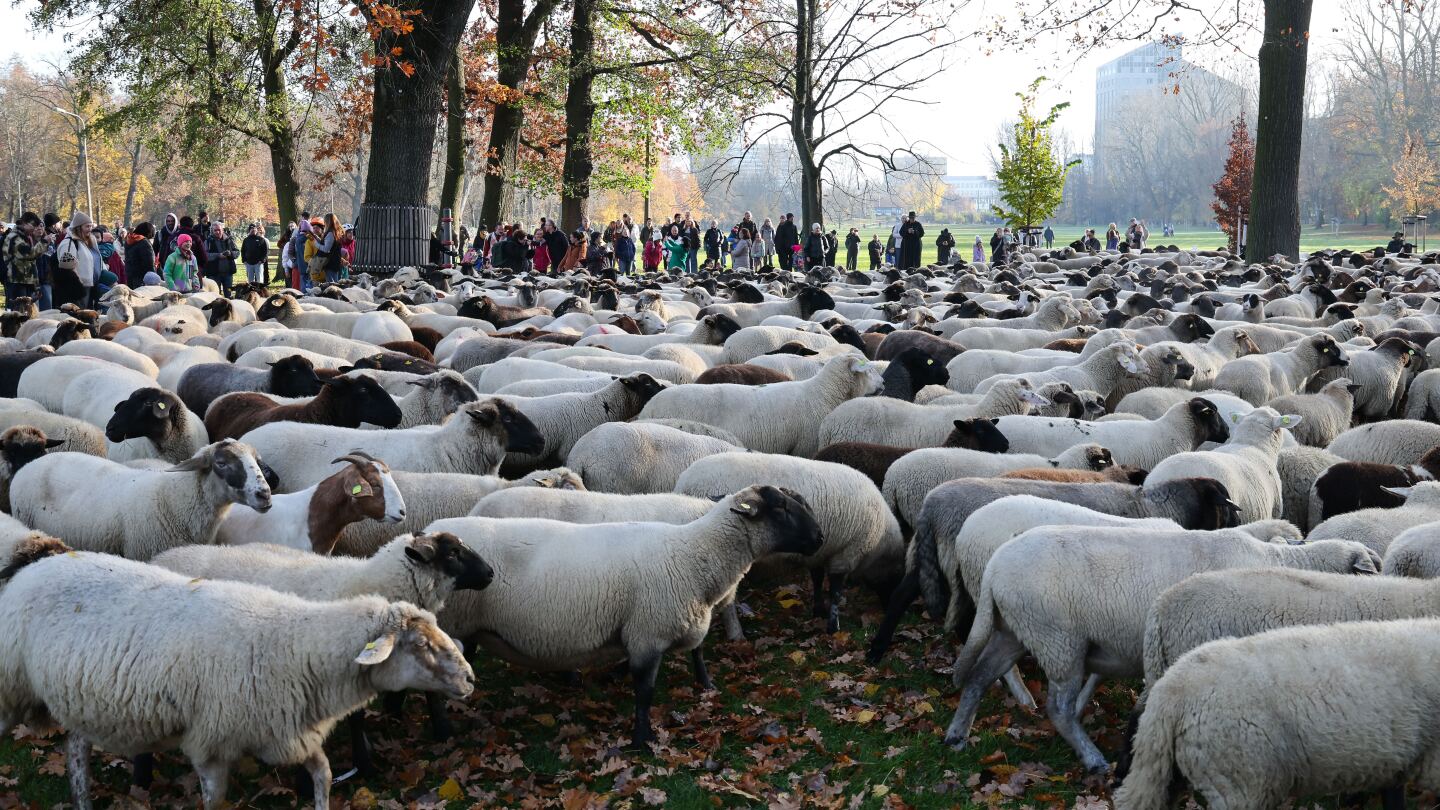
In a charming annual tradition, the streets of Nuremberg, Germany, were transformed into a pastoral scene on Sunday as hundreds of sheep paraded through the city center. The flock, led by shepherd Thomas Gackstatter, comprised approximately 600 sheep, drawing curious onlookers who eagerly captured the spectacle on their cellphones. The event marks the sheep’s journey from their summer grazing grounds in Nuremberg’s meadows to their winter pastures located west of the city. The 10-kilometer (6-mile) route took the flock through the iconic Hauptmarkt, the central market square, making Nuremberg the only known German city where sheep traverse such a prominent urban space. City authorities ensured a smooth passage by urging residents to keep the route clear and keep dogs away. Drones were also prohibited during the event. This practice of using sheep as natural lawnmowers is not unique to Nuremberg; cities like Berlin, Potsdam, and Augsburg also employ sheep for eco-friendly grass maintenance. The slow grazing process supports biodiversity by creating insect-friendly environments and reduces municipal mowing costs. For shepherds like Gackstatter, this arrangement provides a valuable solution to the scarcity of open grazing spaces.
分类: society
-
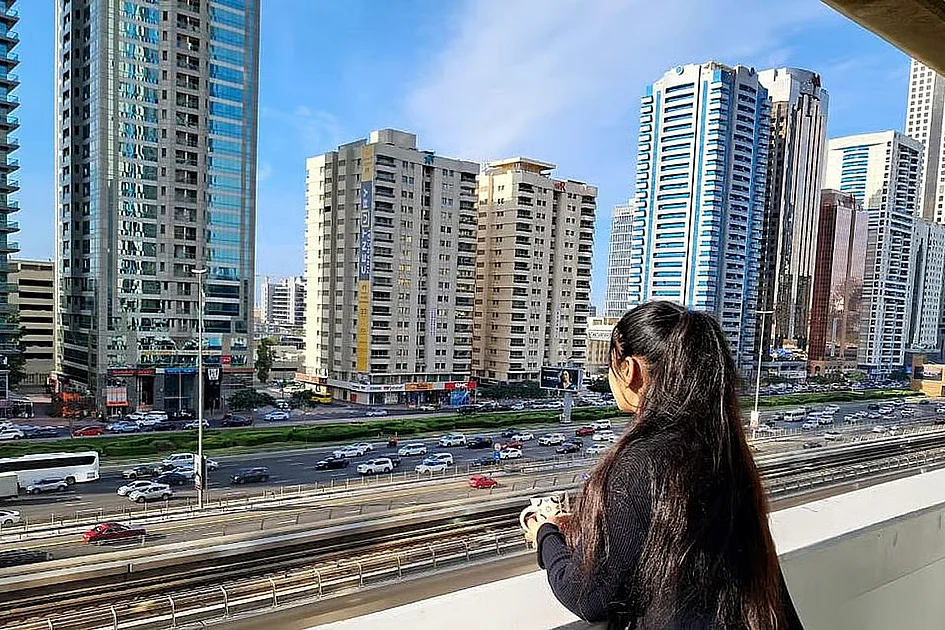
Dubai: Can a landlord charge different rents to tenants of the same building?
In celebration of the 54th Eid Al Etihad, the Sharjah government has announced a five-day paid holiday for its employees, marking a significant gesture of recognition for this national occasion. Simultaneously, the UAE has declared a holiday for both public and private schools, ensuring that students and educators alike can partake in the festivities. This decision underscores the nation’s commitment to honoring its cultural heritage and fostering unity among its citizens. The extended break provides an opportunity for families to come together and celebrate the spirit of the occasion. The announcement has been met with widespread appreciation, as it reflects the government’s dedication to enhancing work-life balance and acknowledging the importance of national milestones.
-

UAE: Is it legal for employees with families to be given priority for annual leave dates?
In the UAE, the allocation of annual leave dates has sparked questions among employees, particularly those without families, who wonder if it is legal for employers to prioritize families during school breaks. According to UAE labor laws, employees are entitled to a minimum of 30 calendar days of annual leave per year of service, as stipulated in Article 29(1)(a) of the Employment Law. However, Article 29(4) grants employers the authority to determine leave dates based on operational needs, provided they notify employees at least one month in advance. This means employers can prioritize families during peak holiday periods, such as school breaks, to accommodate their needs. Nevertheless, employers must ensure that all employees receive their full annual leave entitlement within the year or allow them to carry forward at least 50% of their leave to the following year, as per Article 29(8). Employees are encouraged to discuss alternative leave dates with their employers to reach a mutually agreeable solution. Ashish Mehta, founder of Ashish Mehta & Associates, emphasizes the importance of understanding these legal provisions to navigate leave-related disputes effectively.
-
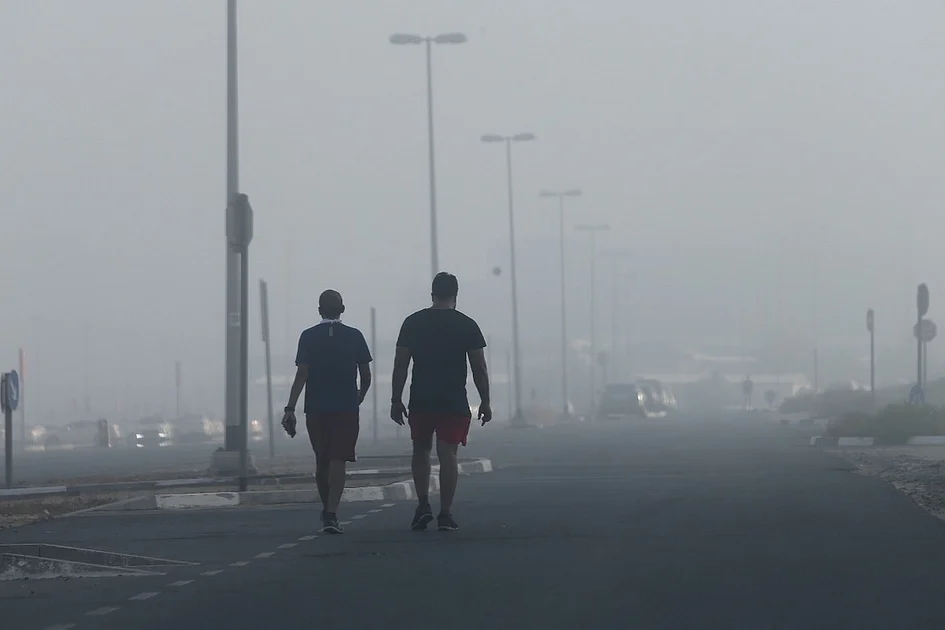
UAE weather: Lowest temperature 19°C in Dubai; fog expected in some parts
As winter sets in across the United Arab Emirates, temperatures have begun to drop significantly, marking a shift in the region’s weather patterns. On Saturday, November 15, 2025, the National Centre of Meteorology reported the lowest temperature of 11.7°C in Mezaira, located in the Al Dhafra Region, at 6:15 AM. This cooling trend is expected to continue, with Dubai forecasted to experience a low of 19°C on Sunday, while Abu Dhabi and Sharjah will see temperatures of 20°C and 18°C, respectively. Meanwhile, the highest temperature recorded on Saturday was 35°C in Sweihan, Al Ain, at 2 PM. On Sunday, Sharjah, Dubai, and Abu Dhabi are expected to reach a maximum of 31°C. The UAE’s skies will remain fair to partly cloudy, with low clouds forming over the sea and islands. Humidity is anticipated to increase by night and into Monday morning, particularly in coastal and internal areas, raising the likelihood of fog or mist formation. Light to moderate southeasterly to northeasterly winds, ranging from 10-20 km/h and occasionally reaching 30 km/h, will prevail. The Arabian Gulf and Oman Sea will experience slight sea conditions. Residents are advised to stay updated on weather developments as the season progresses.
-

Nearly 70 schools to close in Australia over fears of asbestos in play sand
In a significant public health response, 69 schools across the Australian Capital Territory (ACT) will remain closed on Monday following the recall of colored play sand due to asbestos contamination risks. The recall, initiated by major retailers Kmart and Target on Saturday, was prompted by the discovery of asbestos traces in some product samples. The Australian Competition & Consumer Commission (ACCC) has assessed the risk of asbestos becoming airborne as ‘low,’ but authorities are taking no chances. ACT Education Minister Yvette Berry confirmed that air testing across all schools has so far returned negative results for airborne asbestos. However, comprehensive inspections are ongoing and may take several days to complete. This development follows the partial or full closure of several schools and preschools in the region last Friday, triggered by similar asbestos concerns in sand products sold by Officeworks. The issue has also extended to New Zealand, where at least two schools are set to close for testing on Monday. Berry emphasized that the recalled sand products are more widely used in ACT schools than the Officeworks items, necessitating a broader response. Over the weekend, State Emergency Service volunteers and school staff conducted thorough inspections, mapping all colored sand in school premises. The ACT government has assured the public that individuals exposed to the products do not require clinical assessments, but the government is committed to eliminating risks ‘as much as reasonably practicable.’ Meanwhile, 23 schools will remain open, either due to minimal stock or the absence of the recalled products. The affected items include the Active Sandtub 14-piece Sand Castle Building Set and Blue, Green, and Pink Magic Sand. Asbestos, a hazardous material once commonly used in construction, can release toxic fibers when disturbed, posing long-term health risks such as cancer. Both Australia and New Zealand strictly prohibit the import or export of asbestos-containing goods.
-
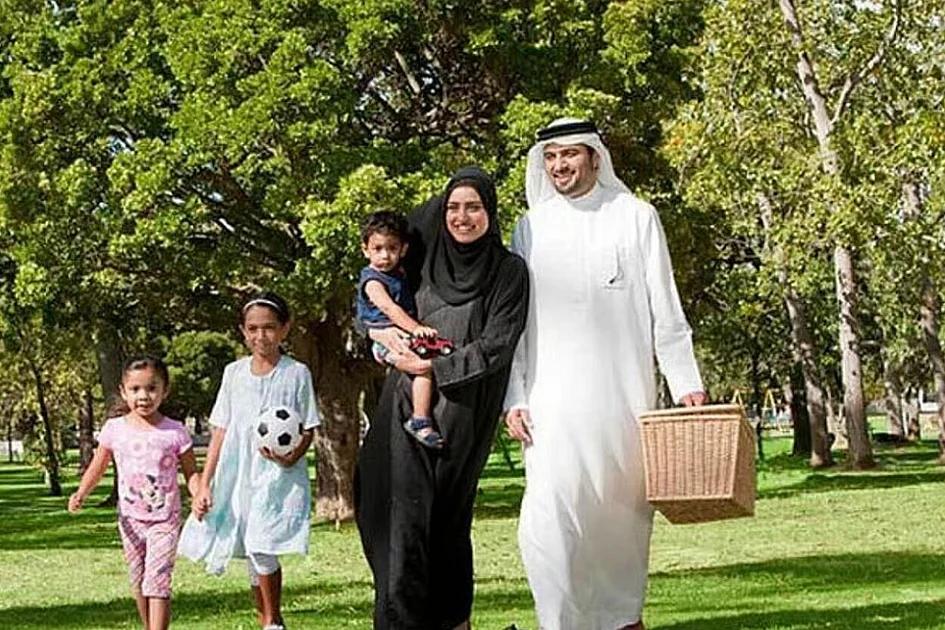
Flexible work, marriage leave: UAE rolls out benefits for parents ahead of ‘Year of Family’
In anticipation of the UAE’s designation of 2026 as the ‘Year of the Family,’ local governments across the Emirates are rolling out a series of progressive policies aimed at enhancing work-life balance and supporting working parents. These initiatives focus on integrating family responsibilities with professional life, offering flexibility and comprehensive support to strengthen the modern family unit.
Ajman has taken a leading role with a comprehensive overhaul of its Human Resources law for government employees. Key provisions include flexible working hours and remote work options, extensive family leave such as enhanced maternity and paternity leave, marriage leave, childcare leave, and bereavement leave. Additionally, pregnant employees and those raising five or more children will benefit from increased work-hour flexibility.
Dubai and Sharjah have introduced paid marriage leave policies to support the formation and stability of new families. Dubai offers 10 working days of fully paid marriage leave to Emirati nationals, including all salary allowances, effective from 2025. Sharjah provides eight days of paid marriage leave and a unique ‘Care Leave’ for female employees who give birth to a sick child or a child with disabilities requiring constant care.
Abu Dhabi has focused on social and civil family law reforms, particularly for its non-Muslim expatriate community. The 2021 Civil Family Law introduced a secular alternative to Sharia-based personal status laws, offering civil options for marriage, divorce, and custody. Key features include legal registration of civil marriages, a non-fault divorce process, and equal custody rights for both parents. The Abu Dhabi Global Market (ADGM) has also extended maternity leave rights to female employees who adopt a child under five years old or experience a stillbirth or miscarriage after 24 weeks.
These initiatives build upon federal reforms, including five days of paid parental leave for all working parents within the first six months of a child’s birth, extended child custody to the age of 18, and equal travel rights for both parents. These measures reflect the UAE’s commitment to promoting shared parental responsibility and enhancing family well-being.
-

Unconfirmed number of deaths following two-car crash
A tragic road traffic accident in County Louth, Republic of Ireland, has resulted in multiple fatalities, with an unconfirmed number of deaths reported. The incident occurred on Saturday evening shortly after 21:00 local time on the L3168 Ardee Road in the townland of Gibstown, Dundalk. According to Gardaí (Irish police), the collision involved two vehicles, and the scene remains active with both vehicles and the bodies of the deceased still present. Emergency services transported several injured individuals to Our Lady of Lourdes Hospital in Drogheda for treatment. The road between the N52 and R171 remains closed as Garda Forensic Collision Investigators conduct a technical examination. Local traffic diversions have been implemented to manage the situation. Authorities are urging anyone who may have witnessed the collision to come forward and assist with the investigation.
-
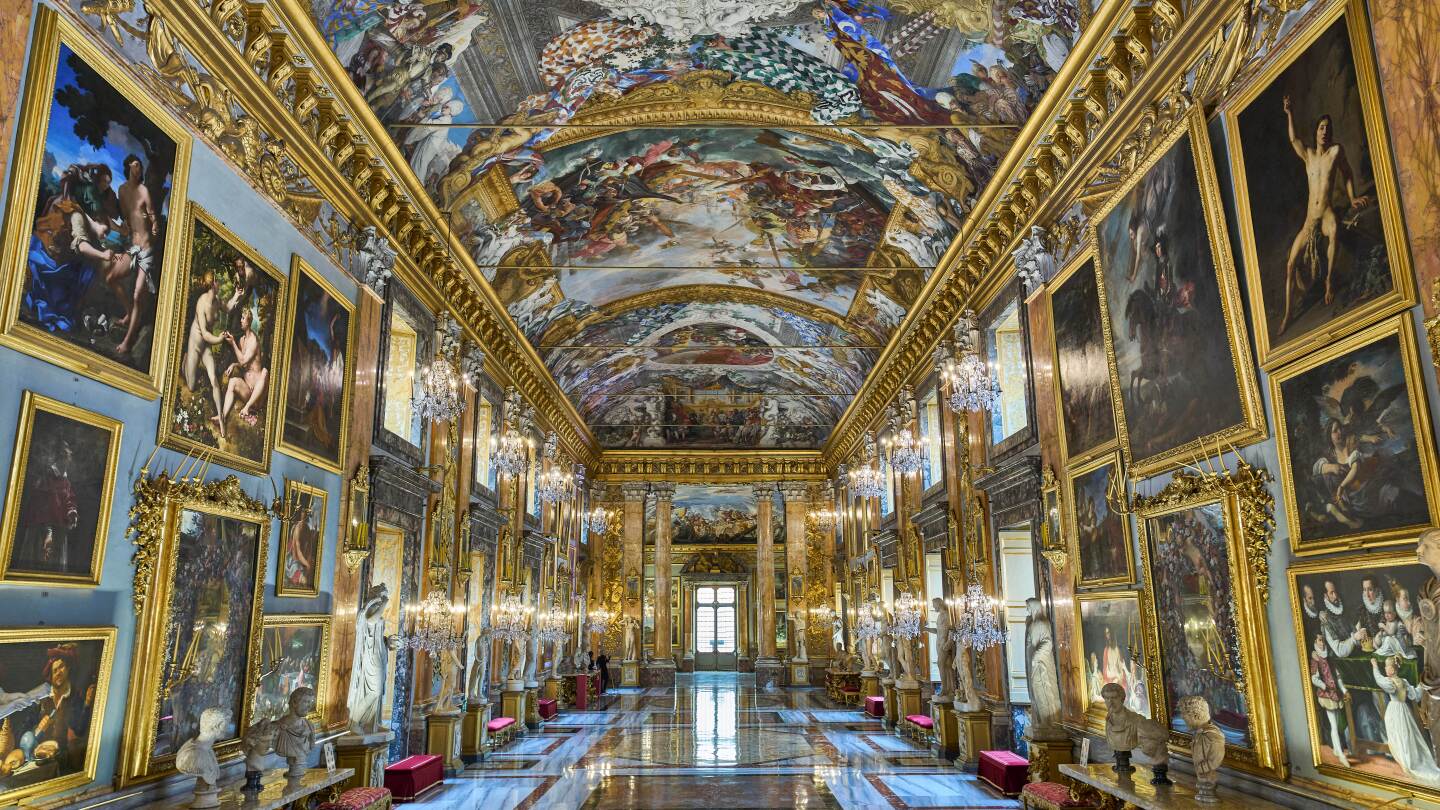
A peek inside the Colonna Palace, Rome’s most exclusive tourist site
Nestled in the heart of Rome, the Colonna Palace remains one of the city’s best-kept secrets, a private home-museum that stands in stark contrast to the bustling tourist hubs of the Colosseum and the Sistine Chapel. Spread across four wings and occupying an entire city block, this baroque masterpiece houses an extraordinary collection of paintings, sculptures, busts, and tapestries, including the awe-inspiring 76-meter Great Hall. Yet, its doors open only sparingly, welcoming small groups of 10 visitors on Friday and Saturday mornings, guided by art historians. ‘Mass tourism is not our wish,’ explains Elisabetta Cecchini, a restorer at the palace, emphasizing that the limited access ensures the preservation of its artistic integrity. ‘Art dies without public appreciation, but this is not a museum meant for commodification.’
The palace remains the residence of Don Prospero Colonna, the family’s sitting prince, who has occasionally permitted high-profile events, such as the 2005 release of Pope John Paul II’s book and the 2018 Metropolitan Museum of Art exhibition on Catholic fashion, attended by luminaries like designer Donatella Versace and Vogue’s Anna Wintour. These rare occasions have allowed journalists fleeting glimpses into this exclusive world. Claudio Strinati, a former superintendent of Rome’s museums, lauds the palace’s seclusion, calling it ‘one of humanity’s greatest artistic heritages’ and a legacy the Colonna family is duty-bound to protect. ‘These spaces were not conceived as tourist attractions,’ he notes. ‘They are for those who truly understand history.’
The Colonna family’s ties to the palace date back to the 12th century, when they became part of the ‘black nobility,’ Roman families loyal to the Pope during Italy’s unification in 1870. Their black banners symbolized mourning for the Papal State, while their walls safeguarded priceless masterpieces. Over the centuries, the family has maintained a trust ensuring the palace’s treasures remain intact. Princess Isabella Colonna played a pivotal role in preserving these artifacts during World War II, ordering them to be hidden in a sealed wing as the Nazis invaded. Today, the palace’s opulent interiors reflect its storied past, from the Throne Room’s portrait of Pope Martin V to the Great Hall’s frescoed ceiling depicting the naval victories of Commander Marcantonio Colonna. ‘The Colonna family and Rome are inseparable,’ says Patrizia Piergiovanni, the palace’s gallery director. ‘Their contributions have shaped the city’s history.’
Adding to its allure, the Great Hall served as the setting for the final scene of the 1952 classic ‘Roman Holiday,’ where Audrey Hepburn, portraying a princess, declared her love for the Eternal City. ‘Rome,’ she said with conviction. ‘By all means, Rome.’ The Colonna Palace, with its blend of art, history, and exclusivity, continues to embody the timeless elegance of Rome itself.
-

South Korean actress and K-pop star fights off home intruder
South Korean actor and K-pop singer Nana, alongside her mother, successfully thwarted a dangerous home invasion, according to local media reports. The incident occurred when a man in his 30s, armed with a weapon, broke into Nana’s residence in Guri, South Korea. The intruder reportedly threatened both women and demanded money. However, Nana (real name Im Jin-ah) and her mother managed to subdue the assailant until law enforcement arrived. During the altercation, Nana’s mother lost consciousness, and both women required medical attention. The suspect, who was attempting to steal valuables, has been detained on charges of aggravated robbery. He was also hospitalized for treatment following the incident. Nana, who gained fame in 2009 as a member of the K-pop group After School, has since transitioned into a successful acting career, starring in popular TV series such as ‘Kill It’ and ‘Justice.’ She recently released her first solo album in September. The incident has sparked widespread concern about home security and safety in South Korea.
-

Nine injured after car rams into crowd at Australia demolition derby
A tragic incident unfolded during the annual Walcha Motorcycle Rally in southeastern Australia, leaving nine people injured, one critically, after a car veered off the track and crashed into a crowd. The accident occurred on Saturday night in the town of Walcha, New South Wales, during a demolition derby—a motorsport event where drivers intentionally collide with each other. According to police, the car breached a fence and struck the grandstand, causing injuries to bystanders aged between 20 and 75. The critically injured individual is a 54-year-old man. Authorities revealed that the 27-year-old driver had been involved in a collision on the track moments before the crash. An investigation is currently underway to determine the exact circumstances of the incident. The Walcha Council expressed shock and sadness in a statement on the rally’s Facebook page, pledging to collaborate with authorities to examine the causes of the accident. Local politicians, including Brendan Moylan, Member of Parliament for Northern Tablelands, and Barnaby Joyce, former deputy prime minister, extended their thoughts and prayers to the victims, praising the emergency responders for their swift and professional actions. The Walcha Motorcycle Rally, described as a grassroots event for motorcycle enthusiasts, ended on a somber note as the community grappled with the aftermath of the tragedy.