分类: society

  • International experts share innovative poverty solutions

    International experts share innovative poverty solutions

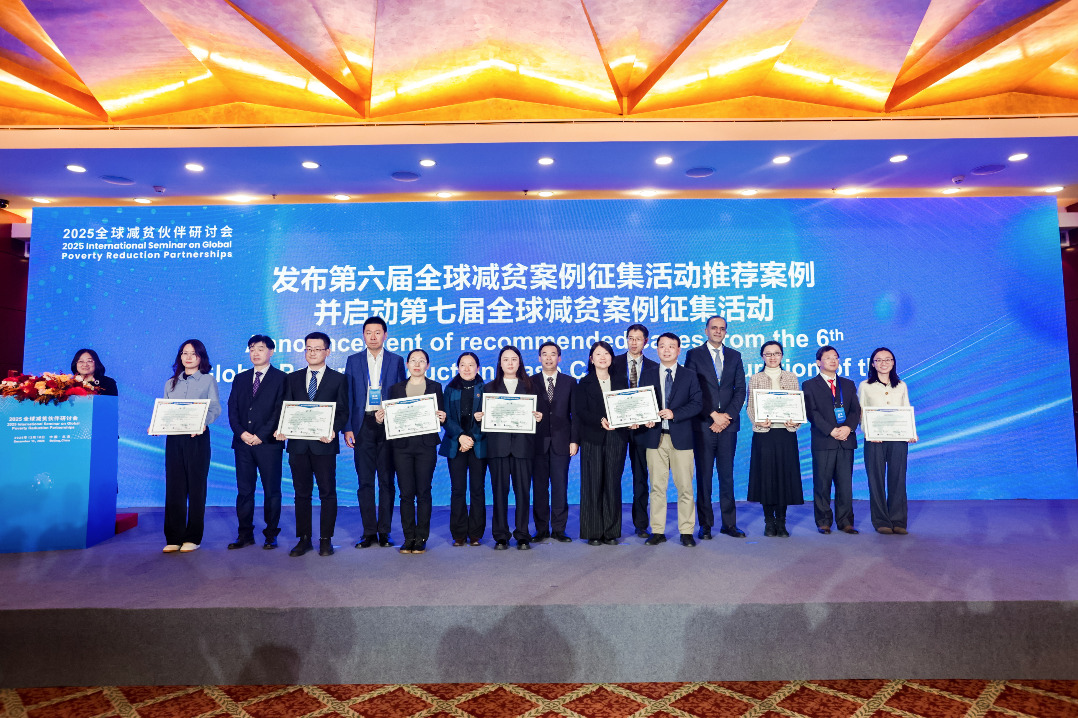
    The 2025 International Seminar on Global Poverty Reduction Partnerships witnessed a significant milestone with the launch of the latest Global Poverty Reduction Case Series, featuring 108 exemplary models selected from 840 submissions across 40 countries and regions. This comprehensive collection showcases sustainable and replicable poverty alleviation strategies, operational technologies, and inclusive approaches designed for vulnerable populations worldwide.

    The curated cases span diverse geographical contexts including Ghana, Kenya, Laos, and Brazil, offering multifaceted insights into effective poverty reduction methodologies. Notable initiatives include an agricultural technical assistance program in Fiji’s Northern Division, rural vitalization projects in China’s Hunan province, and China-Africa collaborative efforts to strengthen rice value chains in West Africa.

    During the seminar, Gao Anming, Editor-in-Chief of China International Communications Group, emphasized the transformative role of technology in poverty governance. He revealed the development of an AI-powered poverty governance intelligent agent that will utilize a global database to automatically identify relevant case studies and propose tailored solutions for specific countries, thereby enhancing the precision of international experience sharing.

    Carlos Aldeco, FAO Representative for China and DPRK, described the case series as an essential global public good that captures “real solutions from real communities for real challenges.” The collection promotes innovations such as digital extension services and climate-smart villages while fostering global solidarity.

    Nii Quaye-Kumah, IFAD Representative to China, underscored the power of partnership and knowledge sharing, noting that “no single country has all the answers.” The China-IFAD South-South and Triangular Cooperation Facility enables real-time strategy enhancement through mutual learning and experience exchange.

    The event convened nearly 200 representatives from 17 countries and 7 international organizations, who shared innovative practices including international organizations’ empowerment of small-holder farmers in poverty reduction efforts. The seminar also marked the official launch of the seventh global poverty reduction case collection.

  • Italian cooking awarded Unesco cultural heritage status

    Italian cooking awarded Unesco cultural heritage status

    In a historic declaration during its annual assembly in New Delhi, UNESCO has formally inscribed Italian culinary traditions onto its prestigious List of Intangible Cultural Heritage. The designation extends beyond specific dishes to encompass the comprehensive ecosystem of Italy’s food culture—including its transmission methods, social practices, and communal significance.

    Italian Prime Minister Giorgia Meloni, who championed this recognition since her election, celebrated the decision as validation of Italy’s gastronomic philosophy. ‘For Italians, cuisine transcends mere sustenance or recipes—it embodies our culture, traditions, labor, and prosperity,’ she affirmed.

    The UNESCO evaluation committee characterized Italian foodways as ‘a vital connective tissue strengthening familial and community bonds, manifested through home cooking, educational environments, and diverse social celebrations.’ This designation places Italian culinary culture alongside other globally recognized food traditions including Japan’s Washoku, France’s Gastronomic Meal, and Malaysia’s Breakfast Culture.

    Celebrated chef Michelangelo Mammoliti of Piedmont’s three-Michelin-starred La Rei Natura expressed profound national and professional pride in the announcement. ‘Regional cuisine profoundly influences Italy’s cultural identity and traditions,’ noted Mammoliti, whose establishment recently earned top honors in the 2026 Michelin Guide.

    Industry leaders anticipate significant economic benefits from the UNESCO designation. Luigi Scordamaglia, CEO of Filiera Italia, described the recognition as a triumph for the entire ‘Made in Italy’ production chain. He emphasized the health-promoting aspects of the Mediterranean diet, noting that ‘Italian cuisine exemplifies dietary balance and variety.’

    The assembly simultaneously recognized several other cultural traditions, including Egypt’s street food staple Koshary (a spicy combination of lentils, rice, and pasta), Iceland’s swimming pool culture, Cuban Son music and dance, and Albania’s lahuta instrument craftsmanship.

    With Italy already welcoming 80 million international visitors annually, tourism authorities expect this cultural endorsement to further enhance the country’s appeal as a premier gastronomic destination.

  • Zhang Yonghe receives Li Buyun Law Prize for human rights work

    Zhang Yonghe receives Li Buyun Law Prize for human rights work

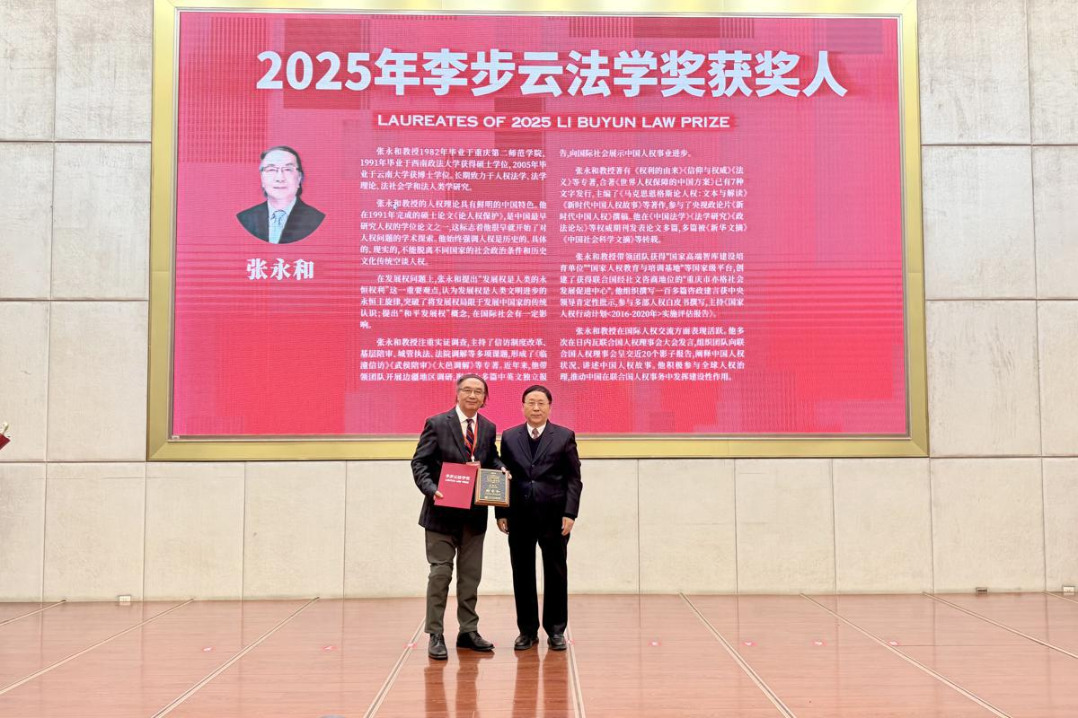
    In a ceremony coinciding with the 77th International Human Rights Day, Southwest University of Political Science and Law in Chongqing hosted the presentation of the esteemed Li Buyun Law Prize on Wednesday. The award was conferred upon Professor Zhang Yonghe, Executive Director of the university’s Human Rights Institute, in recognition of his exceptional contributions to multiple legal disciplines including human rights law, legal theory, sociology of law, and legal anthropology.

    Huang Wenyi, Vice-Chairman of the Li Buyun Law Award Committee, presided over the ceremony and emphasized Professor Zhang’s unique approach to human rights scholarship. Under Zhang’s leadership, research teams have conducted extensive fieldwork in ethnic minority regions, producing more than a dozen comprehensive reports in both Chinese and English that document China’s human rights advancements for international audiences.

    Professor Zhang’s influence extends beyond academic circles into global policy forums. He has regularly participated in United Nations Human Rights Council sessions in Geneva, where he has led delegations in submitting nearly twenty parallel reports that contribute to international human rights discourse. His work effectively bridges theoretical research with practical policy engagement, creating a multidimensional approach to human rights advocacy.

    The Li Buyun Law Prize, named after the renowned Chinese legal scholar, recognizes outstanding achievements in legal research and practice. This year’s award highlights the growing importance of academic institutions in advancing human rights understanding both within China and internationally, particularly through evidence-based research and cross-cultural dialogue.

  • Bahrain announces public holidays for National Day and Accession of King Hamad

    Bahrain announces public holidays for National Day and Accession of King Hamad

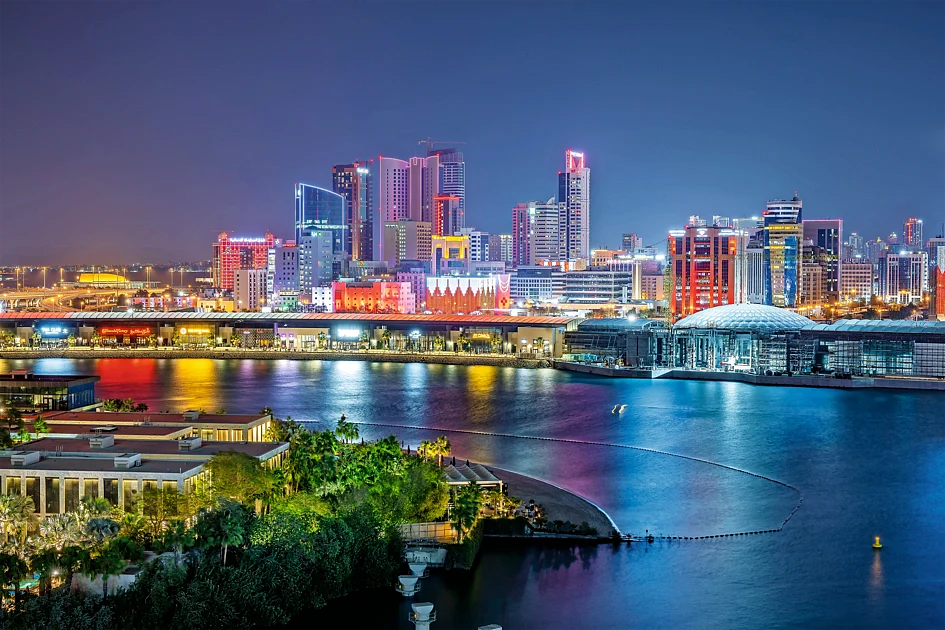
    The Kingdom of Bahrain has officially declared a two-day nationwide public holiday in December 2025 to commemorate significant national occasions. His Royal Highness Prince Salman bin Hamad Al Khalifa, Crown Prince and Prime Minister, confirmed all government ministries, departments, and public institutions will suspend operations on December 16-17, 2025.

    This administrative closure formalizes the dual celebration of Bahrain’s National Day and the Accession Day of His Majesty King Hamad bin Isa Al Khalifa. The holiday period acknowledges Bahrain’s developmental achievements and national unity while honoring the monarch’s reign and contributions to the kingdom’s progress.

    While core government services will experience temporary disruption, essential public services may maintain operations under adjusted schedules. Citizens and residents are advised to consult directly with relevant ministries and departmental authorities for specific service availability and operational hours during the holiday period.

    The National Day observance reflects on the nation’s collective accomplishments and strengthened unity under the current leadership. Simultaneously, Accession Day serves as an annual recognition of King Hamad’s reign, marking his ongoing dedication to steering Bahrain’s continued growth and development on the world stage.

  • BBC training tells staff not to criticise Zionists

    BBC training tells staff not to criticise Zionists

    The BBC has introduced a comprehensive antisemitism training program for its staff, developed in collaboration with the Jewish Staff Network, the Antisemitism Policy Trust, and the Community Security Trust (CST). The training explicitly advises that individuals who “have no intention to offend Jewish people” should avoid criticizing “Zionists” and instead direct their criticism toward “the Israeli government.” This guidance is based on the premise that antisemites frequently use the term “Zionist” as a coded reference to Jews, whether in Israel or elsewhere.

    The training incorporates the controversial International Holocaust Remembrance Alliance (IHRA) definition of antisemitism, which the British government has adopted. This definition includes classifying the characterization of Israel’s existence as a “racist endeavor” as potentially antisemitic. However, legal experts have warned that this approach might lead to a “curtailment of debate” by conflating antisemitism with anti-Zionism or criticism of historical events surrounding Israel’s establishment in 1948 and the displacement of Palestinians.

    The initiative has emerged amid ongoing controversies regarding the BBC’s coverage of Israel and Gaza. A recent study by the Centre for Media Monitoring (CFMM) alleged systemic bias in the BBC’s reporting, claiming that Israeli deaths receive 33 times more coverage than Palestinian casualties. The broadcaster has also faced criticism for withdrawing documentaries focused on Gaza, including “Gaza: How To Survive a Warzone,” following pressure from pro-Israel advocacy groups.

    Outgoing Director General Tim Davie emphasized the BBC’s commitment to inclusivity and anti-discrimination in a December staff email, stating that the organization “stands united against any form of discrimination, prejudice, or intolerance.” In addition to the antisemitism module, an Islamophobia training component is scheduled for release in February.

    The development occurs against a backdrop of heightened tensions, with the CST previously characterizing pro-Palestine marches in London as disruptive to Jewish citizens’ “peace and basic rights” and calling for their cessation. The BBC’s editorial decisions regarding Middle East coverage continue to draw scrutiny from various stakeholders advocating for balanced representation.

  • Recessive genes result in Caucasian appearance for Jiangsu girl

    Recessive genes result in Caucasian appearance for Jiangsu girl

    A three-year-old girl from Jiangsu province has captured national attention through social media due to her unexpected Caucasian features, including blonde hair and blue eyes, despite both parents exhibiting typical Chinese physical characteristics. The child, known affectionately as Little Jam (Xiao Guojiang), speaks fluent Mandarin and represents a fascinating case of recessive genetic expression.

    The family recently appeared on a television program to explain the biological mystery behind their daughter’s appearance. According to Yang, the child’s mother, the explanation lies in their family history: the girl’s great-grandfather was Russian, giving her partial Slavic ancestry. This genetic heritage had remained largely hidden through generations until manifesting prominently in Little Jam.

    Yang recounted that at birth, her daughter appeared similar to other Chinese infants except for notably large eyes. Significant changes occurred after her first birthday, when her eyelashes grew remarkably long and her irises gradually developed their distinctive blue coloration. The mother noted that men in her husband’s family had displayed subtle Slavic traits including increased body hair, aquiline noses, and fair complexions, but these characteristics had never manifested as dramatically as in their daughter.

    The unique appearance naturally draws considerable public attention and discussion, though at her young age, Little Jam remains largely unaware of and unconcerned about the fascination she generates. The family has attempted to introduce Russian language instruction, but the toddler has not yet demonstrated particular aptitude for the language. They plan to let her future language education depend entirely on her own interests and inclinations as she grows older.

  • Judge rules Epstein grand jury records from 2019 case can be released

    Judge rules Epstein grand jury records from 2019 case can be released

    A New York federal judge has authorized the public disclosure of grand jury materials from the 2019 Jeffrey Epstein sex trafficking investigation, reversing his previous position on sealing the documents. U.S. District Judge Richard Berman issued Wednesday’s ruling in response to congressional legislation mandating transparency in the Epstein case.

    The judicial reversal comes precisely one day after a separate ruling granted similar transparency measures in the case of Ghislaine Maxwell, Epstein’s accomplice convicted in 2021 for facilitating his sexual abuse network. Judge Berman’s decision directly references the Epstein Files Transparency Act, recently signed into law by President Donald Trump, which compels the Justice Department to release investigative materials by December 19th.

    Epstein’s case timeline shows he faced sex trafficking charges in July 2019 before dying in a New York prison cell one month later while awaiting trial. The financier’s death sparked numerous conspiracy theories and heightened scrutiny of the justice system’s handling of high-profile cases.

    While ordering the release, Judge Berman emphasized protecting victims’ rights, stating that their “safety and privacy are paramount.” The ruling permits the Justice Department to redact materials that might compromise active investigations or create privacy concerns for victims. This balanced approach attempts to reconcile congressional demands for transparency with the judicial system’s duty to protect vulnerable parties.

    The released materials are expected to include previously sealed grand jury records, unclassified documents, and internal communications related to the Epstein investigation, potentially shedding new light on one of the most notorious sexual abuse cases in recent American history.

  • Why the World Obsesses Over Mummies

    Why the World Obsesses Over Mummies

    A global fascination with ancient Egyptian mummies that began over a century ago continues to exert profound influence on contemporary culture and design. The 1922 discovery of Tutankhamun’s tomb, featuring the legendary golden mask that had rested undisturbed for three millennia, ignited what historians term ‘Egyptomania’ – a cultural phenomenon that transcended archaeological circles to permeate modern aesthetics.

    This enduring obsession with Egyptian antiquities has manifested across diverse creative industries. Jewelry designers incorporate scarab motifs and hieroglyphic patterns, while architectural elements echo pyramid structures and obelisk forms. Hollywood’s film industry has consistently drawn inspiration from ancient Egyptian themes, producing iconic movies that fuel public imagination about the mysterious civilization.

    What explains this sustained captivation with mummified remains from a millennia-old culture? Experts suggest that mummies represent a unique intersection of preservation and mystery, offering tangible connections to human history while maintaining an aura of the unknown. The scientific revelations from mummy studies, combined with the artistic mastery displayed in burial artifacts, create a powerful narrative that continues to resonate across generations.

    The recent release of an English-dubbed documentary episode examining this phenomenon provides fresh insights into how ancient Egyptian culture maintains its grip on the modern psyche, demonstrating that some historical discoveries never truly lose their ability to astonish and inspire.

  • Xinjiang empowers women’s dreams

    Xinjiang empowers women’s dreams

    In a demonstration of regional progress in gender equality, Xinjiang is witnessing a remarkable transformation in professional opportunities for women. The inspiring stories of Haliya Ersibek, a practicing lawyer, and Suofeiyan, a fashion designer, exemplify this shift as they successfully pursue their ambitions in both Xinjiang and China’s capital Beijing.

    Their professional journeys highlight how institutional support and equitable platforms are enabling female talent to thrive in diverse sectors. Rather than facing traditional barriers, these women are accessing unprecedented career pathways that align with their personal aspirations and professional qualifications.

    This development reflects broader social changes within the region, where educational investments and policy initiatives are creating environments conducive to women’s professional advancement. The emergence of such success stories indicates a significant evolution in gender dynamics across Xinjiang’s professional landscape.

    The growing number of young women excelling in fields ranging from legal services to creative industries suggests a structural transformation in employment patterns. This trend not only benefits individual women but also contributes to the region’s economic diversification and social modernization.

    As more women like Haliya and Suofeiyan achieve professional recognition, they create visible role models for younger generations, potentially establishing a virtuous cycle of aspiration and achievement throughout Xinjiang’s communities.

  • Watch: Toronto’s trash-filled basin gets a dramatic lakeside revival

    Watch: Toronto’s trash-filled basin gets a dramatic lakeside revival

    In a remarkable environmental turnaround, a dedicated university professor and his team of students have successfully revitalized Toronto’s severely polluted Peter Street Basin after a three-year cleanup initiative. The project, which began as an academic exercise, has yielded tangible ecological results, transforming what was once a trash-filled urban eyesore into a swimmable waterfront area.

    The restoration effort involved systematic removal of accumulated debris and pollutants that had plagued the basin for decades. Through coordinated clean-up drives and environmental rehabilitation techniques, the academic team addressed both surface-level waste and underlying water quality issues. Their work demonstrates how targeted intervention can reverse environmental degradation in urban water systems.

    This lakeside revival represents more than just aesthetic improvement—it marks a significant achievement in urban ecological restoration. The project’s success has drawn attention from city officials and environmental organizations, potentially serving as a model for similar rehabilitation efforts in other urban waterways. The transformation from contaminated basin to functional aquatic space highlights the powerful impact of community-academic partnerships in addressing environmental challenges.

    The team’s approach combined scientific methodology with practical fieldwork, creating valuable learning experiences for students while delivering measurable environmental benefits to the community. Their achievement underscores the importance of sustained effort in environmental conservation and the potential for academic institutions to drive meaningful urban improvement projects.