Thousands of miles from their native Arabian deserts, camels have become an unexpected, multifaceted fixture of life in Australia’s remote outback, evolving from 19th-century transport workhorses to key players in local agriculture, niche tourism, craft brewing and even outback racing.
First imported by British colonists in the 1800s to help traverse Australia’s harsh, arid interior, camels were released into the wild once motor vehicles rendered their transport services obsolete. Today, population estimates for these introduced animals range widely from 300,000 to one million, most of which roam freely as feral herds. Australian authorities note that unmanaged feral camels create a host of problems: they outcompete domestic livestock for limited food and water resources, destroy boundary fences, contaminate natural waterholes, and cause damage to sacred Indigenous cultural sites across the outback.
But for a growing cohort of Australian producers and entrepreneurs, domesticated camels have emerged as a valuable niche commodity that generates local income and even export revenue. Trade data from 2024 shows Australian camel meat exports surpassed $3.9 million, and as of 2026, 68 live camels have already been shipped to markets in Malaysia and Indonesia.
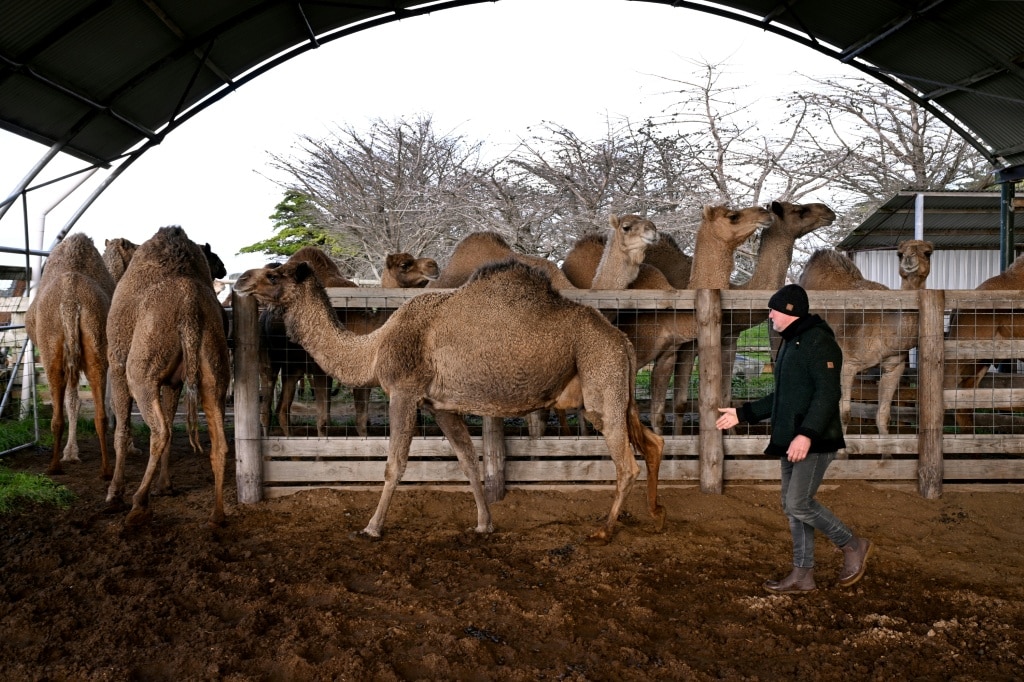
On Humpalicious Farm, located in the coastal South Australian town of Robe, former sea captain turned camel farmer Warwick Hill has built a small business centered on the unique benefits of camel dairy. “They’re very nice to work with. They’re very easily domesticated,” Hill explained in an interview with Agence France-Presse, between sessions cuddling his herd of dromedaries. “If you’re kind and fair with them, they generally reciprocate.”
Hill sells his camel milk for Aus$20 (roughly $14) per liter, and argues it offers far more health benefits than conventional cow’s milk, particularly for consumers with dairy allergies. “It’s one of the closest milks to human milk, and we haven’t met anybody that can’t have camel milk,” he said, positioning his product as a more natural alternative to “overprocessed” mainstream dairy options. While Hill believes the market for camel milk has massive untapped potential, high production costs have kept it out of reach for most consumers. Low milk output per animal and high labor costs push the retail price up, meaning the farm relies on complementary revenue from camel-focused tourism and homestay accommodation to stay afloat. Still, Hill remains optimistic: “Everybody would, once they tasted camel milk, prefer to drink it over anything else.”
Just down the road from Humpalicious, Robe Town Brewery has turned to camels for a truly one-of-a-kind craft beer collaboration. The brewery’s leftover brewing grain is used to feed Hill’s camels, and in turn, the camels’ dried dung is repurposed to smoke the malt that goes into the brewery’s signature porter, “Holy Smokes.” Bottled in dark brown glass adorned with a illustration of a camel dressed as the Virgin Mary, the 8.2% ABV brew is marketed as a “rich, dark and very smokey” beverage. Brewery head Maris Biezaitis is quick to address any potential customer hesitation about the unusual production method: “It doesn’t really taste like dung. In fact, it tastes and smells a bit more like a peat-smoked malt. Smoky beer.”
Further north in the remote outback town of Maree, roughly 370 miles north of Adelaide, camels take on another popular role: competitive racing. Each year, hundreds of spectators travel to the tiny town to attend the annual Marree Camel Cup, where the animals that once hauled freight across the desert now compete for the winner’s trophy. This year’s title went to Young Gun, ridden by jockey Patrick Dennis. For first-time competitor Joanne Bell, 55, who fell in love with camels while working at a petting zoo, camel racing fulfilled a long-held dream. “Always wanted to be a jockey but never had the opportunity to ride horses,” she said. “So camels was the next thing and a jockey’s a jockey, whether it’s a camel or a horse.” Fellow competitor Kyrraley Woodhouse said she loves the sport for its one-of-a-kind character. She explained the secret to picking a winning camel is all about personality: “You would want a little bit of temper, a little bit of fire in them. Something that’s got a heart, that’s going to run.”
Camel racing in Maree also carries deep historical roots: the first cameleers brought to Australia in the 1860s to open up the arid interior were mostly Muslim men from Afghanistan and other Central and South Asian regions, and many of their descendants still call the town home today. “It all revolved around the camels. The reason the camels were brought here was because they were so resilient,” said Greg Burk, whose great-grandfather migrated to Australia in the 1880s to work as a cameleer. “Camels are still dear to my heart.”
Back in Robe, Hill says he hopes his work showcasing well-tended domesticated camels will help change public perception of the animals that have become such an enduring part of outback history. “People come here and they see 50 well-behaved, very nice, cuddly, smoochy camels,” he said. “They’re quite a pleasant animal.”