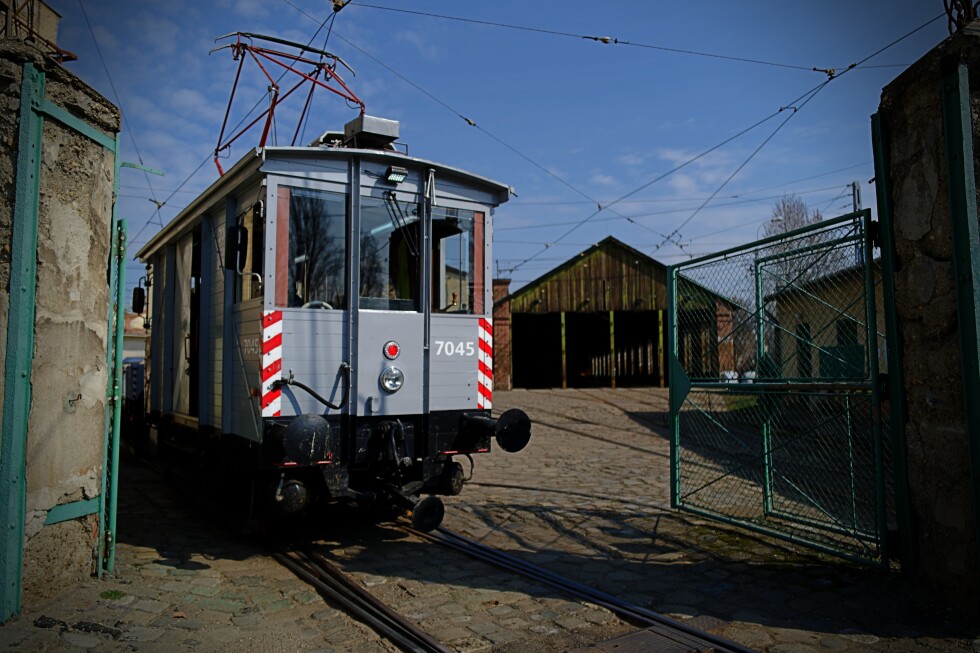
BUDAPEST, Hungary — In a remarkable display of historical continuity, Budapest’s unique fleet of freight trams continues to serve the Hungarian capital after a full century of operation. These distinctive wood-sided vehicles, locally known as “mukis,” represent a living relic of urban industrial history that has adapted to modern needs while maintaining its original character.
The mukis operate on Budapest’s extensive tram network—one of the world’s busiest—utilizing the same overhead electrical system that powers passenger trams. Unlike their yellow counterparts that transport commuters, these specialized vehicles perform essential infrastructure functions including snow clearance, nighttime maintenance, and transporting disabled trams for repairs.
Originally acquired in 1926 as a pragmatic solution to post-World War I freight challenges, the trams were ingeniously constructed using repurposed components from war-damaged vehicles. Ádám Zadravecz, head of tram vehicle development at Budapest’s BKV public transit company, explains: “Engineers designed an electric drive system primarily from vehicles damaged in the war and those designated for scrapping. Their primary purpose was freight transport, but after World War II, these vehicles were also used for removal of the war ruins.
Over decades of service, the mukis have undergone gradual modifications while retaining their fundamental design. The 1960s saw some equipped with snowplows for winter track clearance, and a comprehensive refurbishment in 2018 added modern comforts including cabin heating and driver seats—a significant improvement from their originally spartan design.
Nándor Meixner, head of vehicle maintenance at Budapest’s Ferencváros depot, notes: “When manufactured in the 1920s, they were extremely simple, puritanical devices. During refurbishment, we strove to make our colleagues’ work easier.”
The surviving fleet now numbers just six vehicles, with three remaining in active service. Their remarkable longevity stems from straightforward mechanical design that contrasts sharply with modern electronic systems. “Their maintenance costs are almost zero because these trams are very easy to maintain,” Zadravecz emphasizes. “Compared to today’s complex electronics, there is very little that can break down. People say they can be repaired with a hammer and a file, and that’s absolutely true.”
Operating these historic vehicles requires specialized training and what Meixner describes as a particular “feel” for their operation. “It is not enough to just know the signs and instructions—you must understand the vehicle itself. We used to say the driver has to drive this vehicle with his butt,” he remarks, highlighting the intuitive connection between operator and machine.
These century-old workhorses represent more than just functional infrastructure; they embody Budapest’s resilience and adaptive reuse philosophy. As Zadravecz concludes: “The value of these vehicles lies precisely in their simplicity, in the pure fact that they exist and remain available to us—a testament to practical engineering that continues serving the city a hundred years after their creation.”