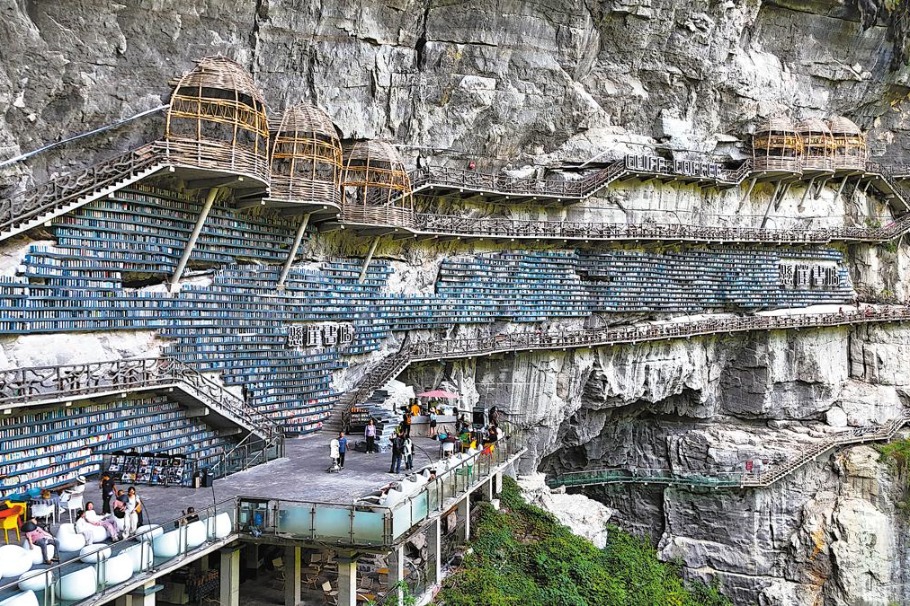
Deep within the spectacular 326-meter Mianhua Sinkhole in China’s Guangxi Zhuang Autonomous Region, an architectural marvel has emerged that seamlessly blends literature with geological wonder. The cliffside bookstore, carved into the karst rock formations of Hechi city, has rapidly evolved into an international cultural destination since its inauguration in May 2025.
Perched precariously along the sinkhole’s vertical walls, the open-air literary sanctuary boasts an impressive collection of over 10,000 volumes arranged across 150 meters of cliff face, creating what visitors describe as a ‘floating canyon of knowledge.’ Accessing this unique cultural space requires navigating an exhilarating 1,000-step plank pathway etched into the limestone cliffs—a journey that transforms into a metaphorical pilgrimage for literature enthusiasts.
The bookstore’s creation presented extraordinary engineering challenges due to the unstable karst topography. He Zhijian, the visionary founder, revealed that specialized anchoring technology was essential for ensuring structural safety, comparing the construction process to ‘performing acrobatics on a cliff.’ His inspiration stemmed from innovative bookstore concepts in Japan and Hangzhou, though the sinkhole adaptation represents an entirely unprecedented approach to literary architecture.
Remarkably, the natural geological formation provides perfect protection from the elements, allowing books to remain completely dry regardless of weather conditions. This natural sheltering effect enables visitors to enjoy reading experiences surrounded by breathtaking panoramic views of the sinkhole’s dramatic interior.
Beyond its cultural significance, the project has catalyzed substantial regional economic development. Wu Taichang, General Manager of Guangxi Luocheng Mianhua Tiankeng Tourism Development Company, emphasized how the attraction encourages extended visitor engagement through additional facilities including a cliffside café, hotel accommodations, and pathways leading to the sinkhole’s base. The surrounding area now features a 600-square-meter sinkhole theater and recently hosted its inaugural Music Festival, further enhancing the site’s cultural offerings.
The development has transformed the fortunes of previously isolated Mianhua village, where geographical constraints once limited agricultural possibilities. Today, the project has generated over 90 local employment opportunities from 108 total staff members, while attracting collective investments from seven neighboring villages. Dividend distributions have surpassed 4 million yuan ($570,000), significantly boosting regional economic prosperity while preserving local communities.
This innovative fusion of cultural space and natural wonder demonstrates how strategic tourism development can simultaneously preserve geological heritage, promote literary culture, and generate sustainable economic benefits for remote communities.