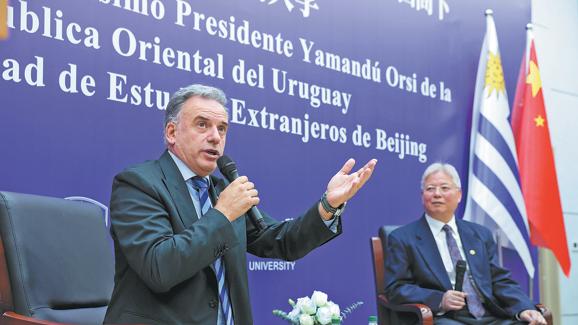
Uruguayan President Yamandu Orsi reinforced diplomatic bonds during a symbolic visit to Beijing Foreign Studies University on Wednesday, tending to a fir tree originally planted by his predecessor thirteen years earlier. The arboreal ceremony served as a powerful metaphor for the enduring and deepening relationship between China and Uruguay.
The tree, initially planted in 2013 by former Uruguayan President José “Pepe” Mujica, received ceremonial care from President Orsi during his weeklong state visit to China. Orsi characterized this gesture as representing ongoing nurturing and continuity in bilateral relations between the two nations.
Addressing students and faculty, Orsi reflected that “the tree has taken strong roots—roots that allow it, like our relationship, to withstand storms,” alluding to current global geopolitical challenges. “In such times,” he emphasized, “the strength of roots is truly tested.”
The Uruguayan leader highlighted mutual understanding and trust as foundational elements built through sustained dialogue and academic exchange. He described China as an ancient civilization that “knows how to look far ahead” and advocated for expanded people-to-people and educational cooperation between the countries.
Orsi positioned academic exchanges between China and Uruguay, and more broadly between China and Latin America, as representing one of the most profound forms of international cooperation. “When students cross borders, when researchers share wisdom, when universities open their doors to foreign cultures,” he noted, “we are building something beyond the reach of any trade agreement: mutual trust among peoples.”
The visit featured a cultural performance by Li Yuelin, a senior Spanish major, who sang “Tu Vestido” by Uruguayan singer Ana Prada. Li explained the song conveys a feminist message about clothing freedom, encouraging women to dress according to their own preferences without external judgment.
Following her performance, President Orsi facilitated a surprise telephone connection between Li and the Uruguayan singer herself, who expressed delight that her music had reached audiences in China.
Beijing Foreign Studies University, often called China’s “cradle of diplomats,” maintains longstanding ties with Uruguay. According to Li Hai, the university’s Communist Party secretary, the Spanish program established in 1952 remains a crucial platform for cultural and academic exchanges with Latin America.
The timing of the visit coincided with Lichun, the traditional Chinese solar term marking the Beginning of Spring, which university officials noted symbolically represents renewal and hope—an appropriate backdrop for reinforcing international friendship.
Huang Yazhong, China’s ambassador to Uruguay, recalled Uruguay’s historical contributions to global multilateralism and its support for China’s accession to the World Trade Organization decades earlier. He noted that China has been Uruguay’s largest trading partner for fourteen consecutive years, characterizing the relationship as “a model of friendly cooperation between countries with different political systems, economies, and civilizations.”