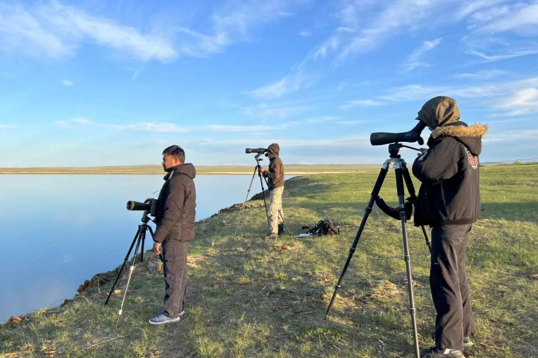
Faysal Ahmad, a Bangladeshi PhD candidate at Beijing Forestry University’s School of Ecology and Nature Conservation, has transformed his childhood fascination with migratory birds into a transnational conservation mission. His journey from the wetlands of Bangladesh to China’s ecological research forefront represents a growing trend of global environmental collaboration.
Growing up alongside Bangladesh’s vibrant wetland ecosystems, Ahmad developed an early understanding of nature’s interconnectedness through observing seasonal bird migrations. This childhood curiosity evolved into professional commitment through his work with conservation organizations, including the Food and Agriculture Organization of the United Nations, where he witnessed firsthand how climate change disrupts both ecosystems and human communities.
‘Conservation remains incomplete without considering human dimensions,’ Ahmad emphasized. ‘Science must ultimately serve those most affected by environmental changes.’
This philosophy led him to China, where he found resonance with the country’s ecological civilization concept. Beijing Forestry University emerged as the ideal institution due to its renowned biodiversity research programs and practical approach to ecological challenges. Under Professor Liu Jinglan’s mentorship, Ahmad’s research focuses on climate change impacts on waterbird species in Beijing’s urban wetlands.
A pivotal moment in his academic journey occurred during field training when handling migratory birds. ‘Holding that bird, I understood that nature recognizes no borders,’ he recalled. ‘Birds migrate with purpose, not passports.’ This realization fundamentally shifted his research approach from pure data collection to developing holistic ecological narratives that connect climate patterns, habitat changes, and human activity.
His academic experience expanded through international research visits to nine countries, including ecological studies in Inner Mongolia’s grasslands, seminars at Harvard University, and coastal research in the Netherlands. These diverse experiences reinforced his belief that conservation knowledge must transcend boundaries as freely as migratory birds.
Beyond research, Ahmad actively engages in knowledge dissemination through the ‘Eco Earth’ Lecture Group and leadership roles in the East Asian–Australasian Flyway Partnership Youth Task Force. His outreach extends to primary school education, where he organizes birdwatching activities and drawing sessions to inspire younger generations.
‘China demonstrated that ecological strength emerges when society embraces environmental values,’ Ahmad noted. ‘Meaningful change occurs when science, policy, and public participation align.’
Looking forward, Ahmad aims to establish collaborative platforms between China and South Asia, transferring ecological wisdom and practical solutions for wetland protection and climate resilience. His journey exemplifies how personal passion, when coupled with academic opportunity and cross-cultural exchange, can address global environmental challenges through localized action and international cooperation.