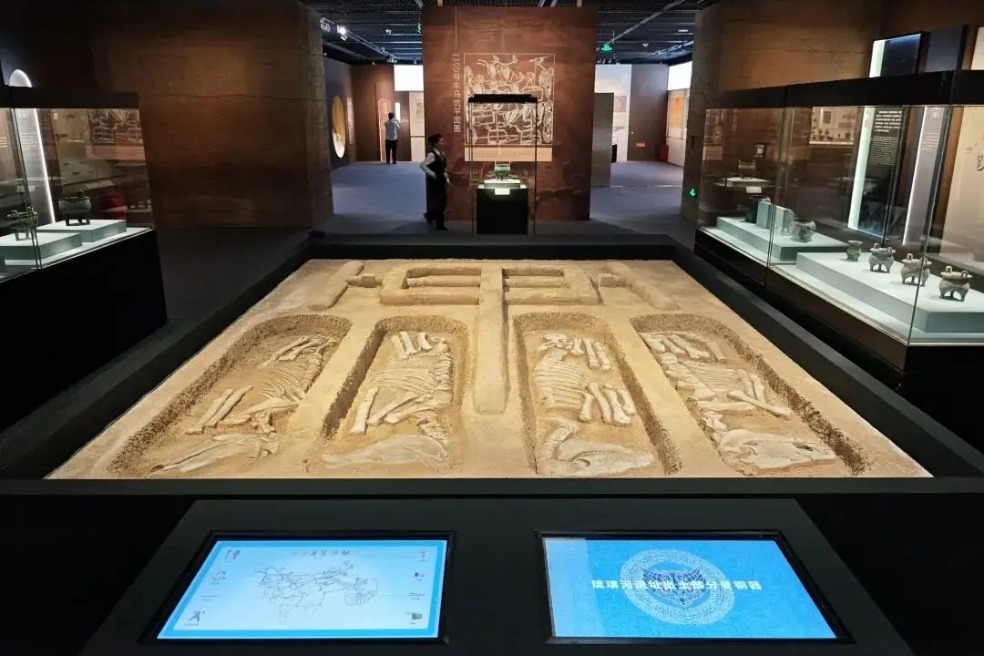
Beijing authorities have announced ambitious plans to establish a new cultural park adjacent to the Liulihe archaeological site, the largest and most thoroughly excavated Western Zhou Dynasty (c. 11th century–771 BC) complex in China. The project, revealed by Fangshan district officials, represents a significant enhancement to the city’s cultural preservation efforts coinciding with Beijing’s 3,070th anniversary celebrations.
The initiative follows Beijing’s formal application for World Heritage status for the Liulihe site earlier this year. According to Lei Huan, Director of Fangshan District’s Publicity Department, an expert panel conducted a comprehensive review of the park’s architectural design in November, moving the project toward implementation.
Recent archaeological breakthroughs have substantially elevated the site’s historical significance. The 2024 excavation campaign revealed a previously unknown dual city-wall structure—the first such discovery at the ancient capital. Within the inner city’s confines, researchers uncovered substantial rammed-earth building foundations, ancient wells, and sophisticated drainage systems that fundamentally reshape understanding of Beijing’s earliest urban planning.
“These findings provide irrefutable visual evidence of Beijing’s earliest form,” Lei stated during Friday’s announcement. “They conclusively establish Liulihe in Fangshan as the genuine ‘origin of the city’.”
The development coincides with Beijing’s launch of a World Cultural Heritage Monitoring and Early Warning Platform, representing a major advancement in digital conservation technologies. This system will enable more precise and comprehensive protection measures across the capital’s exceptional collection of heritage sites.
Beijing currently preserves eight UNESCO World Cultural Heritage locations—the highest concentration of any city worldwide—including the Great Wall, Forbidden City, Temple of Heaven, and the recently nominated Beijing Central Axis. Municipal data reveals substantial investment in heritage conservation, with approximately 9.4 billion yuan ($1.33 billion) allocated between 2021-2024. The 2024 budget alone increased by 29.7% year-over-year, supporting a 41% expansion of full-time conservation staff to 6,344 professionals.
Monitoring indicates consistently improving conditions across all heritage properties, which collectively welcomed 365 million visitors between 2018-2024 while maintaining effective management systems.