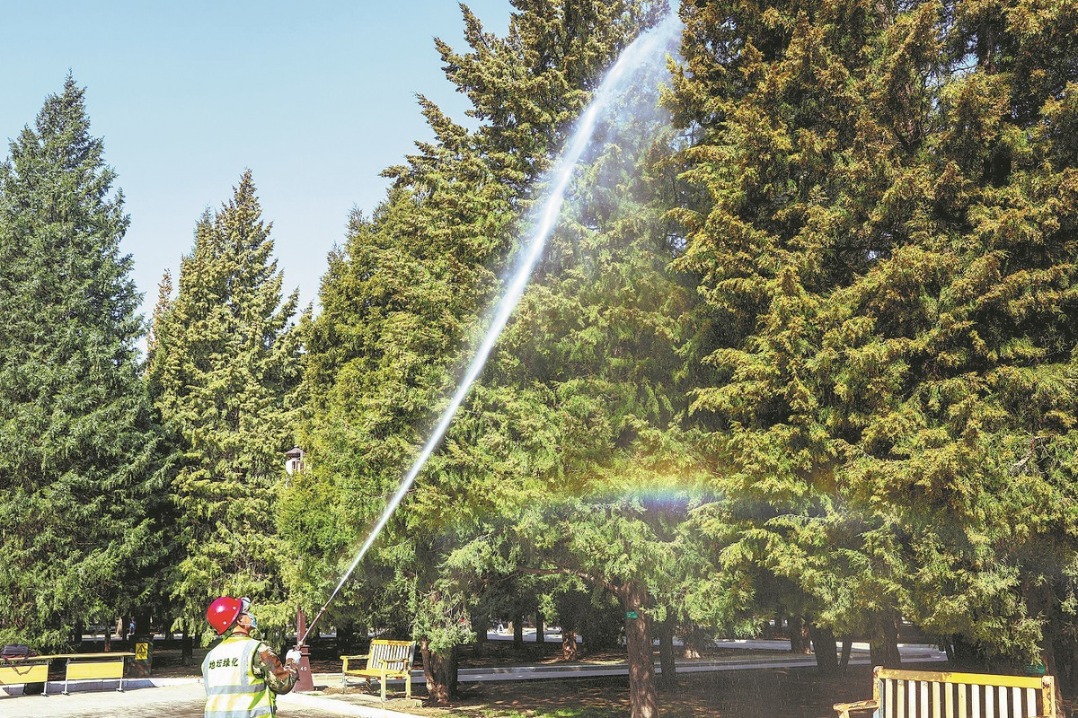
As Beijing enters peak cypress pollen dispersion season in mid-March, municipal authorities have implemented a comprehensive mitigation strategy combining technological interventions and ecological management. The Beijing Municipal Forestry and Parks Bureau has coordinated round-the-clock operations targeting high-risk zones including residential communities, educational institutions, and medical facilities.
The current pollen season, which commenced around March 8 according to expert analysis, has prompted deployment of three primary countermeasures: high-frequency water spraying, strategic pruning of male cypress branches, and application of environmentally-friendly biological agents. These pollen fixatives and control agents represent Beijing’s latest innovation in balancing ecological preservation with public health concerns.
District-level initiatives implemented preventive measures as early as autumn 2025, with Haidian district conducting extensive pruning of pollen-producing cones during dormancy periods. Major green spaces including Temple of Heaven and Ditan Park have intensified suppression efforts following last year’s remarkable phenomenon where billions of pollen particles created visible golden hazes that diffused sunlight into ethereal patterns.
While visually striking, these pollen clouds created severe health impacts for residents like 27-year-old Jin, who experienced debilitating allergy symptoms including nasal congestion, sneezing, and multi-system itching that diminished her quality of life. This year, she reports noticeable improvement attributable to the enhanced mitigation measures.
Director Jiang Yingshu of the bureau’s science and technology division emphasized the need for scientific approaches that acknowledge both the ecological value of cold-resistant cypress species and their public health implications. Approximately 168,000 male cypress trees within the Fifth Ring Road area contribute to pollen dispersion patterns influenced by urban heat island effects and prevailing winds, typically creating higher concentrations in southwestern urban zones.
Medical experts from Beijing Tongren Hospital recommend complementary personal protection strategies during peak dispersion hours (10:00-17:00), including mask usage, protective eyewear, and enhanced indoor air filtration. Chief physician Ouyang Yuhui advises prompt medical consultation for persistent symptoms despite these comprehensive mitigation efforts.