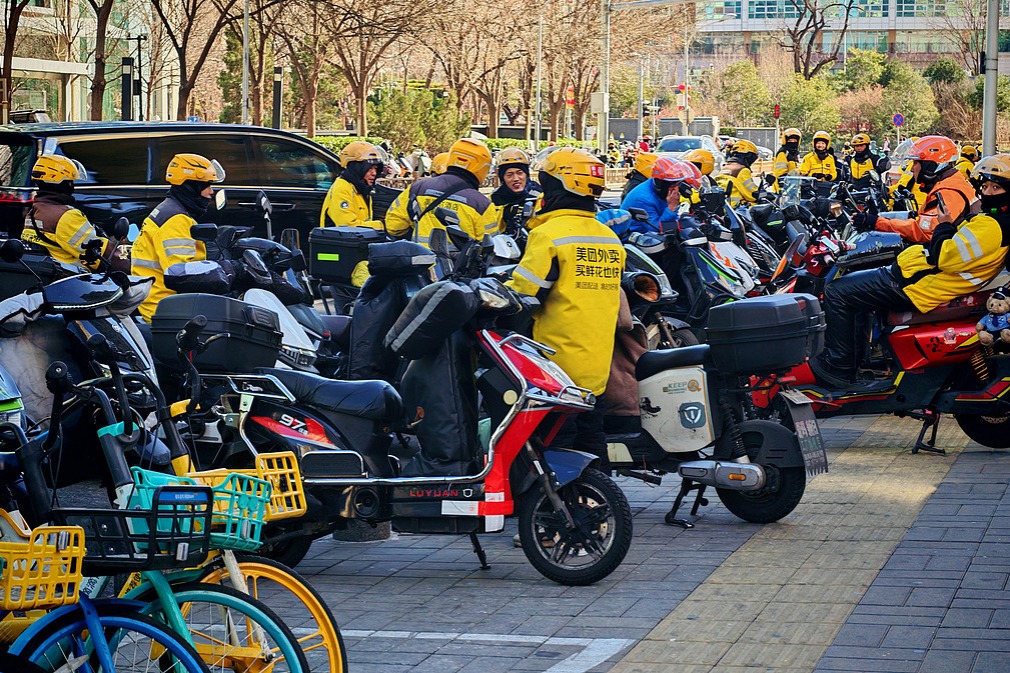
Amid growing public concern over the safety of China’s booming online takeout industry, Beijing’s municipal market regulatory authority has launched a new initiative that enlists thousands of food delivery riders as frontline food safety sentinels, expanding a co-governance model that has already been tested across multiple Chinese regions.
Under the newly announced program, delivery riders are encouraged to document and report food safety violations they encounter during restaurant pickups, such as unlicensed business operations, unsanitary kitchen environments, and non-compliant food handling practices. A specialized in-app “snap and report” tool is provided to streamline the submission process. Reports are first screened by delivery platforms, with verified tips passed along to official regulatory teams for investigation. Riders earn cash or other rewards for confirmed violations, creating a closed-loop system that delivers public transparency and outcome feedback to contributors.
The initiative marks a key expansion of China’s national push toward multi-stakeholder food safety co-governance, which combines formal government regulatory oversight, corporate platform responsibility, and grassroots public participation. Beyond individual case investigations, Beijing regulators plan to aggregate and analyze reporting data to map recurring risk patterns, enabling targeted regulatory inspections and industry-wide food safety training for food service operators.
Several Beijing districts have already completed pilot testing of the model. Haidian District, home to the city’s major university zone and a dense cluster of restaurants, has appointed more than 1,000 participating riders as official food safety sentinels, while Tongzhou District has launched a dedicated mini-program to simplify and speed up the reporting workflow.
Similar programs have already been rolled out across the country, from the coastal commercial hub of Shanghai to eastern Zhejiang Province, and southwestern Guizhou Province to the remote northwestern Qinghai Province and central Hubei Province. Local authorities in these regions have partnered with major delivery platforms to mobilize the country’s millions of delivery riders, who have unmatched daily access to back-of-house restaurant conditions, to supplement formal regulatory resources.
Many localities have already recorded tangible early results from the model. In Qiandongnan Miao and Dong Autonomous Prefecture, Guizhou, more than 400 riders have joined the program as voluntary sentinels. Since launching at the start of 2026, riders have submitted 42 credible violation reports, all of which were confirmed by regulators, leading to six formal enforcement investigations, according to local state-run outlet Guizhou Daily.
One participating rider in Qiandongnan, surnamed Wang, shared his experience reporting a local restaurant where staff handled ready-to-eat food without face masks and no employees held valid required health certificates. “I took photos of the violations and uploaded them through the official reporting channel,” he explained. “Within just two days, regulators had confirmed the violations and ordered the restaurant to correct the issues immediately.” Wang received a reward for his verified report, and added that the extra role has made his daily delivery work feel more meaningful.
Back in Beijing, the new initiative has drawn mixed reactions from the city’s delivery workforce and consumers, highlighting both its potential benefits and remaining challenges. Many riders and consumers have voiced strong support for the program. He Chengyu, a Beijing-based delivery rider with three years of on-the-job experience, noted that the policy creates a clear channel to improve overall industry hygiene standards. “We see the actual conditions in restaurant kitchens every single day that we work,” he said. “With clear rules and fair incentives, food safety for consumers should get a lot better.”
Consumers have also echoed that support. Wang Haoqing, a finance professional who regularly orders takeout for work, said the new system adds an extra layer of reassurance for online food orders. Zhou Yan, a 32-year-old technology industry employee, agreed, pointing out that riders hold unique insight into actual restaurant hygiene that most consumers never see. “If you want to know which restaurants are actually clean, just ask the delivery riders — they know the situation better than anyone else,” she said, describing the policy as a very smart, practical solution to online food safety gaps.
However, some riders have expressed caution about taking on the new responsibility, pointing to the already intense time pressure and algorithm-managed workloads that define the delivery industry. “We are already racing against the clock to hit on-time delivery targets,” one anonymous rider said. “Adding extra reporting responsibilities could hurt our delivery efficiency and ultimately cut into our monthly income.”
In response to these concerns, Beijing regulatory officials have noted that targeted adjustments, including meaningful incentives for participation, pre-program training for riders, and streamlined, low-time-reporting tools, are core parts of the program design. These features are intended to balance the goal of improving food safety with protection for riders’ existing workloads and incomes.