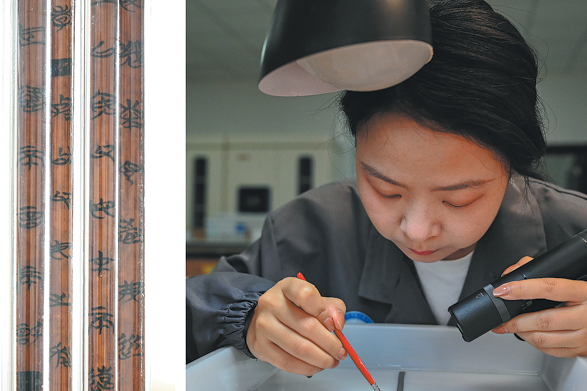
In a remarkable fusion of archaeology and chemistry, experts at China’s Jingzhou Cultural Relics Protection Center have pioneered groundbreaking techniques to resurrect ancient bamboo and wooden slips from their water-damaged states. These fragile artifacts, which served as primary writing materials in China before the widespread use of paper, emerge from tombs as darkened, mushy fragments after millennia submerged in groundwater.
The center has developed two revolutionary conservation methods: sodium dithionite decolorization and cetyl alcohol filling dehydration. The first technique chemically restores the slips’ original pale yellow coloration while making inscribed characters clearly visible. The second method replaces water within the cellular structure of the bamboo with stabilizing compounds, transforming the soft, deteriorated material into flexible, preserved artifacts.
Over three decades, these innovations have enabled the recovery of approximately 180,000 historical fragments nationwide, including extraordinary finds such as the earliest known Nine-Nine Multiplication Table, a previously lost version of The Analects of Confucius, and ancient medical texts detailing treatments for heart conditions, abdominal disorders, and external injuries.
Jingzhou’s significance in this field stems from its history as the ancient capital of the Chu state during the Warring States Period (475-221 BC), where social elites followed customs of burying written records with the deceased. The region has yielded approximately 30,000 slips dating from the Warring States Period through the Han Dynasty (206 BC-AD 220).
According to Zhao Yang, director of the center’s cultural relics protection department, these texts represent ‘social media posts and notebooks of ancient people,’ offering unparalleled insights into classical literature, medical practices, musical scores, divination, and sacrificial rituals across centuries.
The conservation technologies, honored with Hubei Provincial Science and Technology Progress Award recognition, now handle over 80% of China’s waterlogged bamboo slip restoration. Each batch requires two to three years of meticulous work before the preserved artifacts can be studied or exhibited, safeguarding what experts describe as ‘the seed of Chinese culture and evidence of its continuity.’