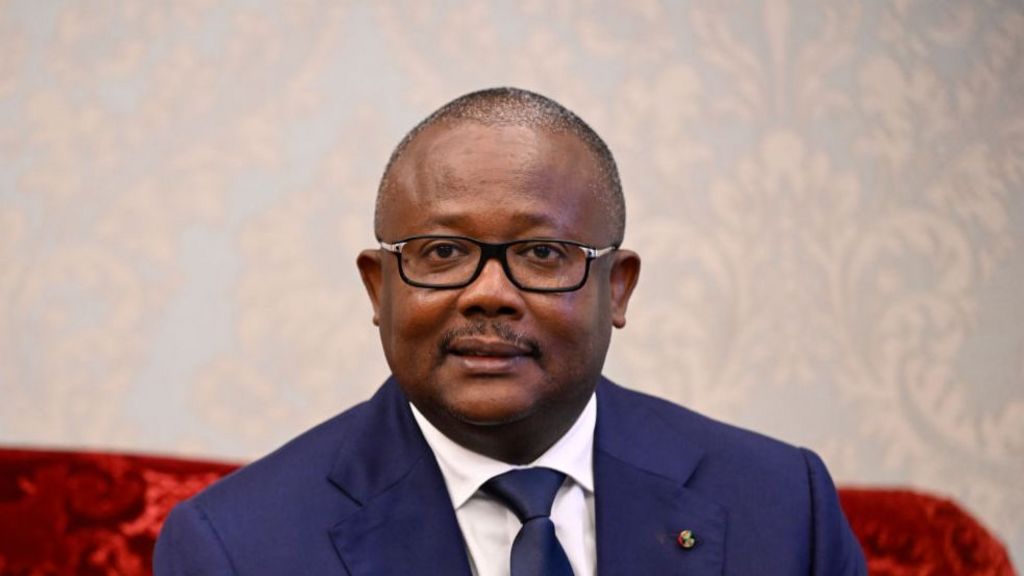
In a dramatic turn of events, Guinea-Bissau’s President Umaro Sissoco Embaló has reportedly been arrested by armed men, according to government sources cited by the BBC. The incident unfolded after gunfire erupted near the presidential palace in the capital, Bissau, around 13:00 GMT. Witnesses reported hearing sustained gunshots, though the identities of those involved remain unclear. This alarming development follows a contentious presidential election held three days prior, during which the main opposition candidate was disqualified. Both Embaló and his closest rival, Fernando Dias, have claimed victory, with official results expected on Thursday. As the situation escalated, hundreds of residents fled on foot and in vehicles, seeking safety from the chaos. Guinea-Bissau, a former Portuguese colony with a population of just under two million, is one of the world’s poorest nations and has a history of political instability, with nine coups or attempted coups since 1980. Embaló himself has faced two previous attempts to overthrow him, the most recent in December 2023. This is a breaking news story, and further updates are anticipated.
作者: admin
-
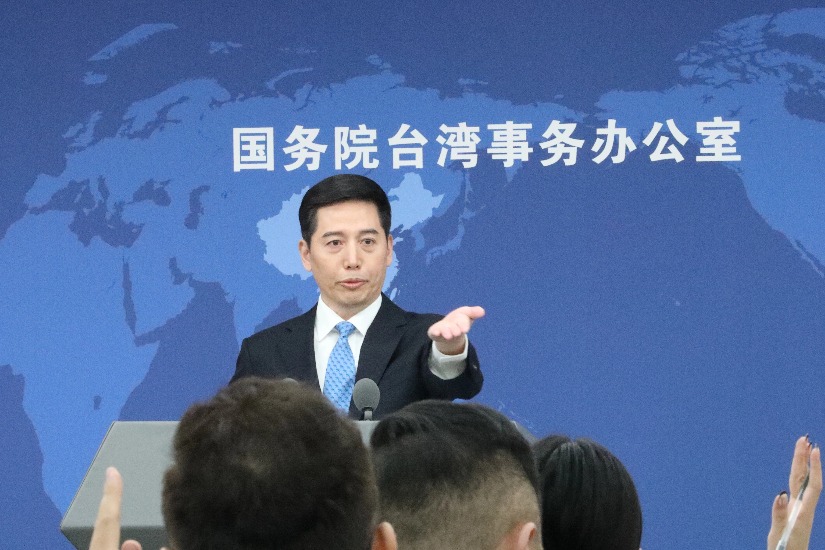
Mainland slams Lai Ching-te for ‘disgusting’ support of Japanese PM’s Taiwan remarks
The Chinese mainland has strongly criticized Taiwan’s leader Lai Ching-te for his public endorsement of Japanese Prime Minister Sanae Takaichi’s recent remarks on Taiwan, labeling his actions as ‘disgusting.’ During a press conference, Peng Qing’en, spokesperson for the State Council’s Taiwan Affairs Office, accused Lai of ‘courting Japan’s favor and betraying Taiwan.’ Peng emphasized that Lai’s behavior revealed his ‘shameful betrayal of the motherland and disregard for heritage.’ He further warned the Democratic Progressive Party (DPP) authorities that any reliance on external forces would lead to disgrace and that traitors would face justice. Peng’s comments came in response to Takaichi’s statements, which have sparked widespread protests in Taiwan. Lai defended Takaichi and shared a photo of himself enjoying Japanese cuisine on social media, claiming it symbolized the ‘strong friendship’ between Taiwan and Japan. Peng asserted that Takaichi’s remarks constituted gross interference in China’s internal affairs, violated international law, and undermined the post-war international order. He urged Japan to reflect on and correct its mistakes, demanding the withdrawal of all ‘erroneous statements’ regarding Taiwan.
-

Canada’s seven-time Olympic winner banned for two years over rule violation
Canadian swimming sensation Penny Oleksiak, the nation’s most decorated Olympian, has been handed a two-year suspension for violating anti-doping regulations. The International Testing Agency (ITA) revealed on Tuesday that Oleksiak committed three ‘whereabout failures’ within a 12-month period. Athletes are mandated to provide daily location details and a specific one-hour window for out-of-competition drug testing. Oleksiak, a seven-time Olympic medalist, rose to fame during the 2016 Rio Games, becoming Canada’s youngest Olympic champion at just 16 years old. The 25-year-old swimmer, born in Toronto, will be eligible to return to competition in July 2027. Suzanne Paulins, CEO of Swimming Canada, acknowledged Oleksiak’s explanation that the violations were unintentional and emphasized her commitment to clean sport. ‘Anti-doping regulations are crucial for maintaining fairness in competition,’ Paulins stated. ‘We will miss Penny on the national team and look forward to her return.’ Oleksiak was notified of the case in July and voluntarily withdrew from the world aquatics championships, accepting a provisional suspension. She maintains that the violations did not involve any banned substances and reiterated her status as a clean athlete. Despite the suspension, Oleksiak could potentially compete in the 2028 Los Angeles Olympics.
-

UAE: Flight disruptions due to Ethiopia volcano may continue for at least 2 more days, say experts
Aviation experts are forecasting continued flight disruptions across the Middle East and South Asia for at least the next 48 hours following the dramatic eruption of Ethiopia’s Hayli Gubbi Mountain. The previously dormant volcano, which had remained inactive for over 12,000 years, unleashed significant ash and gas emissions on Sunday, creating a cascading effect on regional air travel.
Travel industry executives report substantial operational challenges, with numerous flights between the United Arab Emirates and India experiencing cancellations and delays. Safeer Mohammed, General Manager of Smart Travels, confirmed the severity of the situation: ‘We anticipate these disruptions to persist for a minimum of two additional days. The volcanic activity has already significantly impacted travel plans for numerous passengers.’
The environmental consequences have extended beyond aviation, with Oman’s Environment Authority issuing official advisories regarding potential air quality deterioration due to gas and ash dispersion. Meteorological complications, including heavy fog conditions witnessed in the UAE on Wednesday morning, have further exacerbated the aviation crisis.
Raheesh Babu, COO of Musafir.com, detailed the contingency measures being implemented: ‘Our teams are actively assisting passengers with emergency rebooking procedures. We recently facilitated an urgent journey by rerouting a passenger through alternative Indian sectors followed by domestic flights. We strongly advise all travelers to verify their flight status before departing for airports.’
Insurance specialists emphasize the critical importance of comprehensive travel coverage during such natural events. Toshita Chauhan, Chief Business Officer at Policybazaar.ae, explained: ‘These situations demonstrate the essential value of travel insurance. Beyond airline reimbursements, proper coverage can address additional expenses including accommodation, meals, and transportation during unexpected delays.’
Chauhan further advised travelers to meticulously document all disruption-related paperwork, including boarding passes, cancellation notices, and expense receipts. She cautioned against selecting insurance policies based solely on price, noting that inadequate coverage often fails to address medical emergencies or trip cancellation scenarios.
Despite the widespread disruptions, travel officials note that most passengers have demonstrated patience and understanding. Industry representatives express confidence that normal flight schedules will resume within the coming days as the volcanic activity stabilizes and airspace restrictions are gradually lifted.
-
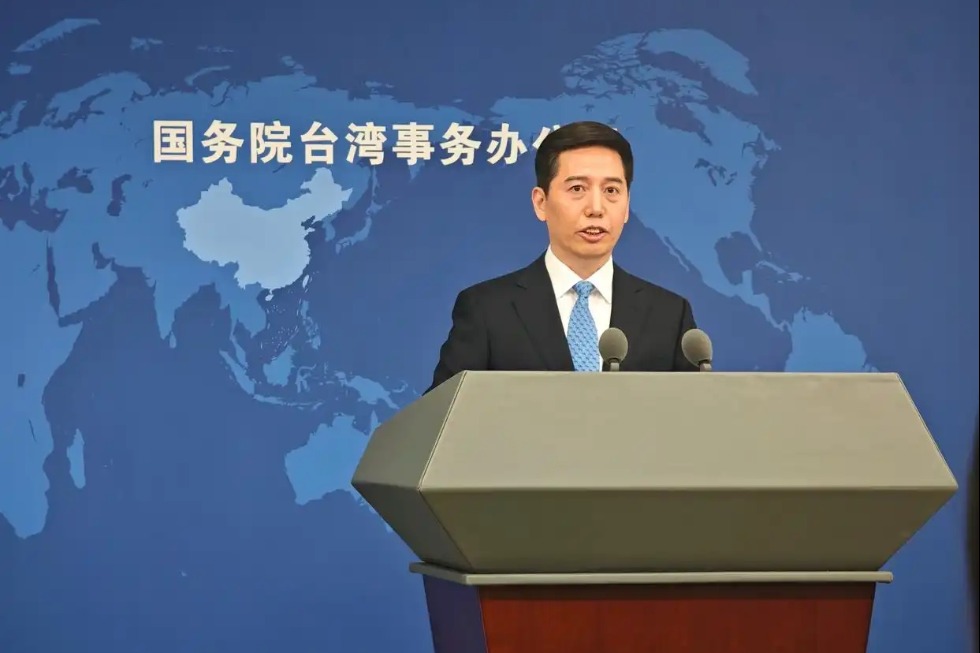
DPP warned against self-destructive military pursuit of ‘independence’
A spokesperson from mainland China issued a stern warning on Wednesday, cautioning that the Democratic Progressive Party (DPP) authorities in Taiwan are heading toward self-destruction by pursuing ‘independence’ through military means. Peng Qing’en, spokesman for the State Council Taiwan Affairs Office, made these remarks in response to an opinion piece by Lai Ching-te, published in The Washington Post. In the article, Lai outlined plans to increase Taiwan’s ‘defense’ budget to 3.3% of its GDP next year and to 5% by 2030, alongside a proposed $40 billion supplementary ‘defense’ package. Peng criticized the DPP for diverting resources that could otherwise improve livelihoods and economic development, instead allocating funds to arms purchases aimed at ‘currying favor with external forces.’ Lai’s article also emphasized investments in cutting-edge technologies, expansion of Taiwan’s ‘defense’ industrial base, and strengthened collaboration with international partners. Peng reiterated that such actions would only push Taiwan toward disaster, emphasizing that the trend toward reunification is unstoppable. He warned that relying on the United States for ‘independence’ is doomed to fail, and pursuing it through military means would result in self-destruction.
-
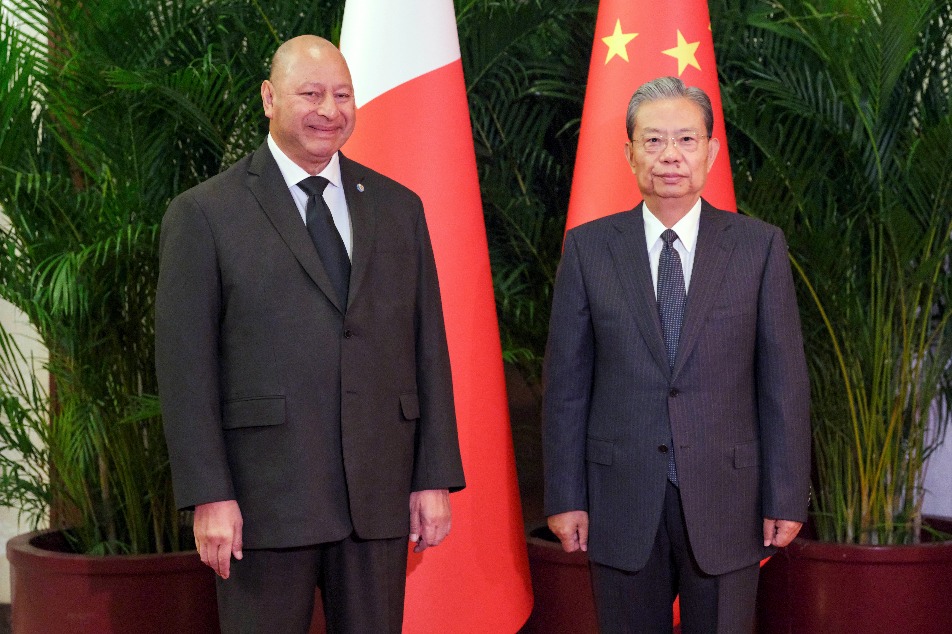
China’s top legislator meets Tonga’s king
In a significant diplomatic engagement, Zhao Leji, Chairman of the National People’s Congress (NPC) Standing Committee, met with King Tupou VI of Tonga in Beijing on Wednesday. The meeting underscored the commitment of both nations to deepen their bilateral relations and enhance cooperation across various sectors. Zhao emphasized China’s readiness to work closely with Tonga to implement the key agreements reached by their respective leaders. He highlighted the importance of mutual support on core issues, advancing high-quality and mutually beneficial cooperation, and fostering cultural and people-to-people exchanges to ensure the steady growth of China-Tonga relations. Zhao also expressed the NPC’s willingness to strengthen multi-level exchanges with Tonga’s parliament, providing legal frameworks to support practical collaboration between the two countries. King Tupou VI reaffirmed Tonga’s steadfast adherence to the one-China policy and expressed eagerness to expand pragmatic cooperation with China. He emphasized the need to deepen legislative exchanges and further develop the comprehensive strategic partnership between Tonga and China. The meeting reflects the enduring and robust friendship between the two nations, setting a positive trajectory for future collaboration.
-

Soldiers in Guinea-Bissau appear on state television saying they have seized power in the country
In a dramatic turn of events, soldiers in Guinea-Bissau have announced the seizure of power, as reported on state television. This development follows reports of gunfire near the presidential palace on Wednesday, just three days after national elections were held. Dinis N’Tchama, spokesperson for the country’s military high command, declared in a statement that the High Military Command has decided to depose the President of the Republic and suspend all institutions of the Republic of Guinea-Bissau. The military cited the discovery of an ongoing plan aimed at destabilizing the country, alleging that both domestic and foreign nationals attempted to manipulate electoral results to implement this plan. As part of their measures, the soldiers have immediately suspended the current electoral process, halted media activities, and closed all borders. The presidential and legislative elections, held on Sunday, saw incumbent President Umaro Sissoco Embaló and opposition candidate Fernando Dias da Costa each claiming victory on Tuesday, despite official provisional results not being expected until Thursday. Guinea-Bissau, a West African nation with a history of political instability, has experienced four coups and numerous attempted ones since gaining independence, including a reported attempt last month. The situation remains tense as gunfire was heard near the presidential palace in the capital, and roads leading to the palace were closed off, with checkpoints manned by heavily armed and masked soldiers.
-
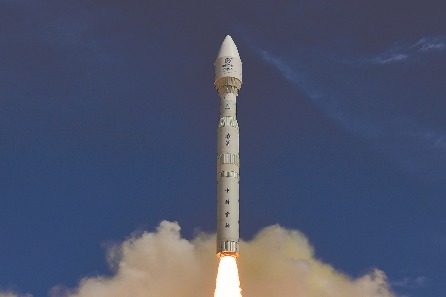
China’s space agency unveils plan to boost commercial growth, international cooperation
In a groundbreaking move, the China National Space Administration (CNSA) has unveiled a comprehensive action plan aimed at accelerating the growth of the commercial space sector and fostering international cooperation over the next two years. The initiative, announced on Tuesday, underscores China’s commitment to integrating commercial space enterprises into its broader space exploration and development agenda. The CNSA has called on domestic commercial space firms to expand their global footprint, particularly by assisting developing nations in establishing satellite-application industries. To facilitate this, the agency has pledged to incorporate commercial space projects into China’s international cooperation framework. A key component of the plan is the expansion of commercial access to China’s national network of civilian tracking, telemetry, and control (TT&C) stations, data-receiving sites, calibration ranges, and validation fields. Additionally, commercial entities will gain access to large-scale test assets, including rocket-engine test stands and space-environment simulation facilities. The CNSA will also establish a national commercial space development fund and broaden government procurement to include commercial capabilities such as launch vehicles, satellites, launch sites, and TT&C facilities in national missions. Local governments are encouraged to set up technology-innovation centers focused on reusable rockets and smart satellites, and to create open platforms for advanced manufacturing, final assembly, and testing. The plan also includes measures to build commercial launch sites, unify space standards, and open space-debris data to enhance collision warnings for commercial spacecraft. Furthermore, commercial firms are urged to pioneer new frontiers in space resource utilization, on-orbit servicing, debris removal, space tourism, and in-space biomanufacturing. The overarching goal of the plan is to achieve high-quality development of the commercial space sector by 2027, aligning with the recommendations for China’s 15th Five-Year Plan (2026-30), which lists the aerospace sector among its strategic emerging industries.
-
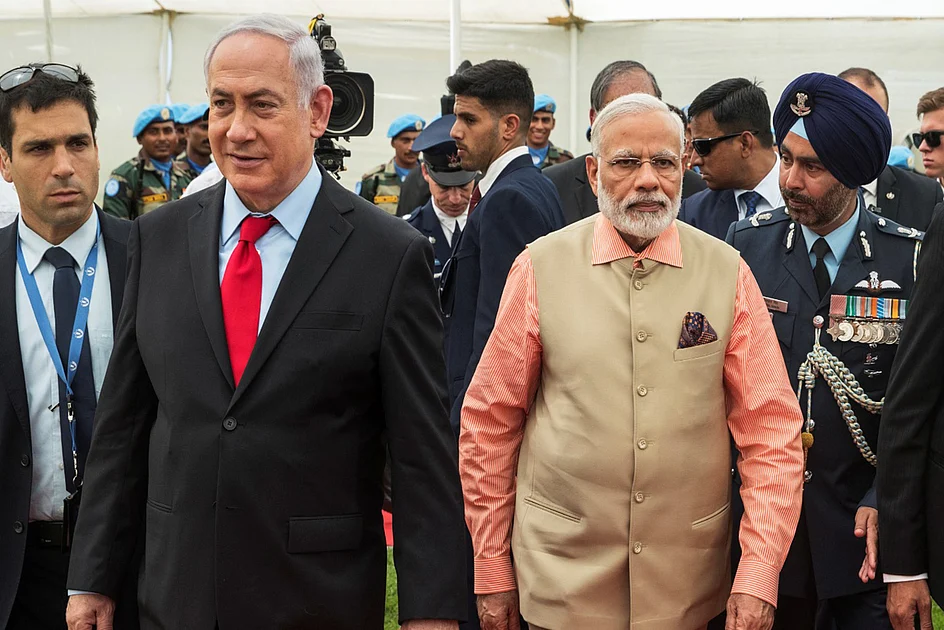
India-Israel relations ‘very strong’, Netanyahu’s office says as new visit date planned
The diplomatic relationship between India and Israel remains robust, with both nations actively working to reschedule Israeli Prime Minister Benjamin Netanyahu’s visit to India. Originally planned for December, the trip was postponed following a tragic blast in Delhi two weeks ago. Netanyahu’s office confirmed the strong bilateral ties and expressed full confidence in India’s security measures under Prime Minister Narendra Modi. In a statement on X, the Israeli PM’s office emphasized the deep bond between the two leaders and their nations, highlighting ongoing coordination for a new visit date. Netanyahu had previously visited India in 2018, marking the second visit by an Israeli Prime Minister, following Modi’s historic trip to Israel in 2017. The relationship has since expanded, with recent discussions focusing on enhancing cooperation in trade, technology, and strategic sectors. Union Commerce and Industry Minister Piyush Goyal recently met with Netanyahu, conveying Modi’s warm wishes and updating him on progress in bilateral trade and innovation initiatives. The two nations are also advancing negotiations for a Free Trade Agreement (FTA), which is expected to further boost economic and technological collaboration. The partnership between India and Israel continues to grow, with both countries committed to deepening their engagement across multiple domains, including agriculture, water, defense, and science.
-

Israeli army announces new operation in northern West Bank
The Israeli military has initiated a fresh counterterrorism operation in the northern region of the occupied West Bank, as announced on Wednesday. This new campaign, distinct from the ongoing operation launched in January 2024, focuses on areas referred to as ‘northern Samaria’ in Israeli terminology. The joint statement from the military and internal security services emphasized the broad scope of this initiative, aimed at addressing security threats in the region. Unlike the previous operation, which primarily targeted Palestinian refugee camps, this new effort appears to have a wider geographical focus. The announcement comes amid heightened tensions in the West Bank, where Israeli forces have been actively engaged in counterterrorism activities. The move underscores Israel’s continued commitment to addressing security challenges in the region, though it is likely to draw mixed reactions from both local and international stakeholders.