
After more than four decades since the last major international joint expedition to the region, a landmark three-year scientific effort has produced the first comprehensive map of wildlife populations and ecosystem health across Cangshan Mountain in southwest China’s Yunnan province, solidifying the site’s reputation as one of the world’s critical biodiversity hotspots. The large-scale collaborative project, which wrapped up its field and analytical work ahead of the April 2026 announcement, spanned nearly 1,000 square kilometers of the mountain range located within Dali Bai Autonomous Prefecture, bringing together experts and resources from multiple leading Chinese research institutions. Zhong Mingchuan, core team member and director of the Yunnan Academy of Forestry and Grassland, noted that this new study marks the most rigorous, systematic assessment of the mountain’s full ecological profile since international researchers conducted joint surveys of the area in the 1980s. Prior to this initiative, much of the existing data on Cangshan’s diverse flora and fauna was fragmented, outdated, or limited to specific taxonomic groups, leaving major gaps in scientific understanding of how the region’s ecosystems have shifted amid global climate change and local human activity over the past generation. The comprehensive mapping effort deployed a mix of traditional field observation, camera trapping, genetic sampling, and habitat assessment techniques to document every documented and newly discovered species across the mountain’s varied elevation zones, from subtropical lowland valleys to alpine tundra at the highest peaks. Researchers involved in the project emphasized that the data collected will serve as a critical baseline for future long-term ecological monitoring, as well as inform evidence-based conservation policies and sustainable land management practices for the protected area. The findings are also expected to support broader global research into patterns of biodiversity in the Hengduan Mountains region, a global priority area for conservation due to its exceptionally high concentration of endemic species found nowhere else on Earth.
作者: admin
-

Macao’s annual tourism expo opens, drawing global industry representatives
One of Asia’s most anticipated annual tourism industry gatherings, the 14th Macao International Travel (Industry) Expo (MITE), officially opened its doors at the Cotai Expo venue in the Macao Special Administrative Region (SAR) on Friday, launching a three-day event packed with global destination showcases, cross-sector industry forums, and professional development workshops.
Hosted by the Macao Government Tourism Office (MGTO), the 2026 expo carries the forward-looking theme “Global Convergence, Future Horizons,” and has drawn a record-level group of participants: more than 700 tourism-focused businesses and government agencies spanning 59 countries and regions, alongside over 600 pre-vetted hosted buyers ready to forge new commercial partnerships.
Speaking at the expo’s opening ceremony, Tai Kin Ip, Secretary for Economy and Finance of the Macao SAR Government, framed the event as a cornerstone of Macao’s international tourism outreach. He noted that MITE has grown into one of the city’s largest and most widely respected international tourism trade exhibitions, creating a shared space where global industry leaders can connect, exchange insights, and advance collaborative initiatives that benefit the worldwide tourism sector.
Tai also shared an encouraging update on Macao’s 2026 tourism recovery: the city has sustained steady growth in visitor arrivals through the first quarter of the year, with total incoming visitors surpassing the 10 million mark. Of that total, international visitor volumes are estimated to exceed 750,000, signaling a strong rebound in cross-border tourism to the region.
As part of this year’s expanded global engagement effort, MITE organizers extended a special invitation to tourism representatives from five Central Asian nations — Kazakhstan, Uzbekistan, Kyrgyzstan, Tajikistan, and Turkmenistan — to join a tailored familiarization tour of Macao. The initiative is designed to strengthen people-to-people and industry ties between Macao and Central Asia, while boosting Macao’s profile and visibility as a premier travel destination across Central Asia and the broader global tourism landscape.
In a post-opening interview, Maria Helena de Senna Fernandes, Director of the MGTO, highlighted growing collaborative momentum across the Guangdong-Hong Kong-Macao Greater Bay Area (GBA). She explained that GBA cities are actively deepening cross-regional coordination to develop more integrated multi-destination travel itineraries for international visitors. Building on the strong foundation of existing partnership work across the region, Fernandes noted that collective strengths can be further leveraged to position the GBA as a must-visit global travel hub, drawing more international tourists to the entire area.
The 14th MITE will remain open to participants and visitors through Sunday, with scheduled B2B matching sessions, cultural showcase events, and policy roundtables planned across the remaining days of the expo.
-

1 killed, 27 injured as tourist bus plunges into a ravine in Spain’s Canary Islands
A devastating transportation incident has shaken Spain’s popular Canary Islands archipelago, after a tourist coach careened off a roadway and fell into a steep ravine on Friday, leaving one person dead and more than two dozen others injured, local emergency response authorities confirmed.
Emergency services officials added that the vast majority of passengers on board the vehicle were citizens of the United Kingdom. The crash unfolded on La Gomera, one of the eight volcanic islands that form the Canary chain, located in the Atlantic Ocean off the northwestern coast of continental Africa.
All 27 injured people have been evacuated and transferred to La Gomera’s primary local medical facility, where they are currently receiving ongoing care for a range of injuries sustained in the fall, according to emergency management representatives.
Famous for its consistently mild, warm climate across all seasons, the Canary Islands have long ranked as one of the most preferred holiday destinations for travelers from the United Kingdom and other Western European countries. La Gomera, one of the archipelago’s smallest inhabited islands, is defined by its dramatic, rugged terrain: the island is marked by towering volcanic peaks, thick ancient forests, and tight-knit villages perched along cliff edges, features that draw tourists seeking quiet, natural getaways but also create steep, winding roadways that can pose navigation risks for large vehicles.
-
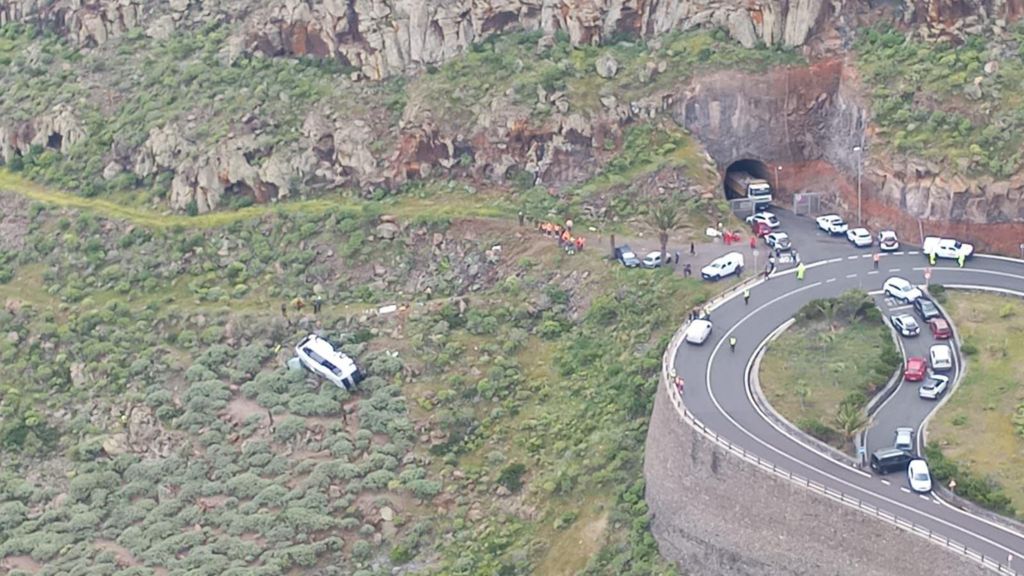
One dead after bus carrying British tourists crashes in Canary Islands, officials say
A devastating road accident on the Spanish island of La Gomera, part of the Canary Islands archipelago, has left one British tourist dead and 27 other passengers injured after their charter bus plummeted into a 10-meter ravine, local emergency response authorities confirmed Tuesday.
All 28 people on board the vehicle were affected by the crash: 27 of the occupants were British tourists visiting the island, with the 28th being the local Spanish driver. According to official statements posted to the social platform X by Canary Islands emergency coordination service 112 Canarias, the fatal victim was one of the traveling British passengers.
The crash unfolded on the GM-2, a winding mountain road cutting through La Gomera’s rugged terrain, close to the island’s capital city of San Sebastián de La Gomera. Images released by emergency responders show the wrecked bus resting at the bottom of the ravine near a sharp hairpin turn, a common hazard on the island’s narrow mountain routes. Spanish national outlet El Mundo confirmed the bus fell approximately 10 meters from the road surface after losing control at the bend.
Héctor Cabrera, head of emergency operations for La Gomera, told Spain’s public broadcaster TVE that all the tourists on the bus were staying at a local island resort as part of their visit. Emergency crews were dispatched to the crash site within minutes of the first 911 call, coordinating multi-agency response efforts to extract passengers and transport them to care.
Of the 27 injured people, three are currently listed in critical condition. Most injured passengers were transported to the island’s main medical facility, Hospital Nuestra Señora de Guadalupe located on eastern La Gomera. However, the two most severely injured patients were airlifted via emergency helicopter to larger, more advanced medical centers on the neighboring island of Tenerife for specialized treatment, 112 Canarias confirmed in their update.
Fernando Clavijo, president of the Canary Islands regional government, issued an official statement shortly after the crash extending his deepest condolences and full support to the victims of the accident, their families, and the emergency teams that responded to the scene. Investigations into the exact cause of the crash are ongoing, with authorities yet to release details on whether speed, mechanical failure, or weather conditions were contributing factors.
-

Charges filed after fire destroys Kimberly-Clark toilet paper warehouse
A devastating fire has swept through a large Kimberly-Clark warehouse dedicated to storing toilet paper and paper towels, leaving the facility and its inventory completely destroyed in the wake of the blaze. Emergency response teams quickly rushed to the scene to contain the spread of the fire, and in a stroke of good fortune, no individuals suffered injuries during the incident, according to official updates.
In the aftermath of the destructive event, legal authorities have formally filed charges against parties connected to the fire, though specific details about the identity of the accused or the exact nature of the charges have not yet been fully released to the public. Investigations are still ongoing to determine the root cause of the ignition, whether it was accidental, negligent, or the result of intentional action.
The warehouse played a key role in regional supply chains for Kimberly-Clark’s popular paper products, and while the destruction has raised temporary concerns about inventory distribution, the company has not yet announced major disruptions to consumer availability. Local officials continue to urge patience as the probe into the fire moves forward, with the legal process already underway to address any wrongdoing linked to the incident.
-

Guangzhou airport unveils replica of China’s first airplane
On Friday, Guangzhou Baiyun International Airport, one of China’s busiest aviation hubs, held an unveiling ceremony for a full-scale replica of China’s first domestically built airplane at its Terminal 2. Named the “Wing Can”, this new installation honors the groundbreaking legacy of Feng Ru, a pioneering aviation engineer from Guangdong Province who designed and constructed the original aircraft in 1909.
Feng Ru, who is widely recognized as the father of Chinese aviation, achieved the historic feat of building and flying China’s first powered airplane more than a century ago, laying the early ideological and technical groundwork for the country’s modern aviation industry. Born in 1884, Feng Ru passed away at a young age in 1912, but his contributions to Chinese aerospace innovation have never been forgotten.
In an official statement released following the unveiling, airport officials framed the new replica as more than a historical monument. The installation is described as a lasting symbol of exploratory ambition, cross-continental connection, and forward momentum, carrying the auspicious cultural connotation of a nation reaching new heights and rising with opportunity. The statement added that the exhibit underscores the unwavering lofty aspirations and pioneering spirit of China’s broader aviation sector, which continues to pursue groundbreaking technological breakthroughs and chart new courses for global connectivity in the modern era. For passengers passing through one of China’s most central travel hubs, the replica offers a tangible connection to the 100-plus-year history of Chinese aviation innovation.
-
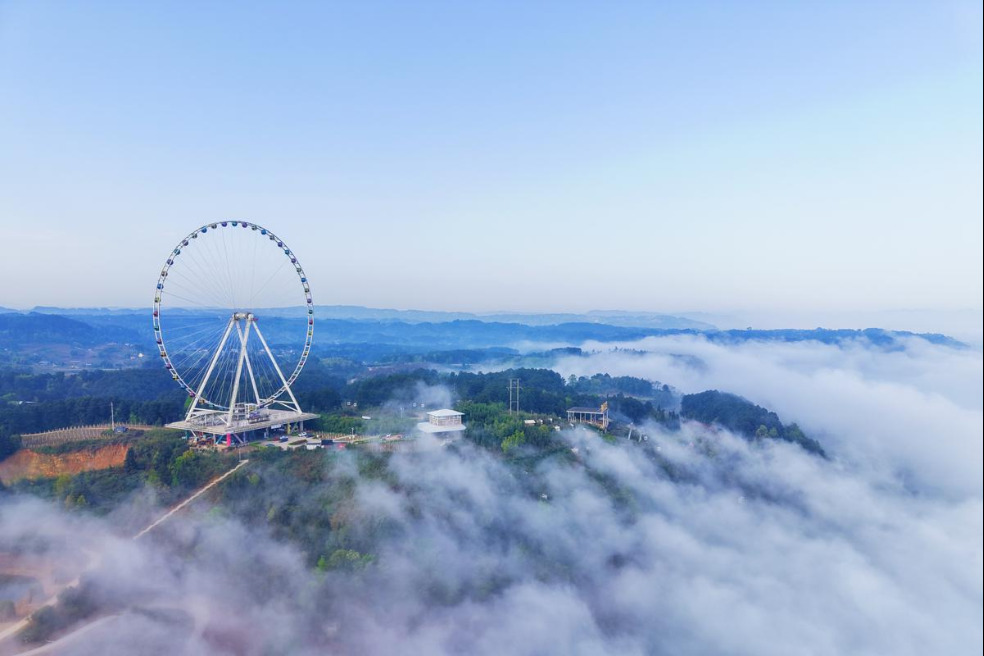
Advection fog cloaks towering Ferris wheel in Chongqing
One recent early morning in southwest China’s Chongqing, a thick blanket of advection fog settled across the rolling hills of Fuling District, turning a well-known local landmark into a surreal, sky-floating spectacle that has captured public attention. The region’s signature 110-meter tall Ferris wheel, perched atop a nearly 700-meter-high mountain in Fuling’s popular Meixin Wine Town scenic area, emerged half-hidden through the swirling mist. Only its upper rim and structural beams pierced the dense fog, giving the towering structure the uncanny appearance of an otherworldly machine drifting against the pale sky.
Advection fog, the natural phenomenon behind this magical landscape, forms when warm, moisture-saturated air travels across cooler land or water surfaces, causing the air temperature to drop and water vapor to condense into a thick, low-hanging mist. For Chongqing, a city defined by its rugged landscape of crisscrossing mountains and winding rivers, this type of fog is a recurring seasonal event, especially during transitional spring weather.
As the tallest manmade structure in the area, the Ferris wheel is already a major draw for visitors to Meixin Wine Town. On clear days, riders stepping into its gondolas are rewarded with unobstructed, sweeping views of the surrounding rolling ranges, blanketed in dense, vibrant green forest. On this foggy morning, however, the landmark took on an entirely new character. The mist erased the lower slopes of the mountain from view, separating the Ferris wheel from its terrestrial base and creating a dreamlike, ethereal scene that local photographers and residents were quick to capture and share across social media.
The rare visual effect has drawn widespread admiration online, with many commenters noting that the fog transformed a familiar local landmark into something magical that highlights Chongqing’s unique natural and manmade landscape.
-

US inflation surges to 3.3% as Iran war impact bites
New government data released Wednesday has confirmed a sharp acceleration in United States inflation for March, driven by skyrocketing energy costs stemming from ongoing conflict between Iran and a US-Israeli military coalition. The sudden price surge has piled political pressure on the Trump administration, just months ahead of November’s critical midterm elections, as Washington pursues new peace talks with Tehran.
The US Bureau of Labor Statistics (BLS) reported that annual inflation reached 3.3% in March, a notable jump from the 2.4% year-on-year reading recorded in February. Most striking was the unprecedented leap in gasoline prices: between February and March, pump prices surged 21.2%, marking the largest single-month increase since the agency started tracking this metric in 1967. For American drivers, the impact is immediate: the national average price for a gallon of regular gasoline now stands at $4.15, up from roughly $3 before the outbreak of hostilities in late February. Even as the world’s top crude oil producer, the US has not escaped the market shock of disrupted global energy supplies.
The conflict traces back to February 28, when US and Israeli forces launched airstrikes on Iran. In retaliation, Tehran blocked shipping traffic through the Strait of Hormuz, the strategic global waterway that carries roughly one-fifth of the world’s daily oil and gas trade. While financial markets had largely anticipated this inflationary spike, per consensus forecasts published by MarketWatch, the long-term economic outlook remains deeply uncertain amid ongoing violence.
Administration officials have sought to downplay concerns, framing the price disruptions as a temporary side effect of the conflict. White House spokesperson Kush Desai emphasized that the US economy “remains on a solid trajectory” in comments following the data release. Top economic advisor Kevin Hassett highlighted small wins for the administration during a Fox News appearance, pointing to falling prices for eggs, beef, and concert tickets. Ahead of upcoming US-Iran peace talks set to take place this weekend in Pakistan, Vice President JD Vance said he was optimistic for a “positive” outcome from the negotiations.
However, independent economists warn that more financial strain is on the horizon, particularly for low- and middle-income households already stretched thin by rising living costs. Heather Long, chief economist at Navy Federal Credit Union, noted that March’s inflation rate is the highest the US has seen in nearly two years. “This is only the beginning. Food prices, travel and shipping costs are all going up in April and will exacerbate the pain,” Long said. Christopher Low, senior analyst at FHN Financial, added that the failure of both sides to uphold an announced ceasefire has kept the Strait of Hormuz largely blocked, extending the energy market disruption. “There’s still very little traffic through the Strait of Hormuz,” Low told AFP.
Independent estimates suggest the sustained oil price increase will cost the average US household at least $350 in additional annual expenses. Consumer sentiment has already taken a hit, with a closely watched University of Michigan survey recording an 11% drop in consumer confidence this month. Federal Reserve Chairman Jerome Powell warned in mid-March that the conflict would likely slow the central bank’s work to bring inflation back to its long-term 2% target – a goal the Fed has missed for five consecutive years, due to lingering post-Covid supply chain disruptions, the ongoing war in Ukraine, and international trade tariffs.
-

Sibling rivals: Popov brothers set for badminton showdown in European semifinals
HUELVA, SPAIN – A once-in-a-generation badminton showdown is set to take center stage at the 2024 European Badminton Championships after siblings Christo Popov and Toma Junior Popov both secured quarterfinal wins on Friday, earning a spot against one another in the event’s semifinal round.
Born in Bulgaria, the athletic pair now competes under the French national flag. Beyond their historic singles meeting this weekend, the brothers are also defending their European men’s doubles title at the tournament. They most recently paired up to represent France at the 2024 Paris Olympic Games, carrying on a family legacy rooted in badminton: their father, Toma Popov, is a former badminton competitor who played and coached for the Bulgarian national team before the family relocated to France.
At 24 years old, left-handed Christo is the younger sibling by three years, compared to 27-year-old right-handed Toma Junior. Entering this semifinal match, Christo holds a 3-1 advantage over his brother in main-tour head-to-head matchups, including two final victories in recent months. Most recently, Christo claimed the title over Toma Junior at the 2024 German Open held in Munich, and prior to that, he also won the Hylo Open in Saarbrücken, Germany against his brother in the final match.
Both brothers delivered dominant performances in Friday’s quarterfinal rounds to advance to the semifinal. Christo, who ranks 5th in the world badminton rankings, fought off a tough challenge from Denmark’s Rasmus Gemke to win 25-23 in the opening set before closing out the match with a 21-15 second-set win. Meanwhile, world No. 16 Toma Junior secured an even more decisive victory over Belgium’s Julien Carraggi, wrapping up the win 21-8, 21-11 to punch his ticket to the semifinal.
If the Popov brothers continue their winning streaks through the semifinal round, Sunday’s men’s singles final could end up as an all-French matchup. The other semi-final on Saturday pits France’s Arnaud Merklé against two-time European champion Anders Antonsen of Denmark, setting the stage for an exciting weekend of elite badminton competition.
-
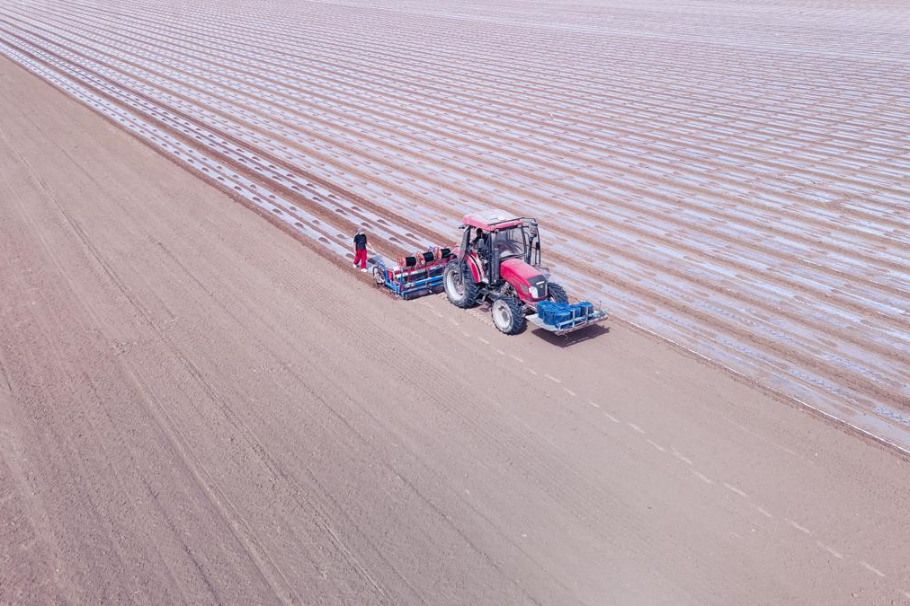
Beidou-guided seeders boost cotton sowing in Xinjiang’s Artux
As the 2026 spring sowing season kicks off across northwest China’s Xinjiang Uygur autonomous region, the cotton fields of Artux have come alive with the deep roar of agricultural machinery and the lively chatter of local farmers gearing up for a new growing cycle. At the region’s flagship high-standard cotton cultivation base, a quiet technological revolution is playing out across the expansive farmland: modern seeding machinery fitted with China’s domestically developed Beidou Navigation Satellite System is reshaping the traditional cotton planting process, delivering unmatched levels of accuracy and productivity that were out of reach for previous generations of growers.
Unlike manual seeding or older mechanized methods that relied on rough visual alignment, Beidou-guided seeders traverse the sprawling fields with consistent, centimeter-level precision, laying each row of cotton seeds at a uniform depth and spacing. As the machines complete their passes, neatly stretched lines of plastic mulch – used to retain soil moisture and suppress weed growth in Xinjiang’s arid climate – stretch toward the horizon in perfectly straight rows, a visible marker of the navigation system’s reliability.
This integration of domestic satellite navigation technology with modern agricultural equipment has cut down on unnecessary fuel use, reduced seed waste, and cut the total time required to complete sowing, streamlining the entire early stage of cotton production for local farming operations. As global demand for cotton remains steady and China continues to push for modernization of its agricultural sector, the adoption of Beidou-powered smart farming tools in major cotton-producing regions like Xinjiang marks a key step forward in boosting domestic output and strengthening the resilience of the global cotton supply chain.