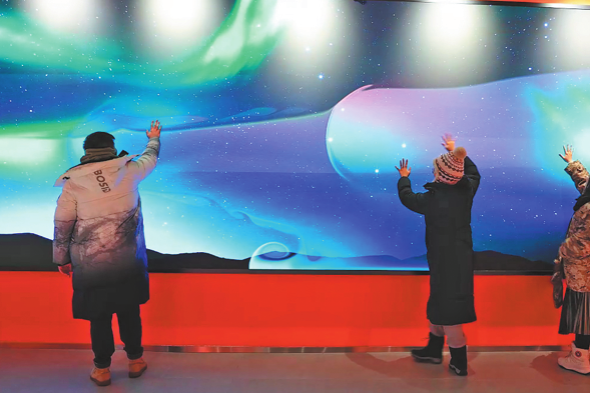
BEIJING – China’s northernmost Arctic village has become home to the nation’s pioneering aurora museum, blending cutting-edge technology with natural wonder in an unprecedented cultural attraction. The Shenlu Aurora Museum, named after the mythical deer god, opened its doors on November 19 in Mohe’s Beiji village, Heilongjiang province, marking a significant milestone in China’s scientific tourism infrastructure.
The 1,000-square-meter facility represents a remarkable engineering achievement, having been constructed in just five months. Since its inauguration, the museum has already welcomed over 5,000 visitors during its inaugural week, demonstrating immediate public appeal. The project combines immersive digital experiences with practical scientific forecasting, creating a comprehensive destination for both education and entertainment.
Visitors are greeted by an impressive LED welcome screen that cycles through educational content and curated aurora footage, immediately immersing guests in the phenomenon’s mystical allure. The museum’s centerpiece features an innovative interactive radar screen where visitors can manipulate aurora visualizations through hand gestures without physical contact. This system supports simultaneous interaction for up to five participants, creating collaborative digital experiences.
The facility extends beyond visual spectacles with multiple specialized zones. A multimedia photo wall enables tactile exploration of Mohe’s cultural and natural heritage through enlargeable images and accompanying text. The polar weather forecast station provides real-time aurora prediction data, assisting visitors in planning optimal viewing times for natural displays. Additionally, the museum houses eight virtual reality digital realms, an augmented reality object recognition table, and a fully-equipped VR classroom with sixteen headsets offering interdisciplinary educational modules.
Manager Yu Heng emphasized the institution’s innovative approach to learning: “We’ve designed a paperless educational environment that transcends traditional curriculum structures through immersive technological experiences. Our goal is to make complex scientific concepts accessible and engaging for all age groups.”
The museum’s opening coincided with spectacular natural aurora displays throughout November, with particularly vivid pink and purple illuminations observed on November 24. These celestial events attracted photographers and tourists to the frozen banks of the Heilongjiang River, creating perfect synergy between natural phenomena and their technological interpretation.
Tourist Xu Qingyue from Shandong province expressed her amazement: “The technological sophistication exceeded all expectations. Witnessing actual auroras after experiencing their digital representation created a profoundly complete understanding of this natural wonder.”
Mohe’s geographical position at China’s highest latitude makes it uniquely suited for aurora observation, with multiple displays occurring since winter’s onset. The museum now provides both context for these occurrences and tools for predicting future events, establishing Beiji village as China’s premier destination for aurora enthusiasts and scientific tourism.