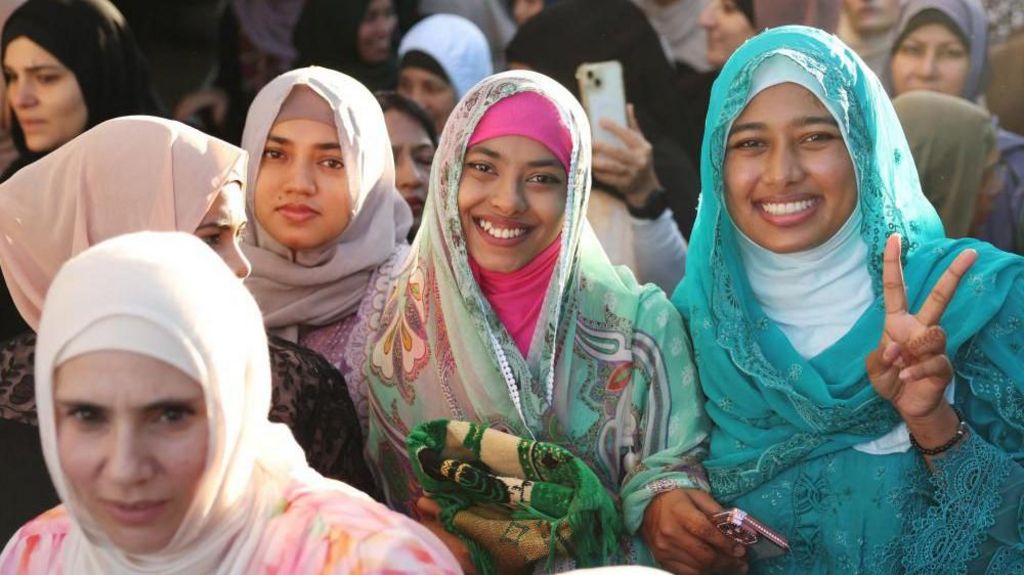
In the heart of Sydney’s Lakemba district, thousands gathered at the Imam Ali bin Abi Taleb Mosque for a community Iftar celebration marking Ramadan’s end. Beneath the surface of this harmonious gathering, however, loomed an unsettling reality: a police surveillance trailer with 360-degree cameras stood watch—a necessary precaution following numerous threats against the Muslim community.
Australia is experiencing an unprecedented surge in anti-Islamic sentiment, with reported incidents skyrocketing by 636% since Hamas’ October 7 attack on Israel. According to the Islamophobia Register Australia, weekly cases have exploded from an average of 2.5 to 18—a figure experts warn represents merely ‘the tip of the iceberg’ as many victims avoid reporting.
The recent Bondi Beach massacre, which police attributed to ‘Islamic state ideology,’ further intensified religious tensions. In its aftermath, Islamophobic incidents surged by 201%, compounding existing fears within Muslim communities. Simultaneously, antisemitic incidents have multiplied nearly fivefold according to the Executive Council of Australian Jewry, creating parallel crises of religious intolerance.
This deterioration in social cohesion was starkly visible when Prime Minister Anthony Albanese and Home Affairs Minister Tony Burke faced heckling and accusations of supporting genocide during their Lakemba mosque visit. Worshipers expressed profound frustration over Australia’s stance on the Middle East conflict and perceived governmental inaction against rising Islamophobia.
Lakemba—where 61% of residents identify as Muslim—has evolved from its Lebanese migrant roots in the 1960s to become Sydney’s multicultural Muslim hub, now including communities from South Asia and beyond. While it offers a safe haven for many, residents report increasing anxiety when venturing beyond their ‘comfort zones.’
Dr. Moshiuzzaman Shakil, a Bangladeshi public health student, recounted losing his job supporting disabled clients post-Bondi: ‘They asked me: are you a Muslim? After the attack, some people thought Muslims were terrorists.’
The current crisis echoes Australia’s troubled history with immigration, from the White Australia policy that limited non-European migration until 1973 to the 2005 Cronulla race riots—still remembered as a traumatic watershed moment. Gamel Kheir, secretary of the Lebanese Muslim Association, noted: ‘This community has been in trauma since Cronulla. Every time an episode happens now, we curl into the fetal position thinking, please don’t be a Muslim person.’
Political discourse has exacerbated tensions. Pauline Hanson, leader of the anti-immigration One Nation Party, wore a burka in parliament to advocate for its banning and recently questioned whether ‘good’ Muslims exist—rhetoric that community leaders say legitimizes racism. Kheir observes: ‘Our Facebook posts now get a thousand-plus bigoted comments instead of five to ten. People feel empowered because politicians have enabled this racism to become rampant.’
Special Envoy to Combat Islamophobia Aftab Malik warns of cumulative damage: ‘Each attack reinforces that Muslim identity isn’t welcome in Australia’s social fabric, reducing institutional legitimacy and fraying social cohesion.’
Despite the challenges, community organizers like Kheir continue advocating for unity. ‘The fair go for all was Australia’s motto,’ he reflects. ‘Sadly, we’re following other Western nations into identity crisis, where the predominant race reasserts itself at minorities’ expense.’
As Dr. Zouhir Gabsi, author of ‘Muslim Perspectives on Islamophobia,’ bluntly summarizes: ‘Multiculturalism is a politician’s word. It works when sharing a meal, but when applying for jobs, you remain a migrant.’