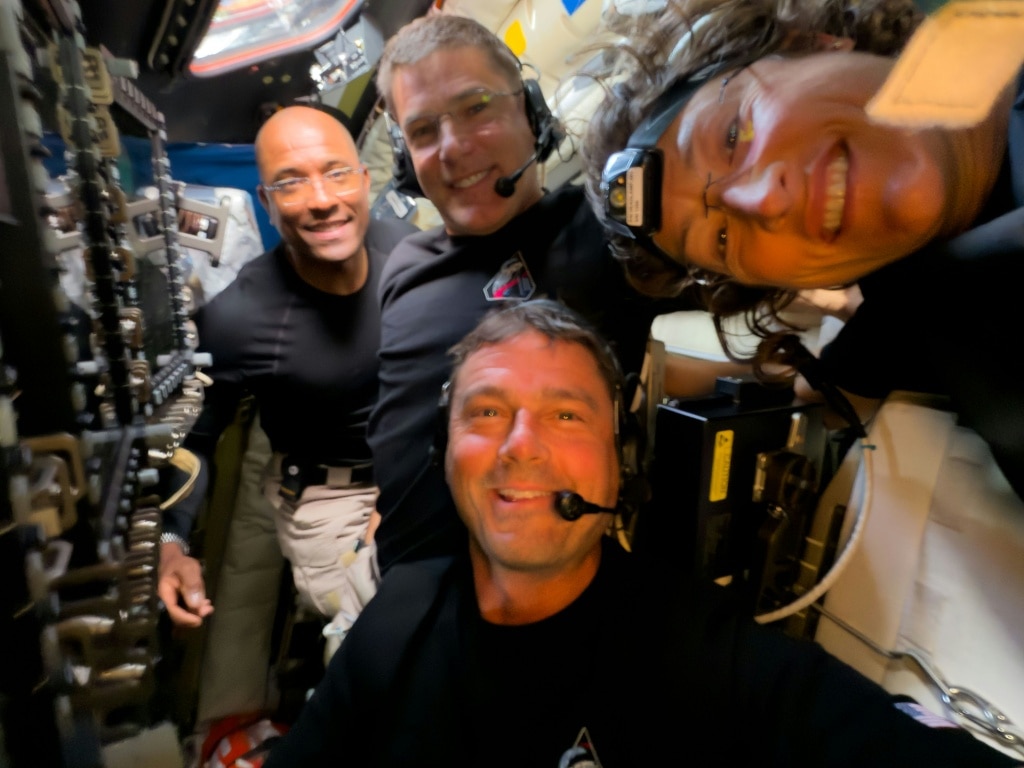
In a rare and historic cross-orbit exchange between two groups of humanity’s space explorers, the four astronauts of NASA’s Artemis II mission — currently streaking back to Earth after completing the first crewed lunar flyby in more than half a century — connected live for a lighthearted, reflective conversation with the crew of the International Space Station (ISS) on Tuesday.
The cross-space call marked a special moment for both teams, coming just one day after the Artemis II crew checked off a string of landmark milestones: breaking the all-time record for the farthest humans have ever traveled from Earth, executing the first close lunar pass by a crewed mission since NASA’s Apollo program in the 1970s, and capturing more than six hours of high-resolution, firsthand observations of the Moon’s cratered surface. For the Artemis team, the chat with ISS colleagues was a long-awaited chance to swap perspectives on life off our home planet.
“We have been waiting for this like you can’t imagine,” Artemis II commander Reid Wiseman opened the conversation. Canadian astronaut Jeremy Hansen, a first-time space traveler making the journey around the Moon as part of NASA’s international partnership on the Artemis program, added: “It’s fun to be up in space with you at the same time!”
Leading the question from the ISS side was Crew-12 commander Jessica Meir, who pressed the Artemis crew on how seeing Earth from the Moon’s neighborhood transformed their view of our planet. At roughly 240,000 miles from Earth, the Artemis II crew’s vantage point is around 1,000 times farther out than the ISS’s low-Earth orbit, creating a dramatically different view of the pale blue planet set against the infinite black of deep space.
“Every astronaut that comes to space remarks on how seeing Earth from orbit changes your perspective,” Meir noted. “We really wanted to hear what that felt like, how different that felt now from your new perspective around the Moon?”
Artemis astronaut Christina Koch — who previously made history alongside Meir as part of the first all-female spacewalk in ISS history — shared that the contrast between Earth and the surrounding blackness of deep space created an unforgettable impression. “It truly emphasized how alike we are, how the same thing keeps every single person on planet Earth alive,” Koch explained.
Beyond the big reflective questions, the conversation turned to the shared practical realities of living and working in space. All three American Artemis II crew members are veteran ISS astronauts, and both teams agreed that every lesson they learned on the low-Earth orbit outpost — from large-scale operational procedures to the small, everyday tricks for surviving in microgravity — prepared the Artemis team for this historic lunar voyage.
“Basically every single thing that we learned on ISS is up here,” Koch said. “And then, of course, there’s the funny and practical, how to eat, how to do silly things with water, how to flip around. We’re bringing that with us too.”
Wiseman shared a lighthearted anecdote that highlighted Hansen’s first-time experience in space, as the crew prepared to fire their engines to leave Earth orbit and set course for the Moon. As the craft aligned for the burn, the view of Earth grew rapidly larger in the capsule’s window, prompting a moment of playful panic from Hansen.
“Jeremy turns around to us and goes, ‘I’m not sure. I think we’re going to run right into it!’” Wiseman recalled. “We were all dyin’ laughin’.”
Following the successful lunar flyby, the Artemis II crew is now on the final leg of their 10-day test mission, which is designed to validate all of the Orion capsule’s critical systems ahead of future crewed lunar landings as part of NASA’s Artemis program. The mission is scheduled to conclude with a splashdown in the Pacific Ocean late Friday.