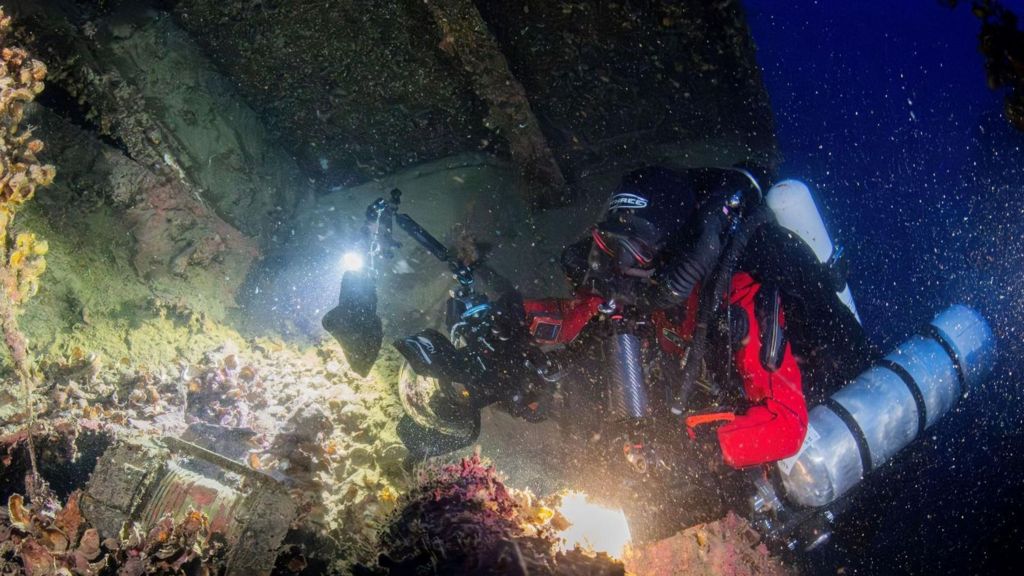
In a remarkable underwater recovery operation, Greece has successfully retrieved artefacts from the wreck of the HMHS Britannic, over a century after the ship was sunk by a German mine during World War I. The operation, conducted in May but announced on Monday by the Greek Ministry of Culture, involved an 11-member team of professional deep-sea divers equipped with closed-circuit technology. The expedition was organized by British historian Simon Mills, founder of the Britannic Foundation. Among the recovered items were the ship’s lookout bell, a portside navigation lamp, binoculars, ceramic tiles from Turkish baths, and equipment from first- and second-class cabins. A porcelain washbasin, though covered in marine organisms, was found intact in one of the second-class cabins. The artefacts were carefully cleaned of marine growth and transported to the Ephorate of Underwater Antiquities in Athens for further conservation. Some planned items could not be recovered due to their condition and location. The artefacts will eventually be displayed at the new National Museum of Underwater Antiquities in Piraeus, in a section dedicated to World War I. The Britannic, the third of the White Star Line’s Olympic-class steamships, was requisitioned by the British Admiralty during the war to serve as a hospital ship. On November 16, 1916, it struck a German mine off the island of Kea and sank in less than an hour, resulting in the deaths of 30 of the 1,065 people on board.